
Pearson+ LogoPearson+ Logo
Ch. 19 - Genetic Analysis of Quantitative Traits
Sanders - Genetic Analysis: An Integrated Approach 3rd Edition
Sanders3rd EditionGenetic Analysis: An Integrated ApproachISBN: 9780135564172Not the one you use?Change textbook
Chapter 19, Problem 17a

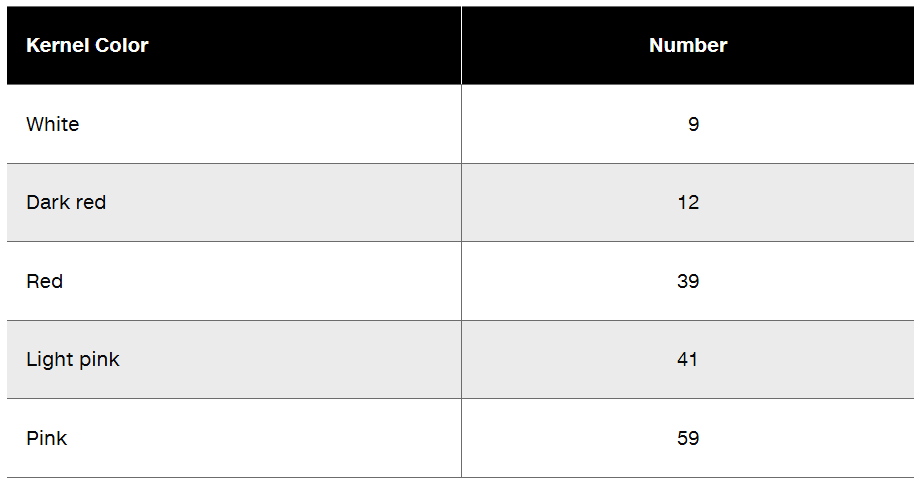
Two pure-breeding wheat strains, one producing dark red kernels and the other producing white kernels, are crossed to produce F₁ with pink kernel color. When an F₁ plant is self-fertilized and its seed collected and planted, the resulting F₂ consists of 160 plants with kernel colors as shown in the following table.
Table showing the number of wheat plants with different kernel colors: white, dark red, red, light pink, and pink.
Based on the F₂ progeny, how many genes are involved in kernel color determination?

Verified step by step guidance
1
Step 1: Understand the problem. The kernel color in wheat is determined by genetic factors, and the F₁ generation shows intermediate phenotypes (pink kernels), suggesting incomplete dominance or additive effects. The F₂ generation displays a range of phenotypes, which indicates polygenic inheritance.
Step 2: Analyze the phenotypic ratios in the F₂ generation. The table shows five distinct phenotypes: white, light pink, pink, red, and dark red. This suggests that multiple genes contribute to kernel color, with each gene having additive effects on the phenotype.
Step 3: Use the formula for polygenic inheritance to determine the number of genes involved. The number of phenotypic classes in the F₂ generation is given as 2n + 1, where n is the number of genes. Here, there are 5 phenotypic classes (white, light pink, pink, red, dark red). Solve for n using the equation: \( 2n + 1 = 5 \).
Step 4: Rearrange the equation to isolate n. Subtract 1 from both sides: \( 2n = 4 \). Then divide both sides by 2: \( n = 2 \). This indicates that two genes are involved in kernel color determination.
Step 5: Verify the result by considering the genetic mechanism. Each gene likely has two alleles, and the additive effects of these alleles result in the observed phenotypic variation. The F₂ generation ratios align with the expected distribution for two genes with additive effects.

Verified video answer for a similar problem:

This video solution was recommended by our tutors as helpful for the problem above.
Video duration:
2m
Was this helpful?

Key Concepts

Here are the essential concepts you must grasp in order to answer the question correctly.

Mendelian Inheritance

Mendelian inheritance refers to the principles of heredity established by Gregor Mendel, which include the concepts of dominant and recessive traits. In this scenario, the dark red and white kernel colors represent two alleles, where one may be dominant over the other. Understanding these principles helps in predicting the phenotypic ratios in offspring based on parental genotypes.
Recommended video:
Guided course
05:13
Organelle Inheritance

Phenotypic Ratios

Phenotypic ratios describe the relative frequencies of different phenotypes in the offspring of a genetic cross. In this case, the F₂ generation shows a variety of kernel colors, which can be analyzed to determine the underlying genetic mechanisms. By examining the observed ratios of the different colors, one can infer the number of genes and their interactions involved in kernel color determination.
Recommended video:
Guided course
10:48
Mutations and Phenotypes

Polygenic Inheritance

Polygenic inheritance occurs when multiple genes influence a single trait, resulting in a continuous range of phenotypes. The variation in kernel colors in the F₂ generation suggests that more than one gene is involved in determining the final color. By analyzing the distribution of the phenotypes, one can estimate the number of genes contributing to the trait, which is essential for understanding complex traits in genetics.
Recommended video:
Guided course
05:13
Organelle Inheritance
Related Practice
Textbook Question

Suppose the length of maize ears has narrow sense heritability (h²) of 0.70. A population produces ears that have an average length of 28 cm, and from this population a breeder selects a plant producing 34-cm ears to cross by self-fertilization. Predict the selection differential (S) and the response to selection (R) for this cross.

401
views
Textbook Question

In a line of cherry tomatoes, the average fruit weight is 16 g. A plant producing tomatoes with an average weight of 12 g is used in one self-fertilization cross to produce a line of smaller tomatoes, and a plant producing tomatoes of 24 g is used in a second cross to produce larger tomatoes. What is the selection differential (S) for fruit weight in each cross?

436
views
Textbook Question

In a line of cherry tomatoes, the average fruit weight is 16 g. A plant producing tomatoes with an average weight of 12 g is used in one self-fertilization cross to produce a line of smaller tomatoes, and a plant producing tomatoes of 24 g is used in a second cross to produce larger tomatoes. If narrow sense heritability (h²) for this trait is 0.80, what are the expected responses to selection (R) for fruit weight in the crosses?

433
views
Textbook Question

Two pure-breeding wheat strains, one producing dark red kernels and the other producing white kernels, are crossed to produce F₁ with pink kernel color. When an F₁ plant is self-fertilized and its seed collected and planted, the resulting F₂ consists of 160 plants with kernel colors as shown in the following table.

How many additive alleles are required to explain the five phenotypes seen in the F₂?

465
views
Textbook Question

Two pure-breeding wheat strains, one producing dark red kernels and the other producing white kernels, are crossed to produce F₁ with pink kernel color. When an F₁ plant is self-fertilized and its seed collected and planted, the resulting F₂ consists of 160 plants with kernel colors as shown in the following table.

Using clearly defined allele symbols of your choice, give genotypes for the parental strains and the F₁. Describe the genotypes that produce the different phenotypes in the F₂.

467
views
Textbook Question

Two pure-breeding wheat strains, one producing dark red kernels and the other producing white kernels, are crossed to produce F₁ with pink kernel color. When an F₁ plant is self-fertilized and its seed collected and planted, the resulting F₂ consists of 160 plants with kernel colors as shown in the following table.

If an F₁ plant is crossed to a dark red plant, what are the expected progeny phenotypes, and what is the expected proportion of each phenotype?

436
views