Pearson+ LogoPearson+ Logo
Ch. 2 - Transmission Genetics
Sanders - Genetic Analysis: An Integrated Approach 3rd Edition
Sanders3rd EditionGenetic Analysis: An Integrated ApproachISBN: 9780135564172Not the one you use?Change textbook
Chapter 2, Problem 25

Blue moon beans produce beans that are either the dominant color blue or the recessive color white. The bean pods for this species always contain four seeds each. If two heterozygous plants that each have the Bb genotype are crossed, what are the predicted frequencies of each of the five outcome classes for combinations of blue and white seeds in pods?

Verified step by step guidance
1
Determine the genotypic ratio of offspring from the cross of two heterozygous plants (Bb x Bb) using a Punnett square. The possible genotypes are BB, Bb, and bb, with a ratio of 1:2:1.
Identify the phenotypes associated with each genotype. BB and Bb produce blue seeds (dominant phenotype), while bb produces white seeds (recessive phenotype). This results in a phenotypic ratio of 3 blue:1 white.
Calculate the probability of each seed being blue or white. The probability of a seed being blue is 3/4, and the probability of a seed being white is 1/4.
Use the binomial probability formula to calculate the frequencies of each outcome class (0, 1, 2, 3, or 4 blue seeds in a pod). The formula is P(X = k) = (n choose k) * (p^k) * ((1-p)^(n-k)), where n = 4 (number of seeds per pod), k = number of blue seeds, p = probability of a blue seed (3/4), and (1-p) = probability of a white seed (1/4).
Compute the frequencies for each outcome class: 0 blue seeds (all white), 1 blue seed, 2 blue seeds, 3 blue seeds, and 4 blue seeds. Substitute k = 0, 1, 2, 3, and 4 into the binomial formula to find the predicted frequencies for each class.

Verified video answer for a similar problem:

This video solution was recommended by our tutors as helpful for the problem above.
Video duration:
2m
Was this helpful?

Key Concepts

Here are the essential concepts you must grasp in order to answer the question correctly.

Mendelian Genetics

Mendelian genetics is the study of how traits are inherited through generations based on the principles established by Gregor Mendel. It involves understanding dominant and recessive alleles, where dominant alleles mask the expression of recessive ones. In this case, the blue color (B) is dominant over the white color (b), which is crucial for predicting the offspring's phenotypes.
Recommended video:
Guided course
03:45
Descriptive Genetics

Punnett Square

A Punnett square is a diagram used to predict the genotypic and phenotypic outcomes of a genetic cross. By arranging the alleles of the parents along the top and side of a grid, one can visualize all possible combinations of alleles in the offspring. For the Bb x Bb cross, the Punnett square helps determine the expected ratios of blue and white seeds in the resulting pods.
Recommended video:
Guided course
18:27
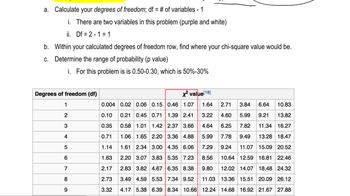
Chi Square Analysis

Genotypic and Phenotypic Ratios

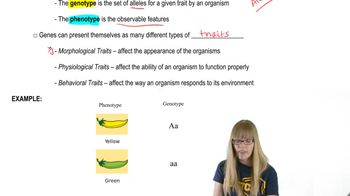
Genotypic ratios refer to the relative frequencies of different genotypes in the offspring, while phenotypic ratios refer to the observable traits. In the case of the Bb x Bb cross, the genotypic ratio is 1 BB : 2 Bb : 1 bb, leading to a phenotypic ratio of 3 blue (BB and Bb) to 1 white (bb). Understanding these ratios is essential for predicting the outcomes of genetic crosses.
Recommended video:
Guided course
07:52
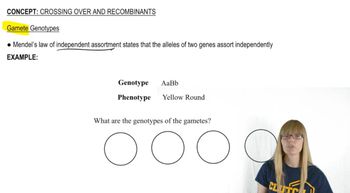
Gamete Genotypes
Related Practice
Textbook Question

Organisms with the genotypes AABbCcDd and AaBbCcDd are crossed. What are the expected proportions of the following progeny?


AabbCcDd

593
views
Textbook Question

Organisms with the genotypes AABbCcDd and AaBbCcDd are crossed. What are the expected proportions of the following progeny?


A phenotype identical to either parent

939
views
Textbook Question

Organisms with the genotypes AABbCcDd and AaBbCcDd are crossed. What are the expected proportions of the following progeny?


A–B–ccdd

486
views
Textbook Question

In the fruit fly Drosophila, a rudimentary wing called 'vestigial' and dark body color called 'ebony' are inherited as independently assorting genes and are recessive to their dominant counterparts full wing and gray body color. Dihybrid dominant-phenotype males and females are crossed, and 3200 progeny are produced. How many progeny flies are expected to be found in each phenotypic class?

1348
views
Textbook Question

In pea plants, plant height, seed shape, and seed color are governed by three independently assorting genes. The three genes have dominant and recessive alleles, with tall (T) dominant to short (t), round (R) dominant to wrinkled (r), and yellow (G) dominant to green (g).


If a true-breeding tall, wrinkled, yellow plant is crossed to a true-breeding short, round, green plant, what phenotypic ratios are expected in the F1 and F2?

1872
views
Textbook Question

In pea plants, plant height, seed shape, and seed color are governed by three independently assorting genes. The three genes have dominant and recessive alleles, with tall (T) dominant to short (t), round (R) dominant to wrinkled (r), and yellow (G) dominant to green (g).


What proportion of the F2 are expected to be tall, wrinkled, yellow? ttRRGg?

531
views