You have four guinea pigs for a genetic study. One male and one female are from a strain that is pure-breeding for short brown fur. A second male and female are from a strain that is pure-breeding for long white fur. You are asked to perform two different experiments to test the proposal that short fur is dominant to long fur and that brown is dominant to white. You may use any of the four original pure-breeding guinea pigs or any of their offspring in experimental matings. Design two different experiments (crossing different animals and using different combinations of phenotypes) to test the dominance relationships of alleles for fur length and color, and make predictions for each cross based on the proposed relationships. Anticipate that the litter size will be 12 for each mating and that female guinea pigs can produce three litters in their lifetime.

Galactosemia is an autosomal recessive disorder caused by the inability to metabolize galactose, a component of the lactose found in mammalian milk. Galactosemia can be partially managed by eliminating dietary intake of lactose and galactose. Amanda is healthy, as are her parents, but her brother Alonzo has galactosemia. Brice has a similar family history. He and his parents are healthy, but his sister Brianna has galactosemia. Amanda and Brice are planning a family and seek genetic counseling. Based on the information provided, complete the following activities and answer the questions.
What is the probability that the first child of Amanda and Brice will have galactosemia? Show your work.
Verified step by step guidance
Verified video answer for a similar problem:
Key Concepts
Autosomal Recessive Inheritance
Carrier Status
Punnett Square
Galactosemia is an autosomal recessive disorder caused by the inability to metabolize galactose, a component of the lactose found in mammalian milk. Galactosemia can be partially managed by eliminating dietary intake of lactose and galactose. Amanda is healthy, as are her parents, but her brother Alonzo has galactosemia. Brice has a similar family history. He and his parents are healthy, but his sister Brianna has galactosemia. Amanda and Brice are planning a family and seek genetic counseling. Based on the information provided, complete the following activities and answer the questions.
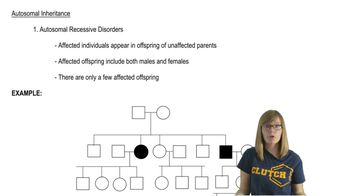
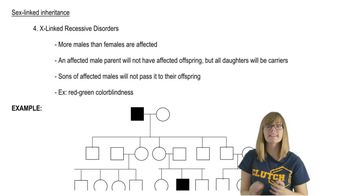
Draw a pedigree that includes Amanda, Brice, and their siblings and parents. Identify the genotype of each person, using G and g to represent the dominant and recessive alleles, respectively.
Galactosemia is an autosomal recessive disorder caused by the inability to metabolize galactose, a component of the lactose found in mammalian milk. Galactosemia can be partially managed by eliminating dietary intake of lactose and galactose. Amanda is healthy, as are her parents, but her brother Alonzo has galactosemia. Brice has a similar family history. He and his parents are healthy, but his sister Brianna has galactosemia. Amanda and Brice are planning a family and seek genetic counseling. Based on the information provided, complete the following activities and answer the questions.
What is the probability that Amanda is a carrier of the allele for galactosemia? What is the probability that Brice is a carrier? Explain your reasoning for each answer.
Galactosemia is an autosomal recessive disorder caused by the inability to metabolize galactose, a component of the lactose found in mammalian milk. Galactosemia can be partially managed by eliminating dietary intake of lactose and galactose. Amanda is healthy, as are her parents, but her brother Alonzo has galactosemia. Brice has a similar family history. He and his parents are healthy, but his sister Brianna has galactosemia. Amanda and Brice are planning a family and seek genetic counseling. Based on the information provided, complete the following activities and answer the questions.
If the first child has galactosemia, what is the probability that the second child will have galactosemia? Explain the reasoning for your answer.
Sweet yellow tomatoes with a pear shape bring a high price per basket to growers. Pear shape, yellow color, and terminal flower position are recessive traits produced by alleles f, r, and t, respectively. The dominant phenotypes for each trait—full shape, red color, and axial flower position—are the product of dominant alleles F, R, and T. A farmer has two pure-breeding tomato lines. One is full, yellow, terminal and the other is pear, red, axial. Design a breeding experiment that will produce a line of tomato that is pure-breeding for pear shape, yellow color, and axial flower position.
A cross between a spicy variety of Capsicum annum pepper and a sweet (nonspicy) variety produces F1 progeny plants that all have spicy peppers. The F1 are crossed, and among the F2 plants are 56 that produce spicy peppers and 20 that produce sweet peppers. Dr. Ara B. Dopsis, an expert on pepper plants, discovers a gene he designates Pun1 that he believes is responsible for spicy versus sweet flavor of peppers. Dr. Dopsis proposes that a dominant allele P produces spicy peppers and that a recessive mutant allele p results in sweet peppers.
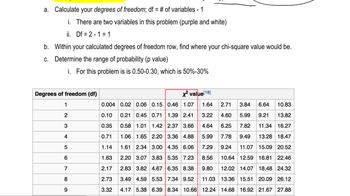
Are the data on the parental cross and the F1 and F2 consistent with the proposal made by Dr. Dopsis? Explain why or why not, using P and p to indicate probable genotypes of pepper plants.
