
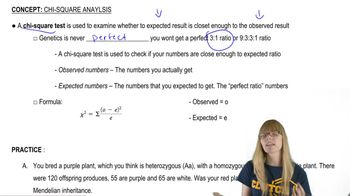
For a single dice roll, there is a 1/6 chance that any particular number will appear. For a pair of dice, each specific combination of numbers has a probability of 1/36 occurring. Most total values of two dice can occur more than one way. As a test of random probability theory, a student decides to roll a pair of six-sided dice 300 times and tabulate the results. She tabulates the number of times each different total value of the two dice occurs. Her results are the following:
Total Value of Two Dice Number of Times Rolled
2 7
3 11
4 23
5 36
6 42
7 53
8 40
9 38
10 30
11 12
12 8
TOTAL 300
The student tells you that her results fail to prove that random chance is the explanation for the outcome of this experiment. Is she correct or incorrect? Support your answer.

- Ch. 1 - The Molecular Basis of Heredity, Variation, and Evolution64
- Ch. 2 - Transmission Genetics144
- Ch. 3 - Cell Division and Chromosome Heredity81
- Ch. 4 - Gene Interaction87
- Ch. 5 - Genetic Linkage and Mapping in Eukaryotes103
- Ch. 6 - Genetic Analysis and Mapping in Bacteria and Bacteriophages73
- Ch. 7 - DNA Structure and Replication71
- Ch. 8 - Molecular Biology of Transcription and RNA Processing79
- Ch. 9 - The Molecular Biology of Translation110
- Ch. 10 - Eukaryotic Chromosome Abnormalities and Molecular Organization100
- Ch. 11 - Gene Mutation, DNA Repair, and Homologous Recombination86
- Ch. 12 - Regulation of Gene Expression in Bacteria and Bacteriophage90
- Ch. 13 - Regulation of Gene Expression in Eukaryotes38
- Ch. 14 - Analysis of Gene Function via Forward Genetics and Reverse Genetics72
- Ch. 15 - Recombinant DNA Technology and Its Applications69
- Ch. 16 - Genomics: Genetics from a Whole-Genome Perspective49
- Ch. 17 - Organelle Inheritance and the Evolution of Organelle Genomes27
- Ch. 18 - Developmental Genetics43
- Ch. 19 - Genetic Analysis of Quantitative Traits66
- Ch. 20 - Population Genetics and Evolution at the Population, Species, and Molecular Levels105
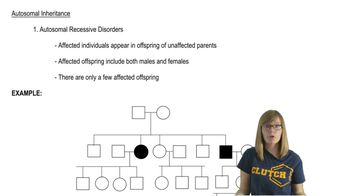
Galactosemia is an autosomal recessive disorder caused by the inability to metabolize galactose, a component of the lactose found in mammalian milk. Galactosemia can be partially managed by eliminating dietary intake of lactose and galactose. Amanda is healthy, as are her parents, but her brother Alonzo has galactosemia. Brice has a similar family history. He and his parents are healthy, but his sister Brianna has galactosemia. Amanda and Brice are planning a family and seek genetic counseling. Based on the information provided, complete the following activities and answer the questions.
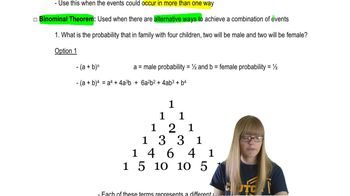
What is the probability that Amanda is a carrier of the allele for galactosemia? What is the probability that Brice is a carrier? Explain your reasoning for each answer.
 Verified step by step guidance
Verified video answer for a similar problem:

Key Concepts
Autosomal Recessive Inheritance
 09:08
09:08
Carrier Probability
 07:41
07:41Punnett Square Analysis
 02:48
02:48Galactosemia is an autosomal recessive disorder caused by the inability to metabolize galactose, a component of the lactose found in mammalian milk. Galactosemia can be partially managed by eliminating dietary intake of lactose and galactose. Amanda is healthy, as are her parents, but her brother Alonzo has galactosemia. Brice has a similar family history. He and his parents are healthy, but his sister Brianna has galactosemia. Amanda and Brice are planning a family and seek genetic counseling. Based on the information provided, complete the following activities and answer the questions.
Draw a pedigree that includes Amanda, Brice, and their siblings and parents. Identify the genotype of each person, using G and g to represent the dominant and recessive alleles, respectively.
Galactosemia is an autosomal recessive disorder caused by the inability to metabolize galactose, a component of the lactose found in mammalian milk. Galactosemia can be partially managed by eliminating dietary intake of lactose and galactose. Amanda is healthy, as are her parents, but her brother Alonzo has galactosemia. Brice has a similar family history. He and his parents are healthy, but his sister Brianna has galactosemia. Amanda and Brice are planning a family and seek genetic counseling. Based on the information provided, complete the following activities and answer the questions.
What is the probability that the first child of Amanda and Brice will have galactosemia? Show your work.
Galactosemia is an autosomal recessive disorder caused by the inability to metabolize galactose, a component of the lactose found in mammalian milk. Galactosemia can be partially managed by eliminating dietary intake of lactose and galactose. Amanda is healthy, as are her parents, but her brother Alonzo has galactosemia. Brice has a similar family history. He and his parents are healthy, but his sister Brianna has galactosemia. Amanda and Brice are planning a family and seek genetic counseling. Based on the information provided, complete the following activities and answer the questions.
If the first child has galactosemia, what is the probability that the second child will have galactosemia? Explain the reasoning for your answer.
Sweet yellow tomatoes with a pear shape bring a high price per basket to growers. Pear shape, yellow color, and terminal flower position are recessive traits produced by alleles f, r, and t, respectively. The dominant phenotypes for each trait—full shape, red color, and axial flower position—are the product of dominant alleles F, R, and T. A farmer has two pure-breeding tomato lines. One is full, yellow, terminal and the other is pear, red, axial. Design a breeding experiment that will produce a line of tomato that is pure-breeding for pear shape, yellow color, and axial flower position.
You have four guinea pigs for a genetic study. One male and one female are from a strain that is pure-breeding for short brown fur. A second male and female are from a strain that is pure-breeding for long white fur. You are asked to perform two different experiments to test the proposal that short fur is dominant to long fur and that brown is dominant to white. You may use any of the four original pure-breeding guinea pigs or any of their offspring in experimental matings. Design two different experiments (crossing different animals and using different combinations of phenotypes) to test the dominance relationships of alleles for fur length and color, and make predictions for each cross based on the proposed relationships. Anticipate that the litter size will be 12 for each mating and that female guinea pigs can produce three litters in their lifetime.