Pearson+ LogoPearson+ Logo
Ch. 2 - Transmission Genetics
Sanders - Genetic Analysis: An Integrated Approach 3rd Edition
Sanders3rd EditionGenetic Analysis: An Integrated ApproachISBN: 9780135564172Not the one you use?Change textbook
Chapter 2, Problem 38

Sweet yellow tomatoes with a pear shape bring a high price per basket to growers. Pear shape, yellow color, and terminal flower position are recessive traits produced by alleles f, r, and t, respectively. The dominant phenotypes for each trait—full shape, red color, and axial flower position—are the product of dominant alleles F, R, and T. A farmer has two pure-breeding tomato lines. One is full, yellow, terminal and the other is pear, red, axial. Design a breeding experiment that will produce a line of tomato that is pure-breeding for pear shape, yellow color, and axial flower position.

Verified step by step guidance
1
Step 1: Identify the genotypes of the two pure-breeding tomato lines. Since one line is full, yellow, and terminal, its genotype is FFrrtt (homozygous dominant for shape, homozygous recessive for color, and homozygous recessive for flower position). The other line, which is pear, red, and axial, has the genotype ffRRtt (homozygous recessive for shape, homozygous dominant for color, and homozygous dominant for flower position).
Step 2: Perform a cross between the two pure-breeding lines. The F1 generation will inherit one allele from each parent for each gene. This results in the genotype FfRrtt for all F1 individuals, which are heterozygous for shape and color, and homozygous recessive for flower position. The phenotype of the F1 generation will be full, red, and terminal.
Step 3: To produce a line that is pure-breeding for pear shape, yellow color, and axial flower position (ffrrTT), perform a self-cross of the F1 generation (FfRrtt × FfRrtt). This will allow for independent assortment and recombination of alleles for all three traits.
Step 4: Use a Punnett square or probability rules to determine the genotypic ratios in the F2 generation. For each gene, calculate the probability of obtaining the desired homozygous recessive genotype (ff for shape, rr for color) and homozygous dominant genotype (TT for flower position). Combine these probabilities to identify the proportion of offspring with the desired genotype ffrrTT.
Step 5: Screen the F2 generation for individuals with the desired phenotype (pear shape, yellow color, and axial flower position). Confirm their genotype through test crosses or molecular techniques if necessary. Select these individuals and propagate them to establish a pure-breeding line with the desired traits.

Verified video answer for a similar problem:

This video solution was recommended by our tutors as helpful for the problem above.
Video duration:
2m
Was this helpful?

Key Concepts

Here are the essential concepts you must grasp in order to answer the question correctly.

Mendelian Genetics

Mendelian genetics is the study of how traits are inherited through generations based on the principles established by Gregor Mendel. It involves understanding dominant and recessive alleles, where dominant traits mask the expression of recessive ones. This framework is essential for predicting the outcomes of genetic crosses, such as those involving the traits of the tomatoes in the question.
Recommended video:
Guided course
03:45
Descriptive Genetics

Genotype and Phenotype

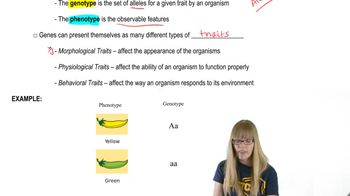
The genotype refers to the genetic makeup of an organism, while the phenotype is the observable physical or biochemical characteristics resulting from the genotype. In the context of the tomato breeding experiment, understanding the genotypes of the parent plants (pure-breeding for specific traits) is crucial for predicting the phenotypes of the offspring and ensuring the desired traits are expressed.
Recommended video:
Guided course
07:52
Gamete Genotypes

Punnett Square

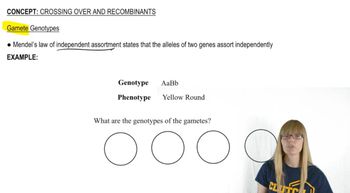
A Punnett square is a diagram used to predict the genetic outcomes of a cross between two organisms. It allows for the visualization of how alleles from each parent combine to form the genotypes of the offspring. In this breeding experiment, a Punnett square can help determine the likelihood of producing pure-breeding lines for the desired recessive traits of pear shape, yellow color, and axial flower position.
Recommended video:
Guided course
18:27
Chi Square Analysis
Related Practice
Textbook Question

Galactosemia is an autosomal recessive disorder caused by the inability to metabolize galactose, a component of the lactose found in mammalian milk. Galactosemia can be partially managed by eliminating dietary intake of lactose and galactose. Amanda is healthy, as are her parents, but her brother Alonzo has galactosemia. Brice has a similar family history. He and his parents are healthy, but his sister Brianna has galactosemia. Amanda and Brice are planning a family and seek genetic counseling. Based on the information provided, complete the following activities and answer the questions.


What is the probability that Amanda is a carrier of the allele for galactosemia? What is the probability that Brice is a carrier? Explain your reasoning for each answer.

433
views
Textbook Question

Galactosemia is an autosomal recessive disorder caused by the inability to metabolize galactose, a component of the lactose found in mammalian milk. Galactosemia can be partially managed by eliminating dietary intake of lactose and galactose. Amanda is healthy, as are her parents, but her brother Alonzo has galactosemia. Brice has a similar family history. He and his parents are healthy, but his sister Brianna has galactosemia. Amanda and Brice are planning a family and seek genetic counseling. Based on the information provided, complete the following activities and answer the questions.


What is the probability that the first child of Amanda and Brice will have galactosemia? Show your work.

688
views
Textbook Question

Galactosemia is an autosomal recessive disorder caused by the inability to metabolize galactose, a component of the lactose found in mammalian milk. Galactosemia can be partially managed by eliminating dietary intake of lactose and galactose. Amanda is healthy, as are her parents, but her brother Alonzo has galactosemia. Brice has a similar family history. He and his parents are healthy, but his sister Brianna has galactosemia. Amanda and Brice are planning a family and seek genetic counseling. Based on the information provided, complete the following activities and answer the questions.


If the first child has galactosemia, what is the probability that the second child will have galactosemia? Explain the reasoning for your answer.

446
views
Textbook Question

A cross between a spicy variety of Capsicum annum pepper and a sweet (nonspicy) variety produces F1 progeny plants that all have spicy peppers. The F1 are crossed, and among the F2 plants are 56 that produce spicy peppers and 20 that produce sweet peppers. Dr. Ara B. Dopsis, an expert on pepper plants, discovers a gene he designates Pun1 that he believes is responsible for spicy versus sweet flavor of peppers. Dr. Dopsis proposes that a dominant allele P produces spicy peppers and that a recessive mutant allele p results in sweet peppers.

Are the data on the parental cross and the F1 and F2 consistent with the proposal made by Dr. Dopsis? Explain why or why not, using P and p to indicate probable genotypes of pepper plants.

417
views
Textbook Question

A cross between a spicy variety of Capsicum annum pepper and a sweet (nonspicy) variety produces F1 progeny plants that all have spicy peppers. The F1 are crossed, and among the F2 plants are 56 that produce spicy peppers and 20 that produce sweet peppers. Dr. Ara B. Dopsis, an expert on pepper plants, discovers a gene he designates Pun1 that he believes is responsible for spicy versus sweet flavor of peppers. Dr. Dopsis proposes that a dominant allele P produces spicy peppers and that a recessive mutant allele p results in sweet peppers.

Assuming the proposal is correct, what proportion of the spicy F2 pepper plants do you expect will be pure-breeding? Explain your answer.

396
views
Textbook Question

Alkaptonuria is an infrequent autosomal recessive condition. It is first noticed in newborns when the urine in their diapers turns black upon exposure to air. The condition is caused by the defective transport of the amino acid phenylalanine through the intestinal walls during digestion. About 4 people per 1000 are carriers of alkaptonuria.

Sara and James had never heard of alkaptonuria and were shocked to discover that their first child had the condition. Sara's sister Mary and her husband, Frank, are planning to have a family and are concerned about the possibility of alkaptonuria in one of their children.

The four adults (Sara, James, Mary, and Frank) seek information from a neighbor who is a retired physician. After discussing their family histories, the neighbor says, "I never took genetics, but I know from my many years in practice that Sara and James are both carriers of this recessive condition. Since their first child had the condition, there is a very low chance that the next child will also have it, because the odds of having two children with a recessive condition are very low. Mary and Frank have no chance of having a child with alkaptonuria because Frank has no family history of the condition." The two couples each have babies and both babies have alkaptonuria.


What are the genotypes of the four adults?

701
views