Pearson+ LogoPearson+ Logo
Ch. 2 - Transmission Genetics
Sanders - Genetic Analysis: An Integrated Approach 3rd Edition
Sanders3rd EditionGenetic Analysis: An Integrated ApproachISBN: 9780135564172Not the one you use?Change textbook
Chapter 2, Problem 18c

In pea plants, the appearance of flowers along the main stem is a dominant phenotype called 'axial' and is controlled by an allele T. The recessive phenotype, produced by an allele t, has flowers only at the end of the stem and is called 'terminal.' Pod form displays a dominant phenotype, 'inflated,' controlled by an allele C, and a recessive 'constricted' form, produced by the c allele. A cross is made between a pure-breeding axial, constricted plant and a plant that is pure-breeding terminal, inflated.
If an F₁ plant from the initial cross described above is crossed with a plant that is terminal, constricted, what is the expected distribution among the resulting progeny?

Verified step by step guidance
1
Step 1: Identify the genotypes of the parent plants in the initial cross. The pure-breeding axial, constricted plant has the genotype TTcc (homozygous dominant for axial flowers and homozygous recessive for constricted pods). The pure-breeding terminal, inflated plant has the genotype ttCC (homozygous recessive for terminal flowers and homozygous dominant for inflated pods).
Step 2: Determine the genotype of the F₁ generation. Since the initial cross involves homozygous parents, the F₁ offspring will inherit one allele from each parent for each gene. This results in the genotype TtCc (heterozygous for both traits). The phenotype of the F₁ plants will be axial flowers and inflated pods, as both traits are dominant.
Step 3: Analyze the second cross. The F₁ plant (TtCc) is crossed with a plant that is terminal and constricted, which has the genotype ttcc (homozygous recessive for both traits). This is a test cross, as one parent is heterozygous and the other is homozygous recessive.
Step 4: Use a Punnett square to determine the possible genotypes and phenotypes of the progeny. For each gene, the F₁ plant contributes either a dominant or recessive allele (T or t for flower position, C or c for pod form), while the terminal, constricted plant contributes only recessive alleles (t and c). Combine these alleles to find all possible combinations.
Step 5: Calculate the expected phenotypic ratios. Each combination of alleles corresponds to a specific phenotype: axial flowers with inflated pods (T_C_), axial flowers with constricted pods (T_cc), terminal flowers with inflated pods (ttC_), and terminal flowers with constricted pods (ttcc). Count the occurrences of each phenotype in the Punnett square to determine the expected distribution among the progeny.

Verified video answer for a similar problem:

This video solution was recommended by our tutors as helpful for the problem above.
Video duration:
2m
Was this helpful?

Key Concepts

Here are the essential concepts you must grasp in order to answer the question correctly.

Dominant and Recessive Alleles

In genetics, alleles are different forms of a gene that can exist at a specific locus on a chromosome. Dominant alleles, represented by uppercase letters (e.g., T, C), mask the expression of recessive alleles, represented by lowercase letters (e.g., t, c). In the context of the question, the dominant traits (axial flowers and inflated pods) will be expressed in the phenotype if at least one dominant allele is present.
Recommended video:
Guided course
04:37
Variations on Dominance

Punnett Square

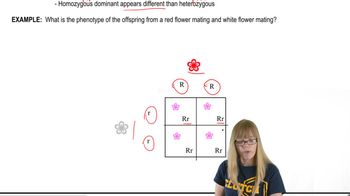
A Punnett square is a diagram used to predict the genotypic and phenotypic outcomes of a genetic cross. By organizing the alleles of the parent plants, it allows for a visual representation of how alleles combine in the offspring. This tool is essential for determining the expected distribution of traits in progeny, especially when dealing with multiple traits and their dominant or recessive nature.
Recommended video:
Guided course
18:27
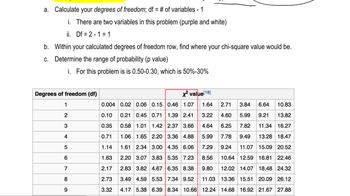
Chi Square Analysis

Phenotypic Ratios

Phenotypic ratios describe the relative frequencies of different phenotypes in the offspring resulting from a genetic cross. These ratios are derived from the combinations of alleles produced in the offspring and can be predicted using a Punnett square. Understanding these ratios is crucial for interpreting the expected distribution of traits, such as axial vs. terminal flowers and inflated vs. constricted pods in the progeny of the described cross.
Recommended video:
Guided course
10:48
Mutations and Phenotypes
Related Practice
Textbook Question

Suppose an F₁ dihybrid (round yellow plant from Problem 16) is crossed to the pure-breeding green, round parental strain. Use a forked-line diagram to predict the phenotypic distribution of the resulting progeny.

466
views
Textbook Question

In pea plants, the appearance of flowers along the main stem is a dominant phenotype called 'axial' and is controlled by an allele T. The recessive phenotype, produced by an allele t, has flowers only at the end of the stem and is called 'terminal.' Pod form displays a dominant phenotype, 'inflated,' controlled by an allele C, and a recessive 'constricted' form, produced by the c allele. A cross is made between a pure-breeding axial, constricted plant and a plant that is pure-breeding terminal, inflated.

The F₁ progeny of this cross are allowed to self-fertilize. What is the expected phenotypic distribution among the F₂ progeny?

476
views
Textbook Question

In pea plants, the appearance of flowers along the main stem is a dominant phenotype called 'axial' and is controlled by an allele T. The recessive phenotype, produced by an allele t, has flowers only at the end of the stem and is called 'terminal.' Pod form displays a dominant phenotype, 'inflated,' controlled by an allele C, and a recessive 'constricted' form, produced by the c allele. A cross is made between a pure-breeding axial, constricted plant and a plant that is pure-breeding terminal, inflated.

Suppose that all of the F₂ progeny with terminal flowers, i.e., plants with terminal flowers and inflated pods and plants with terminal flowers and constricted pods, are saved and allowed to self-fertilize to produce a partial F₃ generation. What is the expected phenotypic distribution among these F₃ plants?

610
views
Textbook Question

In pea plants, the appearance of flowers along the main stem is a dominant phenotype called 'axial' and is controlled by an allele T. The recessive phenotype, produced by an allele t, has flowers only at the end of the stem and is called 'terminal.' Pod form displays a dominant phenotype, 'inflated,' controlled by an allele C, and a recessive 'constricted' form, produced by the c allele. A cross is made between a pure-breeding axial, constricted plant and a plant that is pure-breeding terminal, inflated.

If the plants with terminal flowers produced by the cross in part (c) are saved and allowed to self-fertilize, what is the expected phenotypic distribution among the progeny?

439
views
Textbook Question

If two six-sided dice are rolled, what is the probability that the total number of spots showing is 4?

469
views
Textbook Question

If two six-sided dice are rolled, what is the probability that the total number of spots showing is 7?

420
views