Pearson+ LogoPearson+ Logo
Ch. 2 - Transmission Genetics
Sanders - Genetic Analysis: An Integrated Approach 3rd Edition
Sanders3rd EditionGenetic Analysis: An Integrated ApproachISBN: 9780135564172Not the one you use?Change textbook
Chapter 2, Problem 22c

The seeds in bush bean pods are each the product of an independent fertilization event. Green seed color is dominant to white seed color in bush beans. If a heterozygous plant with green seeds self-fertilizes, what is the probability that 6 seeds in a single pod of the progeny plant will consist of at least 1 white seed?

Verified step by step guidance
1
Understand the genetic basis of the problem: Green seed color (G) is dominant to white seed color (g). A heterozygous plant (Gg) self-fertilizing will produce offspring with the genotypes GG, Gg, and gg in a 1:2:1 ratio. This means the probability of a green seed (G_) is 3/4, and the probability of a white seed (gg) is 1/4.
Determine the probability of all seeds being green: Since each seed is an independent fertilization event, the probability of all 6 seeds being green is the product of the probabilities for each seed being green. This can be expressed as \( P(\text{all green}) = (3/4)^6 \).
Calculate the complement probability: The problem asks for the probability of at least 1 white seed. This is the complement of the probability of all seeds being green. Using the complement rule, \( P(\text{at least 1 white}) = 1 - P(\text{all green}) \).
Substitute the value of \( P(\text{all green}) \) into the complement formula: Replace \( P(\text{all green}) \) with \( (3/4)^6 \) to calculate \( P(\text{at least 1 white}) \).
Simplify the expression: Perform the arithmetic to simplify \( 1 - (3/4)^6 \), which will give the final probability of having at least 1 white seed in the pod.

Verified video answer for a similar problem:

This video solution was recommended by our tutors as helpful for the problem above.
Video duration:
1m
Was this helpful?

Key Concepts

Here are the essential concepts you must grasp in order to answer the question correctly.

Mendelian Genetics

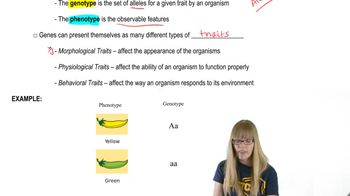
Mendelian genetics is the study of how traits are inherited through generations, based on the principles established by Gregor Mendel. It includes concepts such as dominant and recessive alleles, where dominant traits mask the expression of recessive traits. In this case, green seed color is dominant over white, meaning that a plant with at least one green allele will exhibit green seeds.
Recommended video:
Guided course
03:45
Descriptive Genetics

Punnett Square

A Punnett square is a diagram used to predict the genetic makeup of offspring from a particular cross. It allows for the visualization of all possible combinations of alleles from the parents. For a heterozygous plant (Gg), the Punnett square would show the probabilities of producing offspring with green (GG, Gg) or white (gg) seeds, which is essential for calculating the likelihood of obtaining at least one white seed in the progeny.
Recommended video:
Guided course
18:27
Chi Square Analysis

Binomial Probability

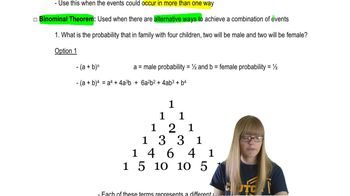
Binomial probability refers to the likelihood of a specific number of successes in a fixed number of independent trials, each with two possible outcomes. In this scenario, we can use the binomial probability formula to determine the chance of getting at least one white seed among six seeds, considering the probability of a single seed being white. This involves calculating the complement probability of getting no white seeds and subtracting it from one.
Recommended video: