Pearson+ LogoPearson+ Logo
Ch. 20 - Population Genetics and Evolution at the Population, Species, and Molecular Levels
Sanders - Genetic Analysis: An Integrated Approach 3rd Edition
Sanders3rd EditionGenetic Analysis: An Integrated ApproachISBN: 9780135564172Not the one you use?Change textbook
Chapter 20, Problem 33b

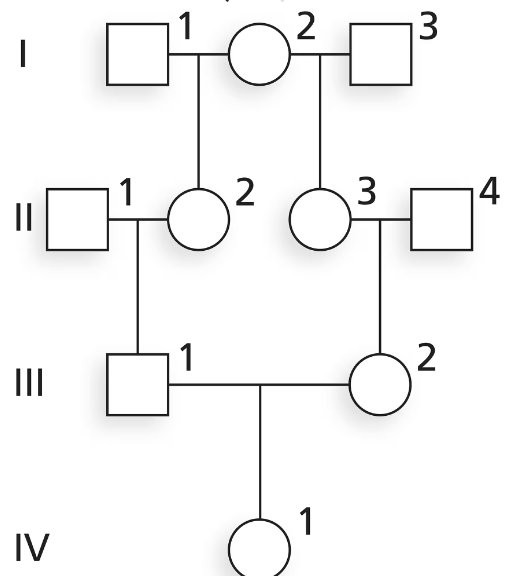
Evaluate the following pedigree, and answer the questions below for individual IV-1. What is F for this individual?

Verified step by step guidance
1
Step 1: Understand the concept of 'F', which represents the inbreeding coefficient. It measures the probability that an individual has two alleles at a locus that are identical by descent due to shared ancestry.
Step 2: Analyze the pedigree provided. Identify all ancestors of individual IV-1 and determine if there are any loops in the pedigree (i.e., instances where the same ancestor appears more than once due to consanguineous mating).
Step 3: For each loop in the pedigree, calculate the contribution to the inbreeding coefficient using the formula: F=Σn(1/2)n+1, where n is the number of individuals in the loop excluding the individual being evaluated.
Step 4: Sum the contributions from all loops to determine the total inbreeding coefficient for individual IV-1. Ensure that you account for all possible paths of shared ancestry.
Step 5: Verify your calculations by cross-checking the pedigree and ensuring that all loops and shared ancestors have been accounted for correctly.

Verified video answer for a similar problem:

This video solution was recommended by our tutors as helpful for the problem above.
Video duration:
1m
Was this helpful?

Key Concepts

Here are the essential concepts you must grasp in order to answer the question correctly.

Pedigree Analysis

Pedigree analysis is a method used to study the inheritance patterns of traits in families. It involves creating a diagram that represents family relationships and the presence or absence of specific traits across generations. This visual representation helps in understanding how traits are passed down and can indicate whether a trait is dominant, recessive, or linked to sex chromosomes.
Recommended video:
Guided course
01:59
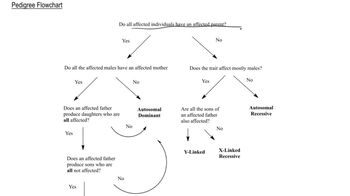
Pedigree Flowchart

Coefficient of Inbreeding (F)

The coefficient of inbreeding (F) quantifies the probability that an individual has inherited identical alleles from both parents due to a common ancestor. It ranges from 0 (no inbreeding) to 1 (complete inbreeding). In pedigree analysis, calculating F helps assess the genetic diversity of a population and the potential for genetic disorders resulting from inbreeding.
Recommended video:
Guided course
08:52
F Factor and Hfr

Generational Relationships

Generational relationships in a pedigree chart indicate the lineage and connections between individuals. Each generation is typically represented by a horizontal row, with parents above their offspring. Understanding these relationships is crucial for determining the inheritance patterns of traits and calculating coefficients like F, as it allows for the identification of common ancestors and the degree of relatedness between individuals.
Recommended video:
Guided course
08:16
Phylogenetic Trees