Pearson+ LogoPearson+ Logo
Ch. 20 - Population Genetics and Evolution at the Population, Species, and Molecular Levels
Sanders - Genetic Analysis: An Integrated Approach 3rd Edition
Sanders3rd EditionGenetic Analysis: An Integrated ApproachISBN: 9780135564172Not the one you use?Change textbook
Chapter 20, Problem 34a

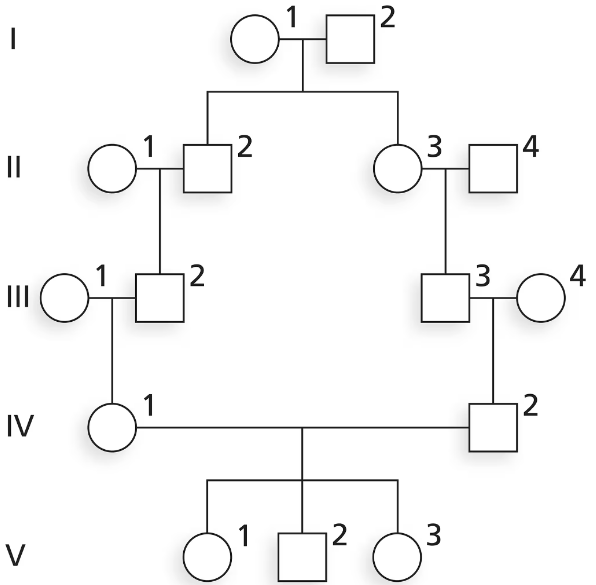
Evaluate the following pedigree, and answer the questions below. Which individual(s) in this family is/are inbred?

Verified step by step guidance
1
Step 1: Understand the concept of inbreeding. Inbreeding occurs when individuals who are closely related genetically (e.g., cousins, siblings) reproduce. This increases the likelihood of homozygosity for recessive alleles, which can lead to genetic disorders.
Step 2: Analyze the pedigree chart provided. Look for instances where individuals share common ancestors, indicating a potential inbreeding event. Specifically, trace the lineage of each individual to identify shared ancestry.
Step 3: Focus on the offspring of unions between individuals who are related. In the chart, identify any individuals whose parents are cousins or otherwise closely related.
Step 4: Highlight the individuals who are products of such unions. For example, if two cousins have children, those children are considered inbred because their parents share a common ancestor.
Step 5: Confirm the inbred individuals by verifying the shared ancestry of their parents. Use the pedigree chart to ensure that the parents are indeed related and that the offspring are direct descendants of this union.

Verified video answer for a similar problem:

This video solution was recommended by our tutors as helpful for the problem above.
Video duration:
1m
Was this helpful?

Key Concepts

Here are the essential concepts you must grasp in order to answer the question correctly.

Pedigree Analysis

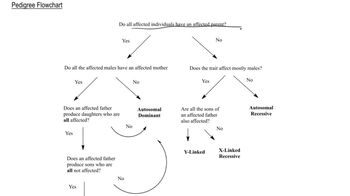
Pedigree analysis is a method used to study the inheritance patterns of traits in families. It involves creating a diagram that represents family relationships and the transmission of genetic traits across generations. By analyzing the pedigree, one can identify carriers of specific traits, determine the mode of inheritance, and assess the likelihood of traits appearing in future generations.
Recommended video:
Guided course
01:59
Pedigree Flowchart

Inbreeding

Inbreeding refers to the mating of individuals who are closely related genetically, which can increase the probability of offspring inheriting genetic disorders. In a pedigree, inbreeding is often indicated by a mating between individuals who share a common ancestor. This practice can lead to a higher incidence of homozygous recessive conditions due to the increased likelihood of both parents carrying the same recessive alleles.
Recommended video:
Guided course
07:55
Non-Random Mating

Symbols in Pedigrees

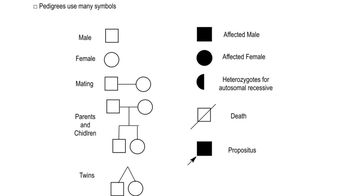
In pedigree charts, specific symbols are used to represent individuals and their relationships. Males are typically represented by squares, while females are represented by circles. A filled symbol indicates an affected individual, while an empty symbol indicates an unaffected individual. Understanding these symbols is crucial for interpreting the pedigree and identifying patterns of inheritance, including potential inbreeding.
Recommended video:
Guided course
02:48
Pedigree Symbols