Pearson+ LogoPearson+ Logo
Ch. 20 - Population Genetics and Evolution at the Population, Species, and Molecular Levels
Sanders - Genetic Analysis: An Integrated Approach 3rd Edition
Sanders3rd EditionGenetic Analysis: An Integrated ApproachISBN: 9780135564172Not the one you use?Change textbook
Chapter 20, Problem 35

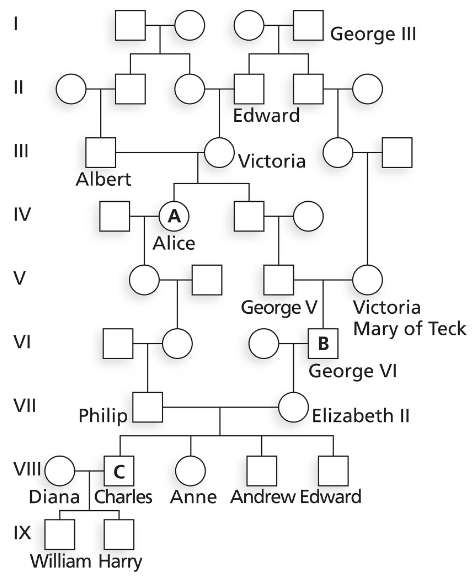
The following is a partial pedigree of the British royal family. The family contains several inbred individuals and a number of inbreeding pathways. Carefully evaluate the pedigree, and identify the pathways and common ancestors that produce inbred individuals A (Alice in generation IV), B (George VI in generation VI), and C (Charles in generation VIII).
Partial pedigree of the British royal family highlighting inbred individuals A, B, and C with their respective generations.

Verified step by step guidance
1
Step 1: Begin by identifying the inbred individuals in the pedigree: Alice (generation IV), George VI (generation VI), and Charles (generation VIII). Inbreeding occurs when an individual inherits alleles from ancestors who are related, leading to shared genetic pathways.
Step 2: For Alice (generation IV), trace her ancestry to find common ancestors. Alice's parents are Albert and Victoria, who are first cousins. Their shared common ancestors are George III and Charlotte, making Alice inbred due to this pathway.
Step 3: For George VI (generation VI), examine his parents, George V and Mary of Teck. Mary of Teck is a descendant of George III and Charlotte, and George V is also a descendant of George III and Charlotte. This shared ancestry creates an inbreeding pathway for George VI.
Step 4: For Charles (generation VIII), analyze his parents, Elizabeth II and Philip. Elizabeth II is a descendant of George III and Charlotte, while Philip is also a descendant of George III and Charlotte through a different lineage. This shared ancestry results in inbreeding for Charles.
Step 5: Summarize the inbreeding pathways: Alice's inbreeding is due to her parents being first cousins, George VI's inbreeding arises from shared ancestry between his parents, and Charles's inbreeding is due to shared ancestry between his parents. The common ancestors for all three individuals are George III and Charlotte.

Verified video answer for a similar problem:

This video solution was recommended by our tutors as helpful for the problem above.
Video duration:
2m
Was this helpful?

Key Concepts

Here are the essential concepts you must grasp in order to answer the question correctly.

Pedigree Analysis

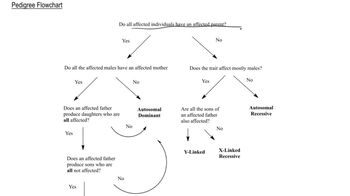
Pedigree analysis is a method used to study the inheritance patterns of traits in families. It involves creating a diagram that represents family relationships and the transmission of genetic traits across generations. By analyzing the pedigree, one can identify carriers of specific traits, determine the likelihood of inheritance, and trace the lineage of individuals, which is crucial for understanding inbreeding and its effects.
Recommended video:
Guided course
01:59
Pedigree Flowchart

Inbreeding

Inbreeding refers to the mating of individuals who are closely related genetically, which can lead to an increased chance of offspring inheriting genetic disorders. Inbreeding can reduce genetic diversity and increase the expression of deleterious alleles. In the context of the pedigree, identifying inbred individuals involves tracing their ancestry to common ancestors, which can reveal potential health risks associated with inbreeding.
Recommended video:
Guided course
07:55
Non-Random Mating

Common Ancestors

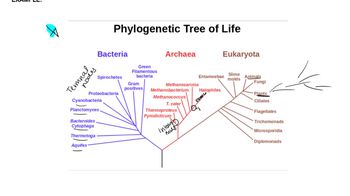
Common ancestors are individuals from whom two or more descendants are directly descended. In pedigree analysis, identifying common ancestors is essential for understanding the genetic relationships between individuals, especially in cases of inbreeding. By pinpointing these ancestors, one can trace the pathways through which genetic traits are passed down, which is vital for evaluating the genetic health of inbred individuals in the royal family.
Recommended video:
Guided course
08:16
Phylogenetic Trees