Pearson+ LogoPearson+ Logo
Ch. 20 - Population Genetics and Evolution at the Population, Species, and Molecular Levels
Sanders - Genetic Analysis: An Integrated Approach 3rd Edition
Sanders3rd EditionGenetic Analysis: An Integrated ApproachISBN: 9780135564172Not the one you use?Change textbook
Chapter 20, Problem 10b

The ability to taste the bitter compound phenylthiocarbamide (PTC) is an autosomal dominant trait. The inability to taste PTC is a recessive condition. In a sample of 500 people, 360 have the ability to taste PTC and 140 do not. Calculate the frequency of the dominant allele.

Verified step by step guidance
1
Determine the total population size (N) from the problem statement. Here, N = 500.
Identify the number of individuals who cannot taste PTC (recessive phenotype). This is given as 140. These individuals are homozygous recessive (genotype q²).
Calculate the frequency of the recessive genotype (q²) by dividing the number of recessive individuals by the total population: q² = 140 / 500.
Find the frequency of the recessive allele (q) by taking the square root of q²: q = √(q²).
Use the Hardy-Weinberg equation (p + q = 1) to calculate the frequency of the dominant allele (p): p = 1 - q.

Verified video answer for a similar problem:

This video solution was recommended by our tutors as helpful for the problem above.
Video duration:
2m
Was this helpful?

Key Concepts

Here are the essential concepts you must grasp in order to answer the question correctly.

Autosomal Dominance and Recessiveness

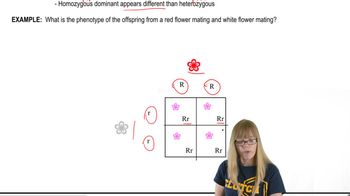
Autosomal dominance refers to a pattern of inheritance where only one copy of a dominant allele is needed for the trait to be expressed. In contrast, recessive traits require two copies of the recessive allele for expression. In the context of PTC tasting, the ability to taste is dominant, while the inability to taste is recessive.
Recommended video:
Guided course
04:37
Variations on Dominance

Hardy-Weinberg Principle

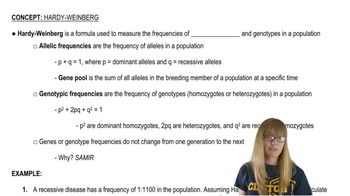
The Hardy-Weinberg principle provides a mathematical framework for understanding allele frequencies in a population under ideal conditions. It states that allele and genotype frequencies will remain constant from generation to generation in the absence of evolutionary influences. This principle is essential for calculating allele frequencies, such as the frequency of the dominant allele in the given population.
Recommended video:
Guided course
13:04
Hardy Weinberg

Allele Frequency Calculation

Allele frequency is the proportion of a specific allele among all allele copies in a population. To calculate the frequency of the dominant allele (T) in the PTC tasting scenario, we can use the observed phenotypic ratios and apply the Hardy-Weinberg equations. This involves determining the number of homozygous dominant and heterozygous individuals based on the total population and the number of individuals expressing the dominant trait.
Recommended video:
Guided course
03:03
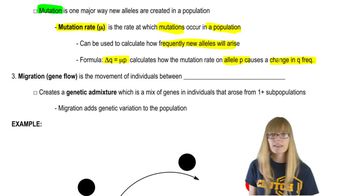
New Alleles and Migration
Related Practice
Textbook Question
Catastrophic events such as loss of habitat, famine, or overhunting can push species to the brink of extinction and result in a genetic bottleneck. What happens to allele frequencies in a species that experiences a near-extinction event, and what is expected to happen to allele frequencies if the species recovers from near extinction?
424
views
Textbook Question
George Udny Yule was wrong in suggesting that an autosomal dominant trait like brachydactyly will increase in frequency in populations. Explain why Yule was incorrect.
606
views
Textbook Question

The ability to taste the bitter compound phenylthiocarbamide (PTC) is an autosomal dominant trait. The inability to taste PTC is a recessive condition. In a sample of 500 people, 360 have the ability to taste PTC and 140 do not. Calculate the frequency of the recessive allele.

561
views
Textbook Question

The ability to taste the bitter compound phenylthiocarbamide (PTC) is an autosomal dominant trait. The inability to taste PTC is a recessive condition. In a sample of 500 people, 360 have the ability to taste PTC and 140 do not. Calculate the frequency of each genotype.

1235
views
Textbook Question

The figure illustrates the effect of an ethanol-rich and an ethanol-free environment on the frequency of the Drosophila AdhF allele in four populations in a 50-generation laboratory experiment. Population 1 and population 2 were reared for 50 generations in a high-ethanol environment, while control 1 and control 2 populations were reared for 50 generations in a zero-ethanol environment. Describe the effect of each environment on the populations, and state any conclusions you can reach about the role of any of the evolutionary processes in producing these effects.

498
views
Textbook Question
Biologists have proposed that the use of antibiotics to treat human infectious disease has played a role in the evolution of widespread antibiotic resistance in several bacterial species, including Staphylococcus aureus and the bacteria causing gonorrhea, tuberculosis, and other infectious diseases. Explain how the evolutionary mechanisms mutation and natural selection may have contributed to the development of antibiotic resistance.
484
views