Pearson+ LogoPearson+ Logo
Ch. 3 - Cell Division and Chromosome Heredity
Sanders - Genetic Analysis: An Integrated Approach 3rd Edition
Sanders3rd EditionGenetic Analysis: An Integrated ApproachISBN: 9780135564172Not the one you use?Change textbook
Chapter 3, Problem 12a

A woman's father has ornithine transcarbamylase deficiency (OTD), an X-linked recessive disorder producing mental deterioration if not properly treated. The woman's mother is homozygous for the wild-type allele.


What is the woman's genotype? (Use D to represent the dominant allele and d to represent the recessive allele.)

Verified step by step guidance
1
Step 1: Understand the inheritance pattern of ornithine transcarbamylase deficiency (OTD). It is an X-linked recessive disorder, meaning the gene responsible for the condition is located on the X chromosome, and the recessive allele (d) causes the disorder.
Step 2: Analyze the genetic information provided for the woman's parents. Her father has OTD, which means he must have the genotype XdY (since males have one X chromosome and one Y chromosome). Her mother is homozygous for the wild-type allele, meaning her genotype is XDXD.
Step 3: Determine the possible X chromosome contributions from each parent. The father can only pass on his Xd chromosome to his daughters (since males pass their Y chromosome to sons). The mother can pass on one of her XD chromosomes to her offspring.
Step 4: Combine the contributions from both parents to determine the woman's genotype. She inherits Xd from her father and XD from her mother, resulting in the genotype XDXd.
Step 5: Conclude that the woman is a carrier for OTD. She has one wild-type allele (XD) and one recessive allele (Xd), meaning she does not exhibit symptoms of the disorder but can pass the recessive allele to her offspring.

Verified video answer for a similar problem:

This video solution was recommended by our tutors as helpful for the problem above.
Video duration:
2m
Was this helpful?

Key Concepts

Here are the essential concepts you must grasp in order to answer the question correctly.

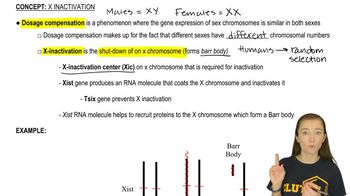
X-Linked Inheritance

X-linked inheritance refers to the pattern of inheritance for genes located on the X chromosome. In X-linked recessive disorders, such as ornithine transcarbamylase deficiency, males (XY) are more likely to express the disorder because they have only one X chromosome. Females (XX) can be carriers if they have one affected X chromosome and one normal X chromosome, but they typically do not express the disorder unless they are homozygous for the recessive allele.
Recommended video:
Guided course
09:30
X-Inactivation

Genotype Representation

Genotype representation involves using symbols to denote the alleles an individual possesses for a particular gene. In this case, 'D' represents the dominant allele and 'd' represents the recessive allele. A woman with one normal allele and one affected allele would be represented as 'Dd', while a woman with two normal alleles would be 'DD', and one with two affected alleles would be 'dd'. Understanding this notation is crucial for determining the woman's genotype.
Recommended video:
Guided course
07:52
Gamete Genotypes

Homozygosity and Heterozygosity

Homozygosity refers to having two identical alleles for a specific gene, while heterozygosity refers to having two different alleles. In this scenario, the woman's mother is homozygous for the wild-type allele (DD), meaning she can only pass on the dominant allele (D) to her offspring. The woman's father, being affected by an X-linked disorder, contributes an affected X chromosome (d) to his daughter, leading to the determination of the woman's genotype based on the combination of alleles inherited from both parents.
Recommended video:
Guided course
13:04
Hardy Weinberg