Pearson+ LogoPearson+ Logo
Ch. 4 - Gene Interaction
Sanders - Genetic Analysis: An Integrated Approach 3rd Edition
Sanders3rd EditionGenetic Analysis: An Integrated ApproachISBN: 9780135564172Not the one you use?Change textbook
Chapter 4, Problem 32

In rabbits, albinism is an autosomal recessive condition caused by the absence of the pigment melanin from skin and fur. Pigmentation is a dominant wild-type trait. Three pure-breeding strains of albino rabbits, identified as strains 1, 2, and 3, are crossed to one another. In the table below, F₁ and F₂ progeny are shown for each cross. Based on the available data, propose a genetic explanation for the results. As part of your answer, create genotypes for each albino strain using clearly defined symbols of your own choosing. Use your symbols to diagram each cross, giving the F₁ and F₂ genotypes. <>

Verified step by step guidance
1
Define the genetic basis of albinism in rabbits. Albinism is an autosomal recessive condition, meaning that two copies of the recessive allele are required for the albino phenotype. Use a symbol such as 'a' for the recessive allele causing albinism and 'A' for the dominant allele responsible for pigmentation.
Analyze the data provided for the F₁ and F₂ generations. If the F₁ progeny from a cross between two albino strains (e.g., strain 1 and strain 2) are all pigmented, this suggests that the two strains have mutations in different genes. This is an example of genetic complementation.
Assign genotypes to each strain based on the complementation results. For example, if strain 1 has a mutation in gene 1 and strain 2 has a mutation in gene 2, you could assign strain 1 the genotype 'aaBB' and strain 2 the genotype 'AAbb'. The F₁ progeny would then have the genotype 'AaBb', which is pigmented because they have at least one dominant allele for each gene.
Diagram the F₁ and F₂ crosses using the assigned genotypes. For the F₁ generation, cross the genotypes of the two parental strains (e.g., 'aaBB' × 'AAbb') to determine the F₁ genotype (e.g., 'AaBb'). For the F₂ generation, perform a Punnett square to determine the genotypic and phenotypic ratios of the offspring when the F₁ individuals are crossed (e.g., 'AaBb' × 'AaBb').
Interpret the F₂ results. If the F₂ generation includes albino offspring, this confirms that the mutations are in different genes. The albino offspring would have genotypes such as 'aaBB', 'AAbb', or 'aabb', depending on the specific genetic combinations resulting from the Punnett square.

Verified video answer for a similar problem:

This video solution was recommended by our tutors as helpful for the problem above.
Video duration:
2m
Was this helpful?

Key Concepts

Here are the essential concepts you must grasp in order to answer the question correctly.

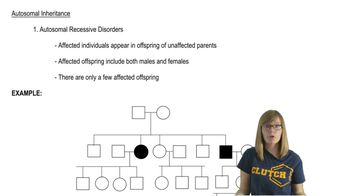
Autosomal Recessive Inheritance

Autosomal recessive inheritance refers to a pattern where a trait is expressed only when an individual has two copies of the recessive allele. In the case of albinism in rabbits, the absence of melanin is due to having two recessive alleles (aa). If an individual has at least one dominant allele (A), they will exhibit the wild-type phenotype, which includes pigmentation.
Recommended video:
Guided course
09:08
Autosomal Pedigrees

Genotype and Phenotype

The genotype is the genetic makeup of an organism, represented by the alleles it carries, while the phenotype is the observable physical or biochemical characteristics resulting from the genotype. For example, in the context of the rabbit strains, the genotypes of the albino rabbits would be homozygous recessive (aa), while the wild-type rabbits would have at least one dominant allele (A).
Recommended video:
Guided course
07:52
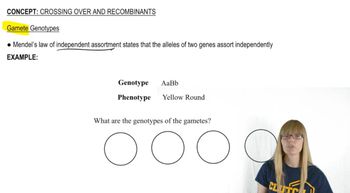
Gamete Genotypes

Punnett Squares and Genetic Crosses

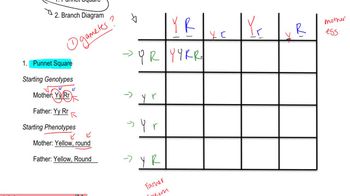
Punnett squares are tools used to predict the genotypes of offspring from genetic crosses. By diagramming the alleles from each parent, one can visualize the potential combinations in the F₁ and F₂ generations. This method is essential for understanding inheritance patterns, especially when analyzing the results of crosses between different strains of rabbits in this scenario.
Recommended video:
Guided course
15:24
Punnet Square
Related Practice
Textbook Question

Dr. Ara B. Dopsis and Dr. C. Ellie Gans are performing genetic crosses on daisy plants. They self-fertilize a blue-flowered daisy and grow 100 progeny plants that consist of 55 blue-flowered plants, 22 purple-flowered plants, and 23 white-flowered plants. Dr. Dopsis believes this is the result of segregation of two alleles at one locus and that the progeny ratio is 1:2:1. Dr. Gans thinks the progeny phenotypes are the result of two epistatic genes and that the ratio is 9:3:4.

The two scientists ask you to resolve their conflict by performing chi-square analysis on the data for both proposed genetic mechanisms. For each proposed mechanism, fill in the values requested on the form the researchers have provided for your analysis.

Use the form below to calculate chi-square for the 9:3:4 hypothesis of Dr. Gans.

437
views
Textbook Question

Dr. Ara B. Dopsis and Dr. C. Ellie Gans are performing genetic crosses on daisy plants. They self-fertilize a blue-flowered daisy and grow 100 progeny plants that consist of 55 blue-flowered plants, 22 purple-flowered plants, and 23 white-flowered plants. Dr. Dopsis believes this is the result of segregation of two alleles at one locus and that the progeny ratio is 1:2:1. Dr. Gans thinks the progeny phenotypes are the result of two epistatic genes and that the ratio is 9:3:4.

The two scientists ask you to resolve their conflict by performing chi-square analysis on the data for both proposed genetic mechanisms. For each proposed mechanism, fill in the values requested on the form the researchers have provided for your analysis.


What is your conclusion regarding these two genetic hypotheses: the 1:2:1 hypothesis and the 9:3:4 hypothesis?

476
views
Textbook Question

Human ABO blood type is determined by three alleles, two of which (I^A and I^B) produce gene products that modify the H antigen produced by protein activity of an independently assorting H gene. A rare abnormality known as the 'Bombay phenotype' is the result of epistatic interaction between the gene for the ABO blood group and the H gene. Individuals with the Bombay phenotype appear to have blood type O based on the inability of both anti-A antibody and anti-B antibody to detect an antigen. The apparent blood type O in Bombay phenotype is due to the absence of H antigen as a result of homozygous recessive mutations of the H gene. Individuals with the Bombay phenotype have the hh genotype. Use the information above to make predictions about the outcome of the cross shown below.

IᴬIᴮHh×IᴬIᴮHh

1400
views
Textbook Question

Dr. O. Sophila, a close friend of Dr. Ara B. Dopsis, reviews the results Dr. Dopsis obtained in his experiment with iris plants described in Genetic Analysis 4.3. Dr. Sophila thinks the F₂ progeny demonstrate that a single gene with incomplete dominance has produced a 1:2:1 ratio. Dr. Dopsis insists his proposal of recessive epistasis producing a 9:4:3 ratio in the F₂ is correct. To test his proposal, Dr. Dopsis examines the F₂ data under the assumptions of the single-gene incomplete dominance model using chi-square analysis. Calculate and interpret this chi-square value. Can Dr. Dopsis reject the single-gene incomplete dominance model on the basis of this analysis? Explain why or why not.

493
views
Textbook Question

In a breed of domestic cattle, horns can appear on males and on females. Males and females can also be hornless. The following crosses are performed with parents from pure-breeding lines.

Explain the inheritance of this phenotype in cattle, and assign genotypes to all cattle in each cross.

481
views
Textbook Question

Cross-1 shown in the following figure illustrates genetic complementation of flower-color mutants. The produced from this cross of two pure-breeding mutant parental plants are dihybrid (CcPp) and have wild-type flower color. If these F₁ are allowed to self-fertilize, what phenotypes are expected in the F₂ , and what are the expected ratios of the phenotypes?


460
views