Pearson+ LogoPearson+ Logo
Ch. 4 - Gene Interaction
Sanders - Genetic Analysis: An Integrated Approach 3rd Edition
Sanders3rd EditionGenetic Analysis: An Integrated ApproachISBN: 9780135564172Not the one you use?Change textbook
Chapter 4, Problem 30c

Dr. Ara B. Dopsis and Dr. C. Ellie Gans are performing genetic crosses on daisy plants. They self-fertilize a blue-flowered daisy and grow 100 progeny plants that consist of 55 blue-flowered plants, 22 purple-flowered plants, and 23 white-flowered plants. Dr. Dopsis believes this is the result of segregation of two alleles at one locus and that the progeny ratio is 1:2:1. Dr. Gans thinks the progeny phenotypes are the result of two epistatic genes and that the ratio is 9:3:4.
The two scientists ask you to resolve their conflict by performing chi-square analysis on the data for both proposed genetic mechanisms. For each proposed mechanism, fill in the values requested on the form the researchers have provided for your analysis.


What is your conclusion regarding these two genetic hypotheses: the 1:2:1 hypothesis and the 9:3:4 hypothesis?

Verified step by step guidance
1
Step 1: Calculate the expected numbers of progeny for each phenotype under both hypotheses. For the 1:2:1 ratio, multiply the total number of progeny (100) by each ratio fraction: 1/4, 2/4, and 1/4 respectively. For the 9:3:4 ratio, multiply 100 by 9/16, 3/16, and 4/16 respectively.
Step 2: For each hypothesis, compute the chi-square (χ²) statistic using the formula: χ² = i (OE)2E, where O is the observed number of plants and E is the expected number for each phenotype category.
Step 3: Determine the degrees of freedom (df) for the chi-square test. Since there are three phenotype categories, df = number of categories - 1 = 2.
Step 4: Compare the calculated chi-square values for each hypothesis to the critical chi-square value at df = 2 and a chosen significance level (commonly 0.05). This will help you decide if the observed data significantly deviate from the expected ratios.
Step 5: Based on the chi-square test results, conclude which hypothesis (1:2:1 or 9:3:4) better fits the observed data by identifying which has a chi-square value less than the critical value, indicating a good fit.

Verified video answer for a similar problem:

This video solution was recommended by our tutors as helpful for the problem above.
Video duration:
8m
Was this helpful?

Key Concepts

Here are the essential concepts you must grasp in order to answer the question correctly.

Mendelian Inheritance and Genotypic Ratios

Mendelian inheritance describes how alleles segregate during gamete formation, producing predictable genotypic ratios in offspring. A single gene with two alleles can yield a 1:2:1 genotypic ratio (homozygous dominant : heterozygous : homozygous recessive), often reflected in phenotypes if incomplete dominance or codominance occurs.
Recommended video:
Guided course
07:52
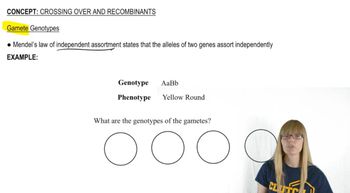
Gamete Genotypes

Epistasis and Modified Phenotypic Ratios

Epistasis occurs when one gene masks or modifies the expression of another gene, altering expected Mendelian ratios. For two genes interacting epistatically, classic phenotypic ratios like 9:3:4 can emerge, reflecting dominant and recessive interactions that affect flower color or other traits.
Recommended video:
Guided course
13:08
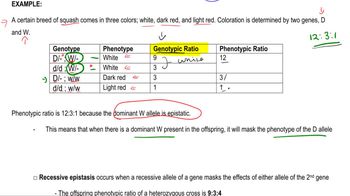
Epistatic Genes

Chi-Square Test for Genetic Hypothesis Testing

The chi-square test compares observed data with expected ratios to evaluate the fit of genetic hypotheses. By calculating chi-square values and corresponding p-values, researchers determine if deviations from expected ratios are due to chance or indicate rejection of a genetic model.
Recommended video:
Guided course
07:33
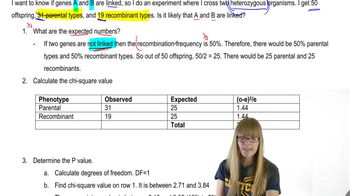
Chi Square and Linkage
Related Practice
Textbook Question

Yeast are single-celled eukaryotic organisms that grow in culture as either haploids or diploids. Diploid yeast are generated when two haploid strains fuse together. Seven haploid mutant strains of yeast exhibit similar normal growth habit at 25°C, but at 37°C, they show different growth capabilities. The table below displays the growth pattern.

Researchers induce fusion in pairs of haploid yeast strains (all possible combinations), and the resulting diploids are tested for their ability to grow at 37°C. The results of the growth experiment are shown below. How many different genes are mutated among these seven yeast strains? Identify the strains that represent each gene mutation.

830
views
Textbook Question

Dr. Ara B. Dopsis and Dr. C. Ellie Gans are performing genetic crosses on daisy plants. They self-fertilize a blue-flowered daisy and grow 100 progeny plants that consist of 55 blue-flowered plants, 22 purple-flowered plants, and 23 white-flowered plants. Dr. Dopsis believes this is the result of segregation of two alleles at one locus and that the progeny ratio is 1:2:1. Dr. Gans thinks the progeny phenotypes are the result of two epistatic genes and that the ratio is 9:3:4.

The two scientists ask you to resolve their conflict by performing chi-square analysis on the data for both proposed genetic mechanisms. For each proposed mechanism, fill in the values requested on the form the researchers have provided for your analysis.

Use the form below to calculate chi-square for the 1:2:1 hypothesis of Dr. Sophila.

517
views
Textbook Question

Dr. Ara B. Dopsis and Dr. C. Ellie Gans are performing genetic crosses on daisy plants. They self-fertilize a blue-flowered daisy and grow 100 progeny plants that consist of 55 blue-flowered plants, 22 purple-flowered plants, and 23 white-flowered plants. Dr. Dopsis believes this is the result of segregation of two alleles at one locus and that the progeny ratio is 1:2:1. Dr. Gans thinks the progeny phenotypes are the result of two epistatic genes and that the ratio is 9:3:4.

The two scientists ask you to resolve their conflict by performing chi-square analysis on the data for both proposed genetic mechanisms. For each proposed mechanism, fill in the values requested on the form the researchers have provided for your analysis.

Use the form below to calculate chi-square for the 9:3:4 hypothesis of Dr. Gans.

437
views
Textbook Question

Human ABO blood type is determined by three alleles, two of which (I^A and I^B) produce gene products that modify the H antigen produced by protein activity of an independently assorting H gene. A rare abnormality known as the 'Bombay phenotype' is the result of epistatic interaction between the gene for the ABO blood group and the H gene. Individuals with the Bombay phenotype appear to have blood type O based on the inability of both anti-A antibody and anti-B antibody to detect an antigen. The apparent blood type O in Bombay phenotype is due to the absence of H antigen as a result of homozygous recessive mutations of the H gene. Individuals with the Bombay phenotype have the hh genotype. Use the information above to make predictions about the outcome of the cross shown below.

IᴬIᴮHh×IᴬIᴮHh

1400
views
Textbook Question

In rabbits, albinism is an autosomal recessive condition caused by the absence of the pigment melanin from skin and fur. Pigmentation is a dominant wild-type trait. Three pure-breeding strains of albino rabbits, identified as strains 1, 2, and 3, are crossed to one another. In the table below, F₁ and F₂ progeny are shown for each cross. Based on the available data, propose a genetic explanation for the results. As part of your answer, create genotypes for each albino strain using clearly defined symbols of your own choosing. Use your symbols to diagram each cross, giving the F₁ and F₂ genotypes. <>

996
views
Textbook Question

Dr. O. Sophila, a close friend of Dr. Ara B. Dopsis, reviews the results Dr. Dopsis obtained in his experiment with iris plants described in Genetic Analysis 4.3. Dr. Sophila thinks the F₂ progeny demonstrate that a single gene with incomplete dominance has produced a 1:2:1 ratio. Dr. Dopsis insists his proposal of recessive epistasis producing a 9:4:3 ratio in the F₂ is correct. To test his proposal, Dr. Dopsis examines the F₂ data under the assumptions of the single-gene incomplete dominance model using chi-square analysis. Calculate and interpret this chi-square value. Can Dr. Dopsis reject the single-gene incomplete dominance model on the basis of this analysis? Explain why or why not.

493
views