Pearson+ LogoPearson+ Logo
Ch. 4 - Gene Interaction
Sanders - Genetic Analysis: An Integrated Approach 3rd Edition
Sanders3rd EditionGenetic Analysis: An Integrated ApproachISBN: 9780135564172Not the one you use?Change textbook
Chapter 4, Problem 27

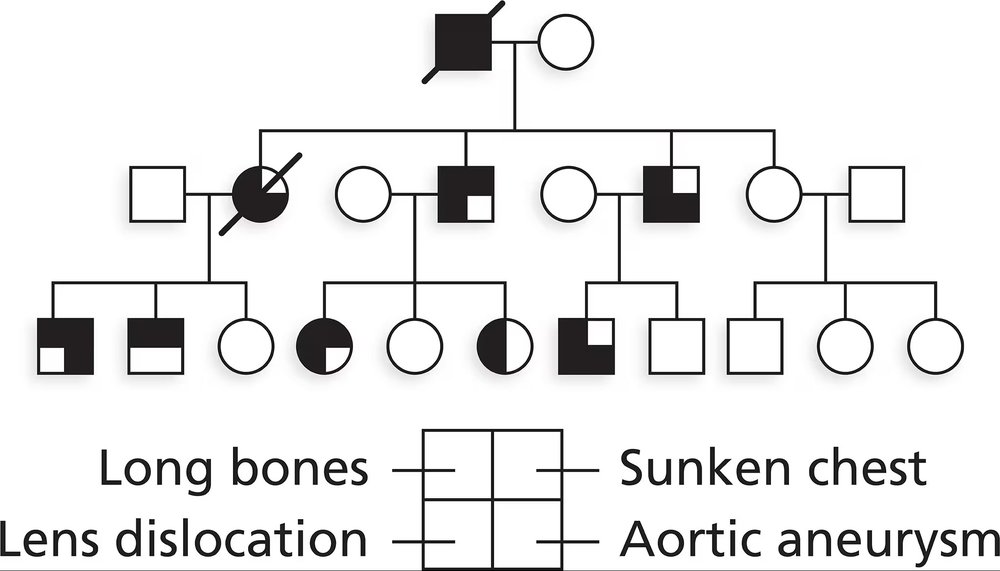
Marfan syndrome is an autosomal dominant disorder in humans. It results from mutation of a gene on chromosome 15 that produces the connective tissue protein fibrillin. In its wild-type form, fibrillin gives connective tissues, such as cartilage, elasticity. When mutated, however, fibrillin is rigid and produces a range of phenotypic complications, including excessive growth of the long bones of the leg and arm, sunken chest, dislocation of the lens of the eye, and susceptibility to aortic aneurysm, which can lead to sudden death in some cases. Different sets of symptoms are seen among various family members, as shown in the pedigree below. Each quadrant of the circles and squares represents a different symptom, as the key indicates.
Pedigree chart illustrating Marfan syndrome symptoms: long bones, lens dislocation, sunken chest, and aortic aneurysm.
All cases of Marfan syndrome are caused by mutation of the fibrillin gene, and all family members with Marfan syndrome carry the same mutant allele. What do the differences shown in the phenotypes of family members say about the expression of the mutant allele?

Verified step by step guidance
1
Understand the genetic basis of Marfan syndrome: It is an autosomal dominant disorder, meaning that only one copy of the mutant allele is sufficient to cause the condition. The mutation affects the fibrillin gene, which is responsible for producing a protein that provides elasticity to connective tissues.
Analyze the concept of variable expressivity: The differences in symptoms among family members suggest that the mutant allele exhibits variable expressivity. This means that individuals with the same genetic mutation can show a range of phenotypic effects, from mild to severe.
Consider environmental and genetic modifiers: Variable expressivity can be influenced by other genetic factors (modifier genes) or environmental factors that interact with the mutant allele, leading to differences in the severity or type of symptoms observed.
Examine the pedigree: The pedigree shows that all affected individuals carry the same mutant allele, but the symptoms differ among them. This supports the idea that the mutant allele's expression is not uniform and is influenced by additional factors.
Conclude the explanation: The differences in phenotypes among family members with Marfan syndrome indicate that the mutant allele's expression is subject to variable expressivity, which is a common phenomenon in genetic disorders. This highlights the complexity of gene expression and the role of other factors in determining phenotypic outcomes.

Verified video answer for a similar problem:

This video solution was recommended by our tutors as helpful for the problem above.
Video duration:
2m
Was this helpful?

Key Concepts

Here are the essential concepts you must grasp in order to answer the question correctly.

Autosomal Dominance

Autosomal dominance is a pattern of inheritance where only one copy of a mutated gene from an affected parent can cause the disorder in offspring. This means that individuals with the mutant allele have a 50% chance of passing it on to their children. In the case of Marfan syndrome, the presence of the mutant allele leads to the manifestation of symptoms, but the severity and type of symptoms can vary among individuals.
Recommended video:
Guided course
04:37
Variations on Dominance

Phenotypic Variation

Phenotypic variation refers to the differences in physical traits and symptoms expressed by individuals with the same genetic mutation. In Marfan syndrome, even though all affected family members carry the same mutant allele, they can exhibit a range of symptoms due to factors such as environmental influences, modifier genes, and the complex nature of gene expression. This variation highlights the role of genetic and non-genetic factors in determining phenotype.
Recommended video:
Guided course
09:28
Genomic Variation

Fibrillin and Connective Tissue

Fibrillin is a crucial protein that contributes to the elasticity and strength of connective tissues, including cartilage and blood vessels. Mutations in the fibrillin gene disrupt its normal function, leading to the rigidity of connective tissues. This dysfunction is responsible for the diverse symptoms of Marfan syndrome, such as skeletal abnormalities and cardiovascular issues, emphasizing the importance of fibrillin in maintaining tissue integrity.
Recommended video:
Guided course
03:46
Drosophilia Development
Related Practice
Textbook Question

Two pure-breeding strains of summer squash producing yellow fruit, Y₁ and Y₂, are each crossed to a pure-breeding strain of summer squash producing green fruit, G₁, and to one another. The following results are obtained:

Examine the results of each cross and predict how many genes are responsible for fruit-color determination in summer squash. Justify your answer. 

488
views
Textbook Question

Two pure-breeding strains of summer squash producing yellow fruit, Y₁ and Y₂, are each crossed to a pure-breeding strain of summer squash producing green fruit, G₁, and to one another. The following results are obtained:

Using clearly defined symbols of your choice, give the genotypes of parental, F₁, and F₂ plants in each cross. 

428
views
Textbook Question

Two pure-breeding strains of summer squash producing yellow fruit, Y₁ and Y₂, are each crossed to a pure-breeding strain of summer squash producing green fruit, G₁, and to one another. The following results are obtained:

If the F₁ of Crosses I and II are mated, predict the phenotype ratio of the progeny. 

531
views
Textbook Question

Yeast are single-celled eukaryotic organisms that grow in culture as either haploids or diploids. Diploid yeast are generated when two haploid strains fuse together. Seven haploid mutant strains of yeast exhibit similar normal growth habit at 25°C, but at 37°C, they show different growth capabilities. The table below displays the growth pattern.

Hypothesize about the nature of the mutation affecting each of these mutant yeast strains, including why strains B and G display different growth habit at 37°C than the other strains.

537
views
Textbook Question

Yeast are single-celled eukaryotic organisms that grow in culture as either haploids or diploids. Diploid yeast are generated when two haploid strains fuse together. Seven haploid mutant strains of yeast exhibit similar normal growth habit at 25°C, but at 37°C, they show different growth capabilities. The table below displays the growth pattern.

Researchers induce fusion in pairs of haploid yeast strains (all possible combinations), and the resulting diploids are tested for their ability to grow at 37°C. The results of the growth experiment are shown below. How many different genes are mutated among these seven yeast strains? Identify the strains that represent each gene mutation.

830
views
Textbook Question

Dr. Ara B. Dopsis and Dr. C. Ellie Gans are performing genetic crosses on daisy plants. They self-fertilize a blue-flowered daisy and grow 100 progeny plants that consist of 55 blue-flowered plants, 22 purple-flowered plants, and 23 white-flowered plants. Dr. Dopsis believes this is the result of segregation of two alleles at one locus and that the progeny ratio is 1:2:1. Dr. Gans thinks the progeny phenotypes are the result of two epistatic genes and that the ratio is 9:3:4.

The two scientists ask you to resolve their conflict by performing chi-square analysis on the data for both proposed genetic mechanisms. For each proposed mechanism, fill in the values requested on the form the researchers have provided for your analysis.

Use the form below to calculate chi-square for the 1:2:1 hypothesis of Dr. Sophila.

517
views