Pearson+ LogoPearson+ Logo
Ch. 5 - Genetic Linkage and Mapping in Eukaryotes
Sanders - Genetic Analysis: An Integrated Approach 3rd Edition
Sanders3rd EditionGenetic Analysis: An Integrated ApproachISBN: 9780135564172Not the one you use?Change textbook
Chapter 5, Problem 31b

A genetic study of an early onset form of heart disease identifies 10 families containing members with the condition. No clear dominant or recessive pattern of inheritance is evident, but an analysis of SNP markers for five families detects a strong association with a marker on chromosome 12, and genetic linkage analysis for the marker produces a lod score of 2.2.


What next step do you recommend for this genetic analysis?

Verified step by step guidance
1
Review the lod score of 2.2: A lod score of 2.2 suggests some evidence of linkage, but it does not meet the conventional threshold of 3.0 for significant linkage. This means further investigation is needed to confirm the association between the marker on chromosome 12 and the heart disease trait.
Expand the study to include more families: Increasing the sample size by analyzing additional families with the condition can provide more statistical power to detect linkage and potentially raise the lod score above the significance threshold.
Perform fine mapping around the associated SNP marker: Narrow down the region on chromosome 12 by analyzing additional SNP markers in the vicinity of the associated marker. This can help identify the specific gene or genetic variant responsible for the condition.
Conduct functional studies on candidate genes: Once a smaller region or specific gene is identified, investigate the biological function of the candidate genes in that region to determine their potential role in early onset heart disease.
Consider whole-genome sequencing (WGS): If fine mapping and candidate gene analysis do not yield conclusive results, WGS can be used to identify rare variants or structural changes in the genome that may contribute to the condition.

Verified video answer for a similar problem:

This video solution was recommended by our tutors as helpful for the problem above.
Video duration:
4m
Was this helpful?

Key Concepts

Here are the essential concepts you must grasp in order to answer the question correctly.

SNP Markers

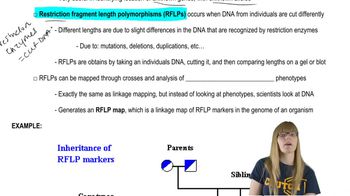
Single Nucleotide Polymorphisms (SNPs) are variations at a single position in a DNA sequence among individuals. They are crucial in genetic studies as they can serve as markers for identifying genetic associations with diseases. In this context, the strong association with a SNP marker on chromosome 12 suggests that this region may contain genes influencing the early onset heart disease.
Recommended video:
Guided course
07:11
Mapping with Markers

Lod Score

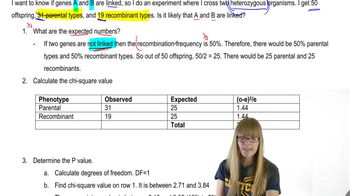
The lod score (logarithm of the odds) is a statistical measure used to evaluate the likelihood of genetic linkage between a trait and a marker. A lod score of 2.2 indicates a significant association, suggesting that the marker is likely linked to the disease-causing gene. This score helps researchers determine whether to pursue further genetic analysis in the identified region.
Recommended video:
Guided course
04:06
Formation of Plant Gametes

Genetic Linkage Analysis

Genetic linkage analysis is a method used to map genes by studying the co-inheritance of traits and genetic markers within families. It helps identify regions of the genome that may harbor genes associated with specific diseases. In this case, the analysis has provided evidence for a potential genetic basis for the heart disease, guiding future research directions.
Recommended video:
Guided course
07:33
Chi Square and Linkage
Related Practice
Textbook Question

A Drosophila experiment examining potential genetic linkage of X-linked genes studies a recessive eye mutant (echinus), a recessive wing-vein mutation (crossveinless), and a recessive bristle mutation (scute). The wild-type phenotypes are dominant. Trihybrid wild-type females (all have the same genotype) are crossed to hemizygous males displaying the three recessive phenotypes. Among the 20,765 progeny produced from these crosses are the phenotypes and numbers listed in the table. Any phenotype not given is wild type.

Compare the recombination frequencies and speculate about the source of any apparent discrepancies in the recombination data.

424
views
Textbook Question

A Drosophila experiment examining potential genetic linkage of X-linked genes studies a recessive eye mutant (echinus), a recessive wing-vein mutation (crossveinless), and a recessive bristle mutation (scute). The wild-type phenotypes are dominant. Trihybrid wild-type females (all have the same genotype) are crossed to hemizygous males displaying the three recessive phenotypes. Among the 20,765 progeny produced from these crosses are the phenotypes and numbers listed in the table. Any phenotype not given is wild type.

Use chi-square analysis to demonstrate that the data in this experiment are not the result of independent assortment.

499
views
Textbook Question

A genetic study of an early onset form of heart disease identifies 10 families containing members with the condition. No clear dominant or recessive pattern of inheritance is evident, but an analysis of SNP markers for five families detects a strong association with a marker on chromosome 12, and genetic linkage analysis for the marker produces a lod score of 2.2.


What do the association and lod score results suggest about this genetic marker?

530
views
Textbook Question

In experiments published in 1918 that sought to verify and expand the genetic linkage and recombination theory proposed by Morgan, Thomas Bregger studied potential genetic linkage in corn (Zea mays) for genes controlling kernel color (colored is dominant to colorless) and starch content (starchy is dominant to waxy). Bregger performed two crosses. In Cross 1, pure-breeding colored, starchy-kernel plants (C1 Wx/C1 Wx) were crossed to plants pure-breeding for colorless, waxy kernels (c1 wx/c1 wx). The F₁ of this cross were test-crossed to colorless, waxy plants. The test-cross progeny were as follows:

In Cross 2, plants pure-breeding for colored, waxy kernels (C1 wx/C1 wx) and colorless, starchy kernels (c1 Wx/c1 Wx) were mated, and their F₁ were test-crossed to colorless, waxy plants. The test-cross progeny were as follows:

For each set of test-cross progeny, determine whether genetic linkage or independent assortment is more strongly supported by the data. Explain the rationale for your answer.

403
views
Textbook Question

In experiments published in 1918 that sought to verify and expand the genetic linkage and recombination theory proposed by Morgan, Thomas Bregger studied potential genetic linkage in corn (Zea mays) for genes controlling kernel color (colored is dominant to colorless) and starch content (starchy is dominant to waxy). Bregger performed two crosses. In Cross 1, pure-breeding colored, starchy-kernel plants (C1 Wx/C1 Wx) were crossed to plants pure-breeding for colorless, waxy kernels (c1 wx/c1 wx). The F₁ of this cross were test-crossed to colorless, waxy plants. The test-cross progeny were as follows:

In Cross 2, plants pure-breeding for colored, waxy kernels (C1 wx/C1 wx) and colorless, starchy kernels (c1 Wx/c1 Wx) were mated, and their F₁ were test-crossed to colorless, waxy plants. The test-cross progeny were as follows:

Calculate the recombination frequency for each of the progeny groups.

422
views
Textbook Question

In experiments published in 1918 that sought to verify and expand the genetic linkage and recombination theory proposed by Morgan, Thomas Bregger studied potential genetic linkage in corn (Zea mays) for genes controlling kernel color (colored is dominant to colorless) and starch content (starchy is dominant to waxy). Bregger performed two crosses. In Cross 1, pure-breeding colored, starchy-kernel plants (C1 Wx/C1 Wx) were crossed to plants pure-breeding for colorless, waxy kernels (c1 wx/c1 wx). The F₁ of this cross were test-crossed to colorless, waxy plants. The test-cross progeny were as follows:

In Cross 2, plants pure-breeding for colored, waxy kernels (C1 wx/C1 wx) and colorless, starchy kernels (c1 Wx/c1 Wx) were mated, and their F₁ were test-crossed to colorless, waxy plants. The test-cross progeny were as follows:

Taken together, are the results of these two experiments compatible with the hypothesis of genetic linkage? Explain why or why not.

471
views