Pearson+ LogoPearson+ Logo
Ch. 5 - Genetic Linkage and Mapping in Eukaryotes
Sanders - Genetic Analysis: An Integrated Approach 3rd Edition
Sanders3rd EditionGenetic Analysis: An Integrated ApproachISBN: 9780135564172Not the one you use?Change textbook
Chapter 5, Problem 32c

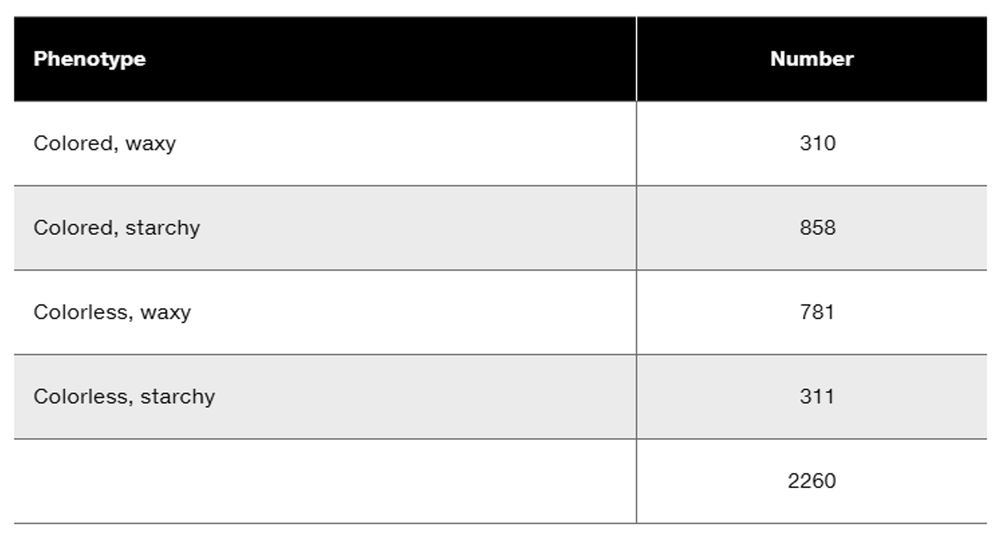
In experiments published in 1918 that sought to verify and expand the genetic linkage and recombination theory proposed by Morgan, Thomas Bregger studied potential genetic linkage in corn (Zea mays) for genes controlling kernel color (colored is dominant to colorless) and starch content (starchy is dominant to waxy). Bregger performed two crosses. In Cross 1, pure-breeding colored, starchy-kernel plants (C1 Wx/C1 Wx) were crossed to plants pure-breeding for colorless, waxy kernels (c1 wx/c1 wx). The F₁ of this cross were test-crossed to colorless, waxy plants. The test-cross progeny were as follows:
Table displaying phenotypes and their corresponding numbers from genetic experiments on corn.
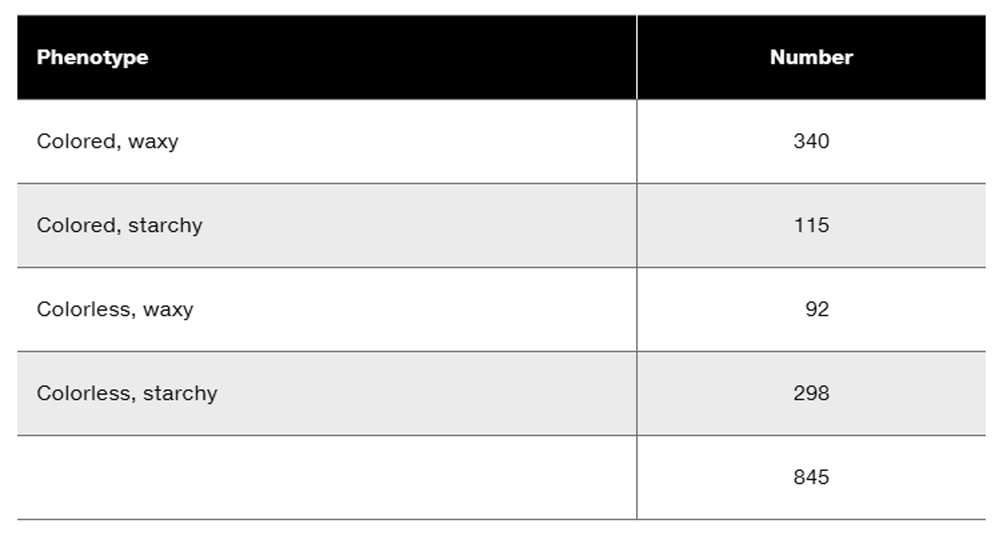
In Cross 2, plants pure-breeding for colored, waxy kernels (C1 wx/C1 wx) and colorless, starchy kernels (c1 Wx/c1 Wx) were mated, and their F₁ were test-crossed to colorless, waxy plants. The test-cross progeny were as follows:
Table displaying phenotypes and their corresponding numbers from genetic experiments on corn.
Taken together, are the results of these two experiments compatible with the hypothesis of genetic linkage? Explain why or why not.

Verified step by step guidance
1
Step 1: Understand the hypothesis of genetic linkage. Genetic linkage occurs when two genes are located close to each other on the same chromosome, and as a result, they tend to be inherited together. This reduces the frequency of recombination between these genes.
Step 2: Analyze the phenotypic ratios in Cross 1. In the test-cross progeny, the phenotypes and their numbers are provided. Identify the parental phenotypes (those with the highest numbers) and the recombinant phenotypes (those with the lowest numbers).
Step 3: Calculate the recombination frequency for Cross 1. Use the formula: \( \text{Recombination Frequency} = \frac{\text{Number of Recombinant Offspring}}{\text{Total Number of Offspring}} \times 100 \). Add the numbers of recombinant phenotypes (colored, waxy and colorless, starchy) and divide by the total offspring, then multiply by 100.
Step 4: Repeat the analysis for Cross 2. Identify the parental and recombinant phenotypes based on their frequencies, and calculate the recombination frequency using the same formula as in Step 3.
Step 5: Compare the recombination frequencies from both crosses. If the recombination frequencies are significantly less than 50%, this supports the hypothesis of genetic linkage. If they are close to or greater than 50%, the genes are likely assorting independently. Use this comparison to determine whether the results are compatible with the hypothesis of genetic linkage.

Verified video answer for a similar problem:

This video solution was recommended by our tutors as helpful for the problem above.
Video duration:
5m
Was this helpful?

Key Concepts

Here are the essential concepts you must grasp in order to answer the question correctly.

Genetic Linkage

Genetic linkage refers to the tendency of genes located close to each other on a chromosome to be inherited together during meiosis. This phenomenon occurs because linked genes are less likely to be separated by recombination events. Understanding genetic linkage is crucial for interpreting the results of breeding experiments, as it can affect the expected ratios of phenotypes in offspring.
Recommended video:
Guided course
07:33
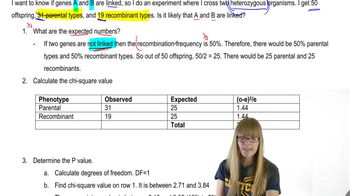
Chi Square and Linkage

Recombination Frequency

Recombination frequency is a measure of how often recombination occurs between two genes during meiosis, expressed as a percentage. It is calculated based on the number of recombinant offspring produced compared to the total number of offspring. A low recombination frequency indicates that the genes are closely linked, while a high frequency suggests they are more distantly located on the chromosome.
Recommended video:
Guided course
03:51
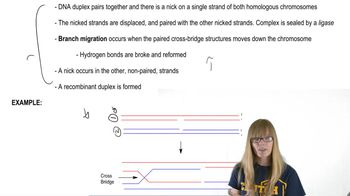
Recombination after Single Strand Breaks

Test Cross

A test cross is a breeding experiment used to determine the genotype of an individual exhibiting a dominant phenotype. This is achieved by crossing the individual with a homozygous recessive individual. The phenotypic ratios of the offspring can reveal whether the dominant individual is homozygous or heterozygous, providing insights into the genetic linkage and inheritance patterns of the traits being studied.
Recommended video:
Guided course
26:08
Trihybrid Cross
Related Practice
Textbook Question

A genetic study of an early onset form of heart disease identifies 10 families containing members with the condition. No clear dominant or recessive pattern of inheritance is evident, but an analysis of SNP markers for five families detects a strong association with a marker on chromosome 12, and genetic linkage analysis for the marker produces a lod score of 2.2.


What next step do you recommend for this genetic analysis?

425
views
Textbook Question

In experiments published in 1918 that sought to verify and expand the genetic linkage and recombination theory proposed by Morgan, Thomas Bregger studied potential genetic linkage in corn (Zea mays) for genes controlling kernel color (colored is dominant to colorless) and starch content (starchy is dominant to waxy). Bregger performed two crosses. In Cross 1, pure-breeding colored, starchy-kernel plants (C1 Wx/C1 Wx) were crossed to plants pure-breeding for colorless, waxy kernels (c1 wx/c1 wx). The F₁ of this cross were test-crossed to colorless, waxy plants. The test-cross progeny were as follows:

In Cross 2, plants pure-breeding for colored, waxy kernels (C1 wx/C1 wx) and colorless, starchy kernels (c1 Wx/c1 Wx) were mated, and their F₁ were test-crossed to colorless, waxy plants. The test-cross progeny were as follows:

For each set of test-cross progeny, determine whether genetic linkage or independent assortment is more strongly supported by the data. Explain the rationale for your answer.

403
views
Textbook Question

In experiments published in 1918 that sought to verify and expand the genetic linkage and recombination theory proposed by Morgan, Thomas Bregger studied potential genetic linkage in corn (Zea mays) for genes controlling kernel color (colored is dominant to colorless) and starch content (starchy is dominant to waxy). Bregger performed two crosses. In Cross 1, pure-breeding colored, starchy-kernel plants (C1 Wx/C1 Wx) were crossed to plants pure-breeding for colorless, waxy kernels (c1 wx/c1 wx). The F₁ of this cross were test-crossed to colorless, waxy plants. The test-cross progeny were as follows:

In Cross 2, plants pure-breeding for colored, waxy kernels (C1 wx/C1 wx) and colorless, starchy kernels (c1 Wx/c1 Wx) were mated, and their F₁ were test-crossed to colorless, waxy plants. The test-cross progeny were as follows:

Calculate the recombination frequency for each of the progeny groups.

422
views
Textbook Question

In experiments published in 1918 that sought to verify and expand the genetic linkage and recombination theory proposed by Morgan, Thomas Bregger studied potential genetic linkage in corn (Zea mays) for genes controlling kernel color (colored is dominant to colorless) and starch content (starchy is dominant to waxy). Bregger performed two crosses. In Cross 1, pure-breeding colored, starchy-kernel plants (C1 Wx/C1 Wx) were crossed to plants pure-breeding for colorless, waxy kernels (c1 wx/c1 wx). The F₁ of this cross were test-crossed to colorless, waxy plants. The test-cross progeny were as follows:

In Cross 2, plants pure-breeding for colored, waxy kernels (C1 wx/C1 wx) and colorless, starchy kernels (c1 Wx/c1 Wx) were mated, and their F₁ were test-crossed to colorless, waxy plants. The test-cross progeny were as follows:

Merge the two sets of progeny data and determine the combined recombination frequency.

529
views
Textbook Question

DNA sequences for 10 individuals are

Identify the nucleotide positions of all SNPs (single nucleotide polymorphisms).

471
views
Textbook Question

DNA sequences for 10 individuals are

How many different SNP haplotypes are represented in the data?

464
views