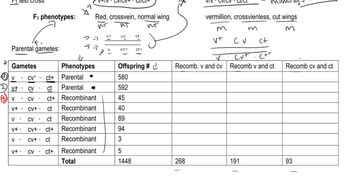
T. H. Morgan's data on eye color and wing form genetic linkage between the two genes. Test the genetic linkage (shown in the figure below) data with chi-square analysis, and show that the results are significantly different from the expectation under the assumption of independent assortment.

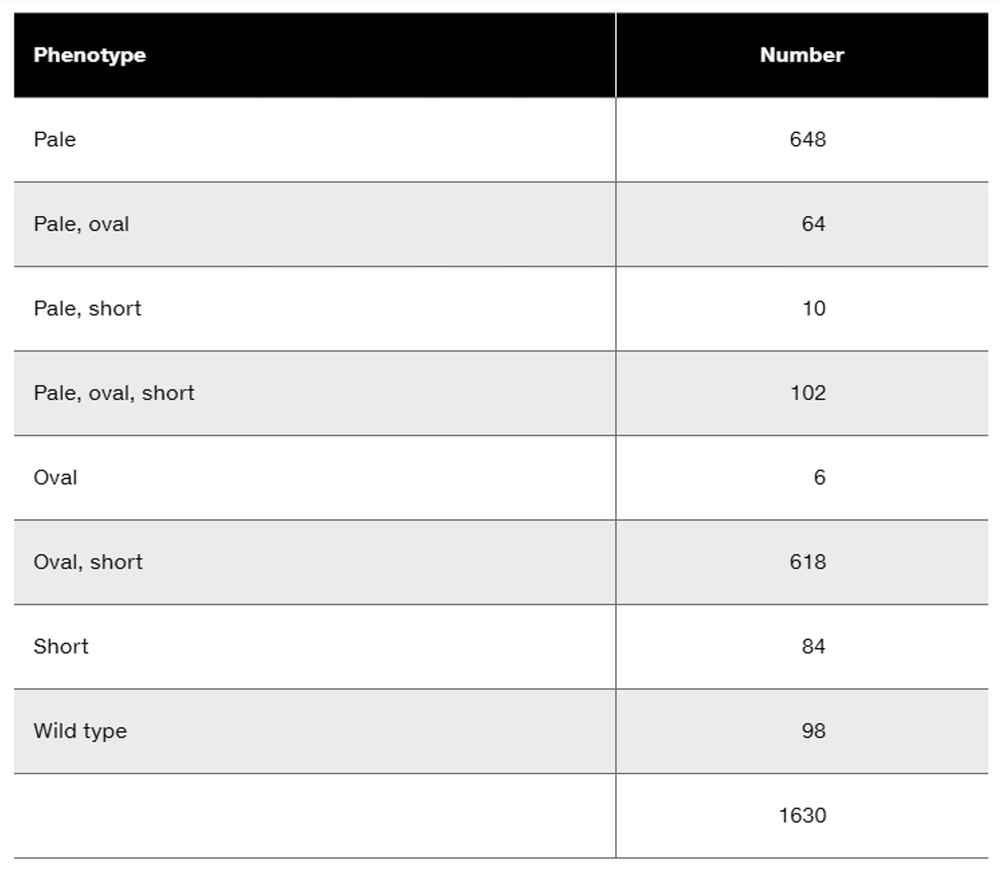
A wild-type trihybrid soybean plant is crossed to a pure-breeding soybean plant with the recessive phenotypes pale leaf (l), oval seed (r), and short height (t). The results of the three-point test cross are shown below. Traits not listed are wild type.

Calculate the interference value for these data.
Verified step by step guidance
Verified video answer for a similar problem:
Key Concepts
Trihybrid Cross
Three-Point Test Cross
Genetic Interference
A wild-type trihybrid soybean plant is crossed to a pure-breeding soybean plant with the recessive phenotypes pale leaf (l), oval seed (r), and short height (t). The results of the three-point test cross are shown below. Traits not listed are wild type.
What are the alleles on each homologous chromosome of the parental wild-type trihybrid soybean plant? Place the alleles in their correct gene order. Use L, R, and T to represent dominant alleles and l, r, and t for recessive alleles.
A wild-type trihybrid soybean plant is crossed to a pure-breeding soybean plant with the recessive phenotypes pale leaf (l), oval seed (r), and short height (t). The results of the three-point test cross are shown below. Traits not listed are wild type.
Calculate the recombination frequencies between the adjacent genes.
The boss in your laboratory has just heard of a proposal by another laboratory that genes for eye color and the length of body bristles may be linked in Drosophila. Your lab has numerous pure-breeding stocks of Drosophila that could be used to verify or refute genetic linkage. In Drosophila, red eyes (c⁺) are dominant to brown eyes (c) and long bristles (d⁺) are dominant to short bristles (d). Your lab boss asks you to design an experiment to test the genetic linkage of eye color and bristle-length genes, and to begin by crossing a pure-breeding line homozygous for red eyes and short bristles to a pure-breeding line that has brown eyes and long bristles.
Give the genotypes of the pure-breeding parental flies and the genotype(s) and phenotype(s) of the F₁ progeny they produce.
The boss in your laboratory has just heard of a proposal by another laboratory that genes for eye color and the length of body bristles may be linked in Drosophila. Your lab has numerous pure-breeding stocks of Drosophila that could be used to verify or refute genetic linkage. In Drosophila, red eyes (c⁺) are dominant to brown eyes (c) and long bristles (d⁺) are dominant to short bristles (d). Your lab boss asks you to design an experiment to test the genetic linkage of eye color and bristle-length genes, and to begin by crossing a pure-breeding line homozygous for red eyes and short bristles to a pure-breeding line that has brown eyes and long bristles.
In your experimental design, what are the genotype and phenotype of the line you propose to cross to the F₁ to obtain the most useful information about genetic linkage between the eye color and bristle-length genes? Explain why you make this choice.
The boss in your laboratory has just heard of a proposal by another laboratory that genes for eye color and the length of body bristles may be linked in Drosophila. Your lab has numerous pure-breeding stocks of Drosophila that could be used to verify or refute genetic linkage. In Drosophila, red eyes (c⁺) are dominant to brown eyes (c) and long bristles (d⁺) are dominant to short bristles (d). Your lab boss asks you to design an experiment to test the genetic linkage of eye color and bristle-length genes, and to begin by crossing a pure-breeding line homozygous for red eyes and short bristles to a pure-breeding line that has brown eyes and long bristles.
Assume the eye color and bristle-length genes are separated by 28 m.u. What are the approximate frequencies of phenotypes expected from the cross you proposed in part (b)?
