Pearson+ LogoPearson+ Logo
Ch. 5 - Genetic Linkage and Mapping in Eukaryotes
Sanders - Genetic Analysis: An Integrated Approach 3rd Edition
Sanders3rd EditionGenetic Analysis: An Integrated ApproachISBN: 9780135564172Not the one you use?Change textbook
Chapter 5, Problem 34a

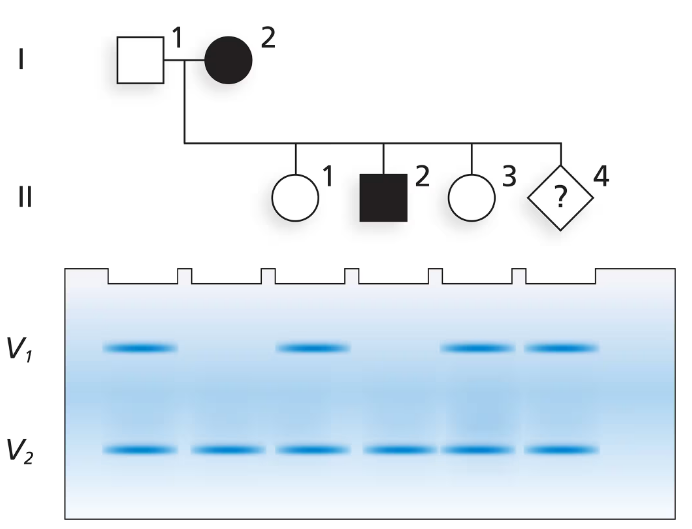
The accompanying pedigree below shows a family in which an autosomal recessive disorder is present. Family members I-2 and II-2 are affected by the disorder and have the genotype dd. A pregnancy involving II-4 has just undergone genetic testing for a VNTR that is linked to the disease gene. The VNTR has a recombination frequency of r = 20 with the disease gene. The VNTR has two alleles, V1 and V2. The gel electrophoresis patterns for each family member are shown, including the VNTR genotype for II-4. Based on the information given, answer the following questions about the family.

Excluding II-4, what is the genotype of each family member for the disease gene?

Verified step by step guidance
1
Step 1: Understand the inheritance pattern of the disorder. Since the disorder is autosomal recessive, individuals must inherit two copies of the recessive allele (dd) to be affected. Carriers will have one dominant allele (D) and one recessive allele (d), while unaffected individuals will have two dominant alleles (DD).
Step 2: Analyze the pedigree and identify the affected individuals. From the problem, I-2 and II-2 are affected, meaning their genotype is dd. This information helps us deduce the genotypes of other family members.
Step 3: Use the gel electrophoresis patterns and VNTR data to determine the linkage between the VNTR alleles (V₁ and V₂) and the disease gene. Since the recombination frequency is r = 20%, this indicates that the VNTR is linked to the disease gene but not perfectly. This linkage can help infer the inheritance of the disease gene alleles.
Step 4: Deduce the genotypes of the parents (I-1 and I-2). Since I-2 is affected (dd), both of her alleles are recessive. I-1 must be a carrier (Dd) because their offspring (II-1, II-2, II-3, and II-4) include both affected and unaffected individuals.
Step 5: Determine the genotypes of the offspring (II-1, II-3, and II-4). II-2 is affected (dd), so both parents contributed a recessive allele. For II-1 and II-3, they are unaffected, meaning they must have at least one dominant allele (D). Based on the inheritance pattern and VNTR linkage, their genotypes are likely Dd (carriers). II-4's genotype can be inferred using the VNTR data and recombination frequency, but this step focuses on excluding II-4.

Verified video answer for a similar problem:

This video solution was recommended by our tutors as helpful for the problem above.
Video duration:
1m
Was this helpful?

Key Concepts

Here are the essential concepts you must grasp in order to answer the question correctly.

Autosomal Recessive Inheritance

Autosomal recessive inheritance occurs when a trait or disorder is expressed only when an individual has two copies of the recessive allele (e.g., 'dd'). In this case, individuals with the genotype 'Dd' are carriers and do not show symptoms, while those with 'dd' are affected. Understanding this inheritance pattern is crucial for determining the genotypes of family members based on their phenotypes.
Recommended video:
Guided course
09:08
Autosomal Pedigrees

VNTR (Variable Number Tandem Repeat)

VNTRs are repeating sequences of DNA that vary in number among individuals. They can be used as genetic markers in linkage analysis to study inheritance patterns. In this scenario, the VNTR's recombination frequency with the disease gene helps assess the likelihood of inheritance of the disease allele, which is essential for predicting the genotypes of family members.
Recommended video:

Gel Electrophoresis

Gel electrophoresis is a laboratory technique used to separate DNA fragments based on their size. In the context of this question, it allows visualization of the VNTR alleles (V₁ and V₂) in family members. By analyzing the gel patterns, one can infer the genotypes of individuals, which is critical for determining the inheritance of the autosomal recessive disorder in the family.
Recommended video:
Related Practice
Textbook Question

DNA sequences for 10 individuals are

How many different SNP haplotypes are represented in the data?

464
views
Textbook Question

DNA sequences for 10 individuals are

What is the sequence of each haplotype?

509
views
Textbook Question

DNA sequences for 10 individuals are

Identify the haplotype carried by each person.

500
views
Textbook Question

The accompanying pedigree below shows a family in which an autosomal recessive disorder is present. Family members I-2 and II-2 are affected by the disorder and have the genotype dd. A pregnancy involving II-4 has just undergone genetic testing for a VNTR that is linked to the disease gene. The VNTR has a recombination frequency of r = 20 with the disease gene. The VNTR has two alleles, V1 and V2. The gel electrophoresis patterns for each family member are shown, including the VNTR genotype for II-4. Based on the information given, answer the following questions about the family.

What is the genotype of each family member, including II-4, for the VNTR?

624
views
Textbook Question

The accompanying pedigree below shows a family in which an autosomal recessive disorder is present. Family members I-2 and II-2 are affected by the disorder and have the genotype dd. A pregnancy involving II-4 has just undergone genetic testing for a VNTR that is linked to the disease gene. The VNTR has a recombination frequency of r = 20 with the disease gene. The VNTR has two alleles, V1 and V2. The gel electrophoresis patterns for each family member are shown, including the VNTR genotype for II-4. Based on the information given, answer the following questions about the family.

What are the syntenic disease gene and VNTR alleles in I-1 and I-2?

654
views
Textbook Question

The accompanying pedigree below shows a family in which an autosomal recessive disorder is present. Family members I-2 and II-2 are affected by the disorder and have the genotype dd. A pregnancy involving II-4 has just undergone genetic testing for a VNTR that is linked to the disease gene. The VNTR has a recombination frequency of r = 20 with the disease gene. The VNTR has two alleles, V1 and V2. The gel electrophoresis patterns for each family member are shown, including the VNTR genotype for II-4. Based on the information given, answer the following questions about the family.

What is the chance II-4 has the disease?

515
views