
Textbook Question
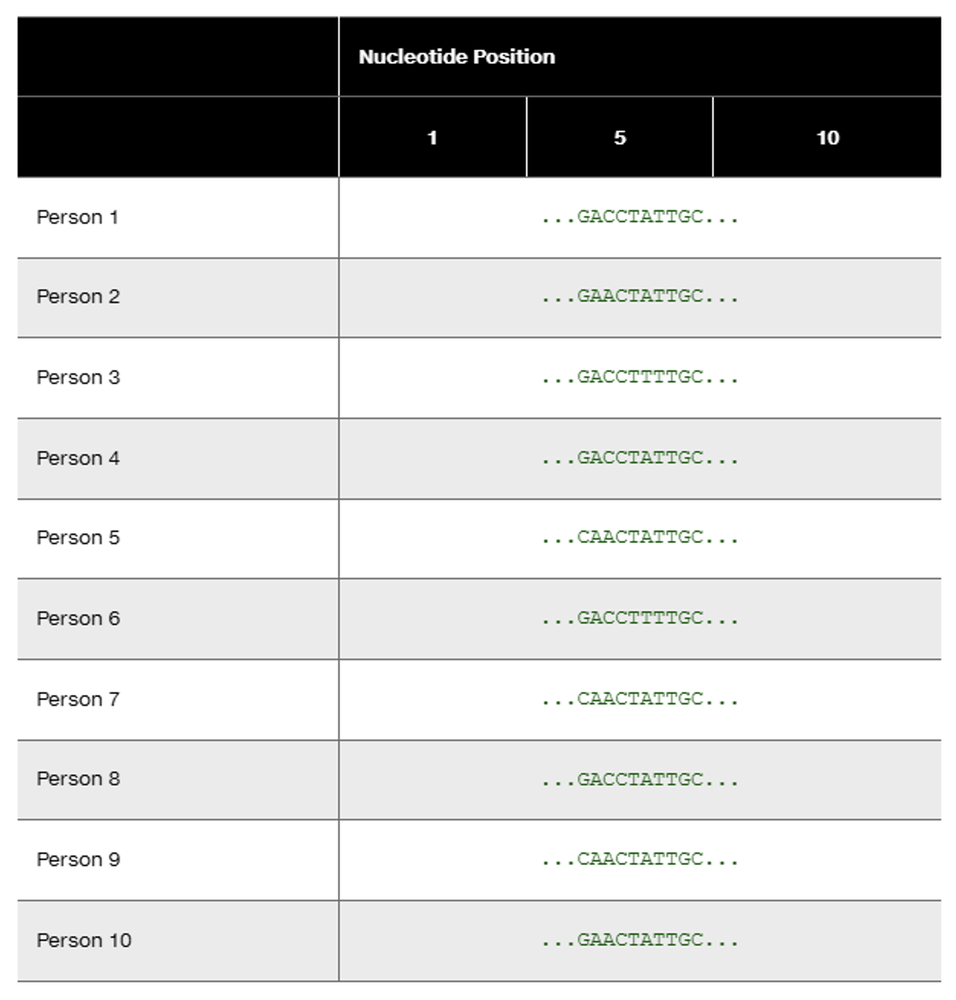
DNA sequences for 10 individuals are
Identify the haplotype carried by each person.
500
views

 Verified step by step guidance
 03:51
03:51
 09:28
09:28DNA sequences for 10 individuals are
Identify the haplotype carried by each person.
In experiments published in 1918 that sought to verify and expand the genetic linkage and recombination theory proposed by Morgan, Thomas Bregger studied potential genetic linkage in corn (Zea mays) for genes controlling kernel color (colored is dominant to colorless) and starch content (starchy is dominant to waxy). Bregger performed two crosses. In Cross 1, pure-breeding colored, starchy-kernel plants (C1 Wx/C1 Wx) were crossed to plants pure-breeding for colorless, waxy kernels (c1 wx/c1 wx). The F₁ of this cross were test-crossed to colorless, waxy plants. The test-cross progeny were as follows:
In Cross 2, plants pure-breeding for colored, waxy kernels (C1 wx/C1 wx) and colorless, starchy kernels (c1 Wx/c1 Wx) were mated, and their F₁ were test-crossed to colorless, waxy plants. The test-cross progeny were as follows:
Merge the two sets of progeny data and determine the combined recombination frequency.
The accompanying pedigree below shows a family in which an autosomal recessive disorder is present. Family members I-2 and II-2 are affected by the disorder and have the genotype dd. A pregnancy involving II-4 has just undergone genetic testing for a VNTR that is linked to the disease gene. The VNTR has a recombination frequency of r = 20 with the disease gene. The VNTR has two alleles, V1 and V2. The gel electrophoresis patterns for each family member are shown, including the VNTR genotype for II-4. Based on the information given, answer the following questions about the family.
Excluding II-4, what is the genotype of each family member for the disease gene?
DNA sequences for 10 individuals are
What is the sequence of each haplotype?
In experiments published in 1918 that sought to verify and expand the genetic linkage and recombination theory proposed by Morgan, Thomas Bregger studied potential genetic linkage in corn (Zea mays) for genes controlling kernel color (colored is dominant to colorless) and starch content (starchy is dominant to waxy). Bregger performed two crosses. In Cross 1, pure-breeding colored, starchy-kernel plants (C1 Wx/C1 Wx) were crossed to plants pure-breeding for colorless, waxy kernels (c1 wx/c1 wx). The F₁ of this cross were test-crossed to colorless, waxy plants. The test-cross progeny were as follows:
In Cross 2, plants pure-breeding for colored, waxy kernels (C1 wx/C1 wx) and colorless, starchy kernels (c1 Wx/c1 Wx) were mated, and their F₁ were test-crossed to colorless, waxy plants. The test-cross progeny were as follows:
Taken together, are the results of these two experiments compatible with the hypothesis of genetic linkage? Explain why or why not.
DNA sequences for 10 individuals are
Identify the nucleotide positions of all SNPs (single nucleotide polymorphisms).