Pearson+ LogoPearson+ Logo
Ch. 7 - DNA Structure and Replication
Sanders - Genetic Analysis: An Integrated Approach 3rd Edition
Sanders3rd EditionGenetic Analysis: An Integrated ApproachISBN: 9780135564172Not the one you use?Change textbook
Chapter 7, Problem 33a

What would be the effects on DNA replication if mutation of DNA pol III caused it to lose each of the following activities?
5' to 3' polymerase activity

Verified step by step guidance
1
Understand the role of DNA polymerase III in DNA replication: DNA polymerase III is the primary enzyme responsible for synthesizing new DNA strands by adding nucleotides in the 5' to 3' direction during replication.
Recognize the importance of 5' to 3' polymerase activity: This activity allows DNA pol III to add nucleotides to the growing DNA strand by forming phosphodiester bonds between the 3' hydroxyl group of the last nucleotide and the 5' phosphate group of the incoming nucleotide.
Consider the consequences of losing 5' to 3' polymerase activity: Without this activity, DNA pol III would be unable to synthesize new DNA strands, effectively halting the elongation process during replication.
Analyze the broader impact on DNA replication: The inability to synthesize new DNA strands would prevent the replication fork from progressing, leading to incomplete replication of the genome and potentially causing cell cycle arrest or cell death.
Conclude the significance of this mutation: The loss of 5' to 3' polymerase activity in DNA pol III would be a critical defect, as it would disrupt the fundamental process of DNA replication, which is essential for cell division and genetic inheritance.

Verified video answer for a similar problem:

This video solution was recommended by our tutors as helpful for the problem above.
Video duration:
2m
Was this helpful?

Key Concepts

Here are the essential concepts you must grasp in order to answer the question correctly.

DNA Polymerase III Function

DNA Polymerase III is the primary enzyme responsible for DNA synthesis during replication in prokaryotes. It adds nucleotides to the growing DNA strand in a 5' to 3' direction, ensuring accurate and efficient replication of the genetic material. Understanding its role is crucial for analyzing the consequences of any mutations affecting its activity.
Recommended video:
Guided course
08:26
Functional Genomics

5' to 3' Directionality

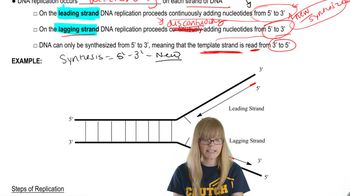
DNA replication occurs in a specific direction, with new nucleotides being added to the 3' end of the growing strand, which means the template strand is read in the 3' to 5' direction. This directionality is essential for the proper synthesis of the leading and lagging strands, and any loss of 5' to 3' polymerase activity would disrupt this process, leading to incomplete or erroneous DNA strands.
Recommended video:
Guided course
05:02
Directionality

Consequences of Mutations

Mutations in essential enzymes like DNA Polymerase III can lead to severe consequences for cellular function. If the 5' to 3' polymerase activity is lost, DNA replication would be halted, resulting in cell cycle arrest, genomic instability, and potentially cell death. Understanding these consequences helps in grasping the importance of enzyme activities in maintaining genetic integrity.
Recommended video:
Guided course
10:48
Mutations and Phenotypes
Related Practice
Textbook Question

Using an illustration style and labeling, draw the electrophoresis gel containing dideoxy sequencing fragments for the DNA template strand 3'-AGACGATAGCAT-5'.

479
views
Textbook Question

A PCR reaction begins with one double-stranded segment of DNA. How many double-stranded copies of DNA are present after the completion of 10 amplification cycles? After 20 cycles? After 30 cycles?

563
views
Textbook Question

DNA replication in early Drosophila embryos occurs about every 5 minutes. The Drosophila genome contains approximately 1.8×10⁸ base pairs. Eukaryotic DNA polymerases synthesize DNA at a rate of approximately 40 nucleotides per second. Approximately how many origins of replication are required for this rate of replication?

739
views
Textbook Question

What would be the effects on DNA replication if mutation of DNA pol III caused it to lose each of the following activities?

3′ to 5′ exonuclease activity

478
views
Textbook Question

A sufficient amount of a small DNA fragment is available for dideoxy sequencing. The fragment to be sequenced contains 20 nucleotides following the site of primer binding: 5'-ATCGCTCGACAGTGACTAGC-[primer site]-3' Dideoxy sequencing is carried out, and the products of the four sequencing reactions are separated by gel electrophoresis. Draw the bands you expect will appear on the gel from each of the sequencing reactions.

548
views
Textbook Question

You are participating in a study group preparing for an upcoming genetics exam, and one member of the group proposes that each of you draw the structure of two DNA nucleotides joined in a single strand. The figures are drawn and exchanged for correction. You receive the accompanying diagram to correct: Identify and correct at least five things that are wrong in the depiction of each nucleotide.

391
views