Pearson+ LogoPearson+ Logo
Ch. 7 - DNA Structure and Replication
Sanders - Genetic Analysis: An Integrated Approach 3rd Edition
Sanders3rd EditionGenetic Analysis: An Integrated ApproachISBN: 9780135564172Not the one you use?Change textbook
Chapter 7, Problem 8b

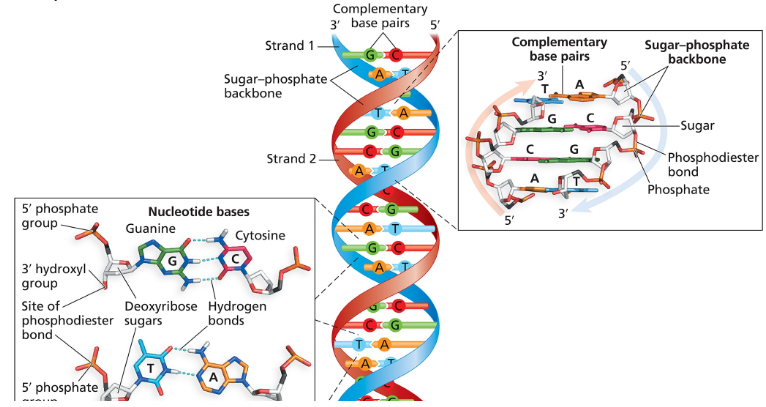
The following figure (Figure 1.6) presents simplified depictions of nucleotides containing deoxyribose, a nucleotide base, and a phosphate group. Use this simplified method of representation to illustrate the sequence 3'-AGTCGAT-5' and its complementary partner in a DNA duplex.

What kind of bonds join the C in one strand to the G in the complementary strand?

Verified step by step guidance
1
Understand the structure of DNA: DNA is a double-stranded molecule where each strand is composed of nucleotides. Each nucleotide consists of three components: a deoxyribose sugar, a phosphate group, and a nitrogenous base (A, T, G, or C). The strands are antiparallel, meaning one runs 3' to 5' and the other runs 5' to 3'.
Illustrate the given sequence: Write the sequence 3'-AGTCGAT-5' as a single strand. Label the 3' and 5' ends to indicate the directionality of the strand.
Determine the complementary strand: Use base-pairing rules to find the complementary sequence. Adenine (A) pairs with Thymine (T), and Guanine (G) pairs with Cytosine (C). Write the complementary strand in the opposite direction (5' to 3').
Identify the bonds between complementary bases: The bases in the two strands are joined by hydrogen bonds. Specifically, Cytosine (C) and Guanine (G) are connected by three hydrogen bonds, while Adenine (A) and Thymine (T) are connected by two hydrogen bonds.
Illustrate the DNA duplex: Draw the two strands of DNA with their complementary base pairs connected by hydrogen bonds. Ensure the antiparallel orientation is clear, with one strand running 3' to 5' and the other running 5' to 3'.

Verified video answer for a similar problem:

This video solution was recommended by our tutors as helpful for the problem above.
Video duration:
1m
Was this helpful?

Key Concepts

Here are the essential concepts you must grasp in order to answer the question correctly.

Nucleotides

Nucleotides are the building blocks of DNA and RNA, consisting of three components: a sugar (deoxyribose in DNA), a phosphate group, and a nitrogenous base. The sequence of these bases encodes genetic information. In the context of the question, understanding the structure of nucleotides is essential for illustrating the DNA sequence and its complementary strand.
Recommended video:
Guided course
06:25
DNA Structure

Complementary Base Pairing

Complementary base pairing refers to the specific pairing of nitrogenous bases in DNA, where adenine (A) pairs with thymine (T), and cytosine (C) pairs with guanine (G). This pairing is crucial for the formation of the double helix structure of DNA and ensures accurate replication and transcription of genetic information. The question requires knowledge of this concept to identify the complementary partner of the given sequence.
Recommended video:
Guided course
03:49
Base Distortions

Hydrogen Bonds

Hydrogen bonds are weak interactions that occur between the nitrogenous bases of the two DNA strands, specifically between adenine and thymine (two hydrogen bonds) and between cytosine and guanine (three hydrogen bonds). These bonds are essential for stabilizing the DNA double helix structure. The question specifically asks about the bonds joining C and G, highlighting the importance of understanding these interactions in DNA structure.
Recommended video:
Guided course
06:25
DNA Structure
Related Practice
Textbook Question

The principles of complementary base pairing and antiparallel polarity of nucleic acid strands in a duplex are universal for the formation of nucleic acid duplexes. What is the chemical basis for this universality?

625
views
Textbook Question

For the following fragment of DNA, determine the number of hydrogen bonds and the number of phosphodiester bonds present:

5'-ACGTAGAGTGCTC-3'

3'-TGCATCTCACGAG-5'

882
views
Textbook Question

The following figure (Figure 1.6) presents simplified depictions of nucleotides containing deoxyribose, a nucleotide base, and a phosphate group. Use this simplified method of representation to illustrate the sequence 3'-AGTCGAT-5' and its complementary partner in a DNA duplex.

What kind of bond joins the C to G within a single strand?

434
views
Textbook Question

The following figure (Figure 1.6) presents simplified depictions of nucleotides containing deoxyribose, a nucleotide base, and a phosphate group. Use this simplified method of representation to illustrate the sequence 3'-AGTCGAT-5' and its complementary partner in a DNA duplex.

How many phosphodiester bonds are present in this DNA duplex?

425
views
Textbook Question

The following figure (Figure 1.6) presents simplified depictions of nucleotides containing deoxyribose, a nucleotide base, and a phosphate group. Use this simplified method of representation to illustrate the sequence 3'-AGTCGAT-5' and its complementary partner in a DNA duplex.

How many hydrogen bonds are present in this DNA duplex?

525
views
Textbook Question

Consider the sequence 3'-ACGCTACGTC-5'.

What is the double-stranded sequence?

661
views