Pearson+ LogoPearson+ Logo
Ch. 7 - DNA Structure and Replication
Sanders - Genetic Analysis: An Integrated Approach 3rd Edition
Sanders3rd EditionGenetic Analysis: An Integrated ApproachISBN: 9780135564172Not the one you use?Change textbook
Chapter 7, Problem 8c

The following figure (Figure 1.6) presents simplified depictions of nucleotides containing deoxyribose, a nucleotide base, and a phosphate group. Use this simplified method of representation to illustrate the sequence 3'-AGTCGAT-5' and its complementary partner in a DNA duplex.

How many phosphodiester bonds are present in this DNA duplex?

Verified step by step guidance
1
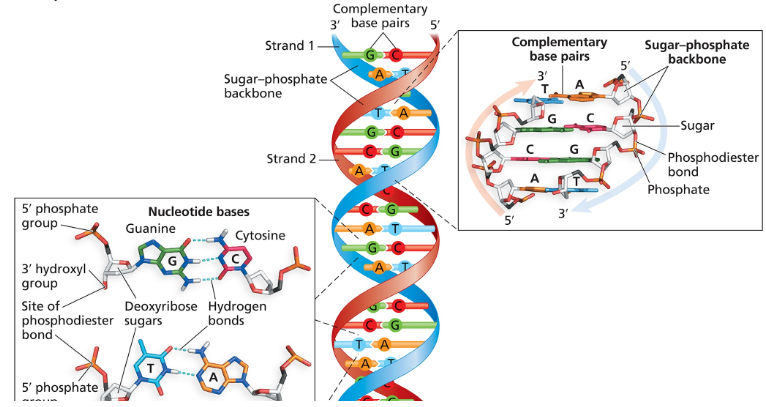
Start by understanding the structure of a DNA nucleotide. Each nucleotide consists of three components: a deoxyribose sugar, a phosphate group, and a nitrogenous base (adenine, guanine, cytosine, or thymine).
Illustrate the given sequence 3'-AGTCGAT-5' by arranging the nucleotides in the correct order. Remember that the 3' and 5' ends refer to the carbon positions in the sugar molecule where the phosphate group is attached.
Determine the complementary sequence for the given strand. Use the base-pairing rules: adenine (A) pairs with thymine (T), and guanine (G) pairs with cytosine (C). The complementary strand will run in the opposite direction (5'-3').
Count the number of phosphodiester bonds in each strand. A phosphodiester bond connects the 3' carbon of one nucleotide's sugar to the 5' carbon of the next nucleotide's sugar via a phosphate group. For a strand with 'n' nucleotides, there are (n-1) phosphodiester bonds.
Since the DNA duplex consists of two strands, calculate the total number of phosphodiester bonds by summing the bonds in both strands. Ensure you account for the complementary strand's length, which matches the original strand.

Verified video answer for a similar problem:

This video solution was recommended by our tutors as helpful for the problem above.
Video duration:
1m
Was this helpful?

Key Concepts

Here are the essential concepts you must grasp in order to answer the question correctly.

Nucleotides

Nucleotides are the building blocks of DNA and RNA, consisting of three components: a sugar (deoxyribose in DNA), a phosphate group, and a nitrogenous base. In DNA, the sequence of these nucleotides encodes genetic information. Understanding the structure of nucleotides is essential for analyzing DNA sequences and their complementary pairs.
Recommended video:
Guided course
06:25
DNA Structure

Complementary Base Pairing

Complementary base pairing refers to the specific pairing of nitrogenous bases in DNA, where adenine (A) pairs with thymine (T) and cytosine (C) pairs with guanine (G). This pairing is crucial for the formation of the double helix structure of DNA and ensures accurate replication and transcription of genetic information. Recognizing these pairs is vital for determining the complementary sequence of a given DNA strand.
Recommended video:
Guided course
03:49
Base Distortions

Phosphodiester Bonds

Phosphodiester bonds are covalent bonds that link nucleotides together in a DNA or RNA strand. They form between the phosphate group of one nucleotide and the hydroxyl group of the sugar of another, creating a sugar-phosphate backbone. The number of phosphodiester bonds in a DNA duplex can be calculated by counting the number of nucleotides in the strand and subtracting one, as each bond connects two nucleotides.
Recommended video:
Guided course
06:25
DNA Structure
Related Practice
Textbook Question

For the following fragment of DNA, determine the number of hydrogen bonds and the number of phosphodiester bonds present:

5'-ACGTAGAGTGCTC-3'

3'-TGCATCTCACGAG-5'

882
views
Textbook Question

The following figure (Figure 1.6) presents simplified depictions of nucleotides containing deoxyribose, a nucleotide base, and a phosphate group. Use this simplified method of representation to illustrate the sequence 3'-AGTCGAT-5' and its complementary partner in a DNA duplex.

What kind of bond joins the C to G within a single strand?

434
views
Textbook Question

The following figure (Figure 1.6) presents simplified depictions of nucleotides containing deoxyribose, a nucleotide base, and a phosphate group. Use this simplified method of representation to illustrate the sequence 3'-AGTCGAT-5' and its complementary partner in a DNA duplex.

What kind of bonds join the C in one strand to the G in the complementary strand?

487
views
Textbook Question

The following figure (Figure 1.6) presents simplified depictions of nucleotides containing deoxyribose, a nucleotide base, and a phosphate group. Use this simplified method of representation to illustrate the sequence 3'-AGTCGAT-5' and its complementary partner in a DNA duplex.

How many hydrogen bonds are present in this DNA duplex?

525
views
Textbook Question

Consider the sequence 3'-ACGCTACGTC-5'.

What is the double-stranded sequence?

661
views
Textbook Question

Consider the sequence 3'-ACGCTACGTC-5'.

What is the total number of covalent bonds joining the nucleotides in each strand?

942
views