Pearson+ LogoPearson+ Logo
Ch. 8 - Molecular Biology of Transcription and RNA Processing
Sanders - Genetic Analysis: An Integrated Approach 3rd Edition
Sanders3rd EditionGenetic Analysis: An Integrated ApproachISBN: 9780135564172Not the one you use?Change textbook
Chapter 8, Problem 6

Compare and contrast the properties of DNA polymerase and RNA polymerase, listing at least three similarities and at least three differences between the molecules.

Verified step by step guidance
1
Identify the role of DNA polymerase: DNA polymerase is an enzyme responsible for synthesizing DNA molecules from deoxyribonucleotides, the building blocks of DNA. It plays a crucial role in DNA replication.
Identify the role of RNA polymerase: RNA polymerase is an enzyme that synthesizes RNA from a DNA template during transcription. It is essential for the process of gene expression.
List similarities: Both DNA polymerase and RNA polymerase are enzymes that synthesize nucleic acids, require a template strand to guide synthesis, and add nucleotides in a 5' to 3' direction.
List differences: DNA polymerase requires a primer to initiate synthesis, while RNA polymerase does not. DNA polymerase synthesizes DNA, whereas RNA polymerase synthesizes RNA. DNA polymerase has proofreading activity to correct errors, while RNA polymerase generally lacks this ability.
Summarize the comparison: Both enzymes are crucial for genetic information processing, but they operate in different contexts (replication vs. transcription) and have distinct requirements and functions.

Verified video answer for a similar problem:

This video solution was recommended by our tutors as helpful for the problem above.
Video duration:
3m
Was this helpful?

Key Concepts

Here are the essential concepts you must grasp in order to answer the question correctly.

DNA Polymerase

DNA polymerase is an enzyme responsible for synthesizing DNA molecules from deoxyribonucleotides, the building blocks of DNA. It plays a crucial role in DNA replication, ensuring that genetic information is accurately copied during cell division. DNA polymerase requires a primer to initiate synthesis and can only add nucleotides in a 5' to 3' direction.
Recommended video:
Guided course
01:45
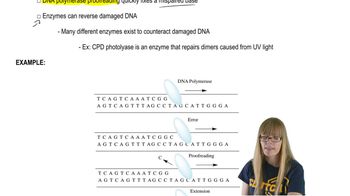
DNA Proofreading

RNA Polymerase

RNA polymerase is an enzyme that synthesizes RNA from a DNA template during the process of transcription. Unlike DNA polymerase, RNA polymerase does not require a primer to start synthesis and can initiate RNA synthesis at specific promoter regions on the DNA. It also synthesizes RNA in a 5' to 3' direction but produces single-stranded RNA molecules.
Recommended video:

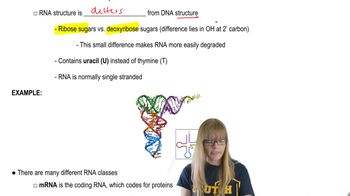
Similarities and Differences

Both DNA and RNA polymerases are essential enzymes in nucleic acid synthesis, sharing similarities such as directionality of synthesis (5' to 3') and the requirement for a template strand. However, they differ in their substrates (deoxyribonucleotides for DNA polymerase and ribonucleotides for RNA polymerase), their roles in the cell (replication vs. transcription), and their initiation mechanisms (requirement of a primer for DNA polymerase vs. no primer for RNA polymerase).
Recommended video:
Guided course
01:49
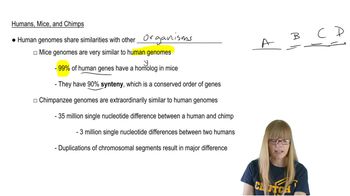
Humans, Mice, and Chimps
Related Practice
Textbook Question

The following is a portion of an mRNA sequence:

3'-AUCGUCAUGCAGA-5'

During transcription, was the adenine at the left-hand side of the sequence the first or the last nucleotide used to build the portion of mRNA shown? Explain how you know.

456
views
Textbook Question

The following is a portion of an mRNA sequence:

3'-AUCGUCAUGCAGA-5'

Write out the sequence and polarity of the DNA duplex that encodes this mRNA segment. Label the template and coding DNA strands.

471
views
Textbook Question

The following is a portion of an mRNA sequence:

3'-AUCGUCAUGCAGA-5'

Identify the direction in which the promoter region for this gene will be located.

490
views
Textbook Question

The DNA sequences shown below are from the promoter regions of six bacterial genes. In each case, the last nucleotide in the sequence (highlighted in blue) is the nucleotide that initiates transcription. Examine these sequences and identify the Pribnow box sequence at approximately -10 for each promoter.

665
views
Textbook Question

The DNA sequences shown below are from the promoter regions of six bacterial genes. In each case, the last nucleotide in the sequence (highlighted in blue) is the nucleotide that initiates transcription. Determine the consensus sequence for the Pribnow box from these sequences.

646
views
Textbook Question

Bacterial and eukaryotic gene transcripts can differ—in the transcripts themselves, in whether the transcripts are modified before translation, and in how the transcripts are modified. For each of these three areas of contrast, describe what the differences are and why the differences exist.

514
views