Textbook Question
The following is a portion of an mRNA sequence:
3'-AUCGUCAUGCAGA-5'
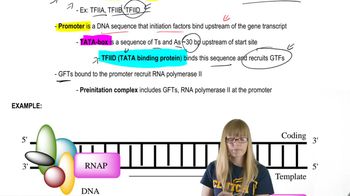
Identify the direction in which the promoter region for this gene will be located.
491
views

 Sanders 3rd EditionCh. 8 - Molecular Biology of Transcription and RNA ProcessingProblem 5b
 Verified step by step guidance
 09:16
09:16
 03:03
03:03 03:49
03:49The following is a portion of an mRNA sequence:
3'-AUCGUCAUGCAGA-5'
Identify the direction in which the promoter region for this gene will be located.
Compare and contrast the properties of DNA polymerase and RNA polymerase, listing at least three similarities and at least three differences between the molecules.
The following is a portion of an mRNA sequence:
3'-AUCGUCAUGCAGA-5'
During transcription, was the adenine at the left-hand side of the sequence the first or the last nucleotide used to build the portion of mRNA shown? Explain how you know.
The diagram below shows a DNA duplex. The template strand is identified, as is the location of the nucleotide.
If this region is a eukaryotic gene transcribed by RNA polymerase III, where are the promoter consensus sequences located?
The diagram below shows a DNA duplex. The template strand is identified, as is the location of the nucleotide. consensus sequences.
Assume this region contains a gene transcribed to form mRNA in a eukaryote. Identify the location of the most common promoter.
The DNA sequences shown below are from the promoter regions of six bacterial genes. In each case, the last nucleotide in the sequence (highlighted in blue) is the nucleotide that initiates transcription. Examine these sequences and identify the Pribnow box sequence at approximately -10 for each promoter.