Pearson+ LogoPearson+ Logo
Ch. 8 - Molecular Biology of Transcription and RNA Processing
Sanders - Genetic Analysis: An Integrated Approach 3rd Edition
Sanders3rd EditionGenetic Analysis: An Integrated ApproachISBN: 9780135564172Not the one you use?Change textbook
Chapter 8, Problem 11

Describe the difference between introns and exons.

Verified step by step guidance
1
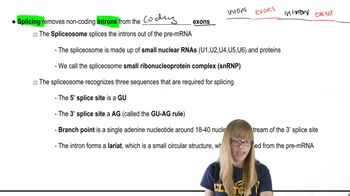
Understand that genes are composed of both introns and exons, which are sequences of DNA within a gene.
Recognize that exons are the coding regions of a gene that are expressed and translated into proteins.
Identify that introns are non-coding regions that are transcribed into RNA but are removed during RNA splicing before translation.
Note that during the process of transcription, both introns and exons are copied into pre-mRNA.
Learn that the splicing process removes introns from the pre-mRNA, resulting in a mature mRNA composed only of exons, which is then translated into a protein.

Verified video answer for a similar problem:

This video solution was recommended by our tutors as helpful for the problem above.
Video duration:
2m
Was this helpful?

Key Concepts

Here are the essential concepts you must grasp in order to answer the question correctly.

Introns

Introns are non-coding sequences of DNA that are found within a gene. They are transcribed into precursor mRNA but are removed during the RNA splicing process before translation into proteins. Introns play roles in gene regulation and alternative splicing, which can lead to the production of multiple protein variants from a single gene.
Recommended video:
Guided course
08:39
mRNA Processing

Exons

Exons are the coding sequences of a gene that remain in the mature mRNA after splicing. They are essential for encoding the amino acid sequence of proteins. The arrangement and combination of exons can influence the final protein product, and their presence is crucial for the proper expression of genetic information.
Recommended video:
Guided course
08:39
mRNA Processing

RNA Splicing

RNA splicing is the process by which introns are removed and exons are joined together in precursor mRNA to form mature mRNA. This process is vital for the correct expression of genes, as it ensures that only the coding regions are translated into proteins. Splicing can also lead to alternative splicing, allowing for the generation of diverse protein isoforms from a single gene.
Recommended video:
Related Practice
Textbook Question

Bacterial and eukaryotic gene transcripts can differ—in the transcripts themselves, in whether the transcripts are modified before translation, and in how the transcripts are modified. For each of these three areas of contrast, describe what the differences are and why the differences exist.

514
views
Textbook Question

Describe the two types of transcription termination found in bacterial genes. How does transcription termination differ for eukaryotic genes?

739
views
Textbook Question

What is the role of enhancer sequences in transcription of eukaryotic genes? Speculate about why enhancers are not part of transcription of bacterial genes.

781
views
Textbook Question

Draw a bacterial promoter and label its consensus sequences. How does this promoter differ from a eukaryotic promoter transcribed:

By RNA polymerase II?

By RNA polymerase I?

By RNA polymerase III?

577
views
Textbook Question

For a eukaryotic gene whose transcription requires the activity of an enhancer sequence, explain how proteins bound at the enhancer interact with RNA pol II and transcription factors bound at the promoter.

579
views
Textbook Question

Three genes identified in the diagram as A, B, and C are transcribed from a region of DNA. The 5'-to-3' transcription of genes A and C elongates mRNA in the right-to-left direction, and transcription of gene B elongates mRNA in the left-to-right direction. For each gene, identify the coding strand by designating it as an 'upper strand' or 'lower strand' in the diagram.

674
views