Pearson+ LogoPearson+ Logo
Ch. 8 - Molecular Biology of Transcription and RNA Processing
Sanders - Genetic Analysis: An Integrated Approach 3rd Edition
Sanders3rd EditionGenetic Analysis: An Integrated ApproachISBN: 9780135564172Not the one you use?Change textbook
Chapter 8, Problem 14

Three genes identified in the diagram as A, B, and C are transcribed from a region of DNA. The 5'-to-3' transcription of genes A and C elongates mRNA in the right-to-left direction, and transcription of gene B elongates mRNA in the left-to-right direction. For each gene, identify the coding strand by designating it as an 'upper strand' or 'lower strand' in the diagram.
Diagram showing transcription of genes A, B, and C, with coding strands labeled as upper or lower strands.

Verified step by step guidance
1
Understand the concept of transcription: During transcription, the RNA polymerase reads the template strand of DNA in the 3'-to-5' direction to synthesize mRNA in the 5'-to-3' direction. The coding strand is the DNA strand that has the same sequence as the mRNA (except that thymine is replaced by uracil in RNA).
Analyze the direction of transcription for each gene: For genes A and C, transcription elongates mRNA in the right-to-left direction. For gene B, transcription elongates mRNA in the left-to-right direction.
Determine the template strand for each gene: The template strand is complementary to the mRNA strand. For genes A and C, since transcription occurs right-to-left, the lower strand must be the template strand. For gene B, since transcription occurs left-to-right, the upper strand must be the template strand.
Identify the coding strand for each gene: The coding strand is the strand opposite to the template strand. For genes A and C, the upper strand is the coding strand because the lower strand is the template strand. For gene B, the lower strand is the coding strand because the upper strand is the template strand.
Summarize the results: For gene A, the coding strand is the upper strand. For gene B, the coding strand is the lower strand. For gene C, the coding strand is the upper strand.

Verified video answer for a similar problem:

This video solution was recommended by our tutors as helpful for the problem above.
Video duration:
1m
Was this helpful?

Key Concepts

Here are the essential concepts you must grasp in order to answer the question correctly.

Transcription Directionality

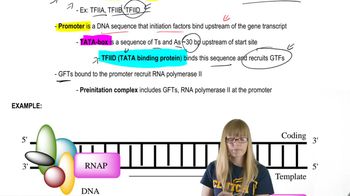
Transcription directionality refers to the orientation in which RNA polymerase synthesizes mRNA from a DNA template. In eukaryotic cells, transcription occurs in the 5'-to-3' direction, meaning that nucleotides are added to the 3' end of the growing mRNA strand. This directionality is crucial for understanding which DNA strand serves as the template and how the resulting mRNA aligns with the coding sequence.
Recommended video:
Guided course
09:16
Eukaryotic Transcription

Coding and Template Strands

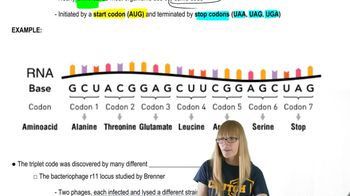
In the context of DNA transcription, the coding strand (also known as the sense strand) has the same sequence as the mRNA (except for uracil replacing thymine), while the template strand (antisense strand) is complementary to the mRNA. Identifying which strand is the coding strand is essential for determining the correct sequence of the mRNA produced during transcription, as it dictates the protein-coding potential of the gene.
Recommended video:
Guided course
11:43
The Genetic Code

Gene Orientation

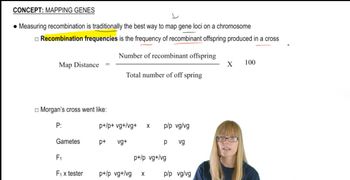
Gene orientation refers to the arrangement of genes on a DNA molecule, which can be oriented in either direction. This orientation affects how transcription occurs, as genes can be transcribed from either the upper or lower strand of the DNA. Understanding gene orientation is vital for correctly identifying which strand corresponds to each gene's transcription direction, as seen in the question regarding genes A, B, and C.
Recommended video:
Guided course
09:09
Mapping Genes