Pearson+ LogoPearson+ Logo
Ch. 8 - Molecular Biology of Transcription and RNA Processing
Sanders - Genetic Analysis: An Integrated Approach 3rd Edition
Sanders3rd EditionGenetic Analysis: An Integrated ApproachISBN: 9780135564172Not the one you use?Change textbook
Chapter 8, Problem 12

Draw a bacterial promoter and label its consensus sequences. How does this promoter differ from a eukaryotic promoter transcribed:
By RNA polymerase II?
By RNA polymerase I?
By RNA polymerase III?

Verified step by step guidance
1
Start by drawing a bacterial promoter. A bacterial promoter typically consists of two key consensus sequences: the -10 sequence (Pribnow box) and the -35 sequence. Label these sequences on your drawing. The -10 sequence is usually 'TATAAT', and the -35 sequence is typically 'TTGACA'.
Indicate the transcription start site (+1) on your drawing. This is the point where RNA polymerase begins transcription. The -10 and -35 sequences are located upstream of this site, with the -10 sequence closer to the transcription start site.
Explain how the bacterial promoter differs from a eukaryotic promoter transcribed by RNA polymerase II. Eukaryotic promoters often contain a TATA box (similar to the -10 sequence in bacteria) but also include additional regulatory elements such as enhancers and silencers. These elements can be located far from the transcription start site, unlike bacterial promoters.
Describe the differences between bacterial promoters and those transcribed by RNA polymerase I. RNA polymerase I transcribes rRNA genes, and its promoters are specialized, containing core promoter elements and upstream control elements (UCEs) that are distinct from bacterial promoter sequences.
Discuss the differences between bacterial promoters and those transcribed by RNA polymerase III. RNA polymerase III transcribes tRNA and 5S rRNA genes, and its promoters are often located within the transcribed region (internal promoters), which is a key distinction from bacterial promoters that are entirely upstream of the transcription start site.

Verified video answer for a similar problem:

This video solution was recommended by our tutors as helpful for the problem above.
Video duration:
3m
Was this helpful?

Key Concepts

Here are the essential concepts you must grasp in order to answer the question correctly.

Bacterial Promoter Structure

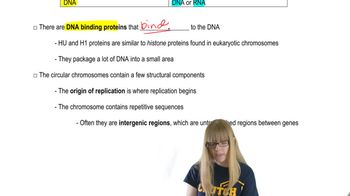
A bacterial promoter is a specific DNA sequence that initiates transcription in prokaryotes. It typically contains consensus sequences such as the -10 (Pribnow box) and -35 regions, which are recognized by RNA polymerase. These sequences are crucial for the binding of the transcription machinery and the subsequent initiation of RNA synthesis.
Recommended video:
Guided course
02:39
Bacteria and Viral Chromosome Structure

Eukaryotic Promoter Variability

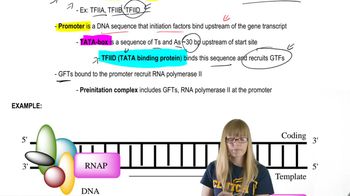
Eukaryotic promoters are more complex than bacterial promoters and can vary significantly between different RNA polymerases. For instance, RNA polymerase II promoters often include a TATA box and other regulatory elements, while RNA polymerase I and III promoters have distinct sequences and structures that facilitate the transcription of rRNA and tRNA, respectively. This complexity allows for greater regulation of gene expression in eukaryotes.
Recommended video:
Guided course
09:16
Eukaryotic Transcription

Transcription Factors and Regulation

In eukaryotes, transcription factors play a critical role in the binding of RNA polymerase to the promoter. These proteins can enhance or inhibit transcription by interacting with specific DNA sequences and the transcription machinery. This regulatory mechanism is essential for the precise control of gene expression in response to various cellular signals, distinguishing it from the simpler regulation seen in prokaryotes.
Recommended video:
Guided course
09:16
Eukaryotic Transcription