Pearson+ LogoPearson+ Logo
Ch. 8 - Molecular Biology of Transcription and RNA Processing
Sanders - Genetic Analysis: An Integrated Approach 3rd Edition
Sanders3rd EditionGenetic Analysis: An Integrated ApproachISBN: 9780135564172Not the one you use?Change textbook
Chapter 8, Problem 15c

The eukaryotic gene Gen-100 contains four introns labeled A to D. Imagine that Gen-100 has been isolated and its DNA has been denatured and mixed with polyadenylated mRNA from the gene.
Are intron regions single stranded or double stranded? Why?

Verified step by step guidance
1
Understand the structure of eukaryotic genes: Eukaryotic genes contain exons (coding regions) and introns (non-coding regions). During transcription, the entire gene, including both exons and introns, is transcribed into pre-mRNA.
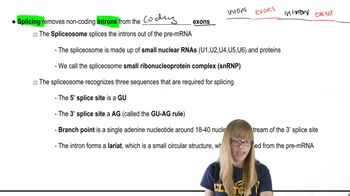
Learn about RNA splicing: In eukaryotes, introns are removed from the pre-mRNA during a process called splicing, leaving only the exons to form the mature mRNA. This mature mRNA is polyadenylated (has a poly-A tail) and is used for translation.
Consider the experimental setup: The DNA of the gene Gen-100 is denatured (separated into single strands) and mixed with the mature, polyadenylated mRNA. The mRNA will hybridize (base-pair) with its complementary sequence on the DNA strand.
Analyze the hybridization: Since the mature mRNA only contains exons, it will hybridize with the exon regions of the DNA. The intron regions, which are not present in the mRNA, will remain single-stranded because they have no complementary sequence in the mRNA to pair with.
Conclude the reasoning: The intron regions are single-stranded in this experiment because they are not represented in the mature mRNA and therefore cannot form double-stranded regions through hybridization.

Verified video answer for a similar problem:

This video solution was recommended by our tutors as helpful for the problem above.
Video duration:
1m
Was this helpful?

Key Concepts

Here are the essential concepts you must grasp in order to answer the question correctly.

Introns and Exons

Introns are non-coding regions of a gene that are transcribed into pre-mRNA but are removed during RNA splicing. Exons, on the other hand, are the coding sequences that remain in the mature mRNA. Understanding the distinction between introns and exons is crucial for analyzing gene structure and function.
Recommended video:
Guided course
08:39
mRNA Processing

DNA Denaturation

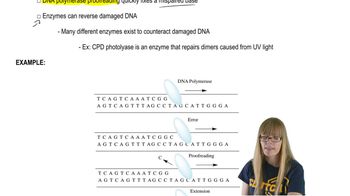
DNA denaturation refers to the process of separating the two strands of the DNA double helix, typically through heat or chemical treatment. This results in single-stranded DNA, which is essential for processes like transcription and hybridization with mRNA. Recognizing the state of DNA during denaturation helps in understanding the context of intron and exon interactions.
Recommended video:
Guided course
01:45
DNA Proofreading

mRNA and Its Structure

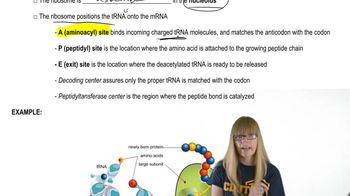
mRNA, or messenger RNA, is a single-stranded molecule that carries genetic information from DNA to the ribosome for protein synthesis. It is synthesized from the DNA template during transcription and includes only exons after splicing. Knowing the structure of mRNA is important for understanding how it relates to introns, which are absent in the final mRNA product.
Recommended video:
Guided course
03:49
Ribosome Structure
Related Practice
Textbook Question

Three genes identified in the diagram as A, B, and C are transcribed from a region of DNA. The 5'-to-3' transcription of genes A and C elongates mRNA in the right-to-left direction, and transcription of gene B elongates mRNA in the left-to-right direction. For each gene, identify the coding strand by designating it as an 'upper strand' or 'lower strand' in the diagram.

674
views
Textbook Question

The eukaryotic gene Gen-100 contains four introns labeled A to D. Imagine that Gen-100 has been isolated and its DNA has been denatured and mixed with polyadenylated mRNA from the gene.

Illustrate the R-loop structure that would be seen with electron microscopy.

571
views
Textbook Question

The eukaryotic gene Gen-100 contains four introns labeled A to D. Imagine that Gen-100 has been isolated and its DNA has been denatured and mixed with polyadenylated mRNA from the gene.

Label the introns.

586
views
Textbook Question

The segment of the bacterial TrpA gene involved in intrinsic termination of transcription is the following:

3'-TGGGTCGGGGCGGATTACTGCCCCGAAAAAAAACTTG-5'

5'-ACCCAGCCCCGCCTAATGACGGGGCTTTTTTTTGAAC-3' Draw the mRNA structure that forms during transcription of this segment of the TrpA gene.

546
views
Textbook Question

The segment of the bacterial TrpA gene involved in intrinsic termination of transcription is the following:

3'-TGGGTCGGGGCGGATTACTGCCCCGAAAAAAAACTTG-5'

5'-ACCCAGCCCCGCCTAATGACGGGGCTTTTTTTTGAAC-3'

Label the template and coding DNA strands.

483
views
Textbook Question

The segment of the bacterial TrpA gene involved in intrinsic termination of transcription is the following:

3'-TGGGTCGGGGCGGATTACTGCCCCGAAAAAAAACTTG-5'

5'-ACCCAGCCCCGCCTAATGACGGGGCTTTTTTTTGAAC-3'

Explain how a sequence of this type leads to intrinsic termination of transcription.

555
views