Pearson+ LogoPearson+ Logo
Ch. 8 - Molecular Biology of Transcription and RNA Processing
Sanders - Genetic Analysis: An Integrated Approach 3rd Edition
Sanders3rd EditionGenetic Analysis: An Integrated ApproachISBN: 9780135564172Not the one you use?Change textbook
Chapter 8, Problem 16c

The segment of the bacterial TrpA gene involved in intrinsic termination of transcription is the following:
3'-TGGGTCGGGGCGGATTACTGCCCCGAAAAAAAACTTG-5'
5'-ACCCAGCCCCGCCTAATGACGGGGCTTTTTTTTGAAC-3'
Explain how a sequence of this type leads to intrinsic termination of transcription.

Verified step by step guidance
1
Intrinsic termination of transcription in bacteria relies on specific sequences in the DNA that form a hairpin structure in the RNA transcript. Begin by identifying the sequence in the given DNA that could form a complementary base-pairing region in the RNA transcript.
Look for a region in the DNA sequence that is rich in G and C nucleotides. These regions are important because they form strong hydrogen bonds, leading to the formation of a stable hairpin structure in the RNA transcript.
After the GC-rich region, identify the stretch of adenine (A) nucleotides on the template strand (3'-5' strand). This corresponds to a stretch of uracil (U) nucleotides in the RNA transcript, which forms a weak RNA-DNA hybrid due to the weaker A-U base pairing.
Explain that during transcription, the RNA polymerase transcribes the GC-rich region, which folds into a hairpin structure in the RNA. This structure causes the RNA polymerase to pause.
Finally, describe how the weak A-U base pairing downstream of the hairpin destabilizes the RNA-DNA hybrid, leading to the release of the RNA transcript and termination of transcription.

Verified video answer for a similar problem:

This video solution was recommended by our tutors as helpful for the problem above.
Video duration:
3m
Was this helpful?

Key Concepts

Here are the essential concepts you must grasp in order to answer the question correctly.

Intrinsic Termination of Transcription

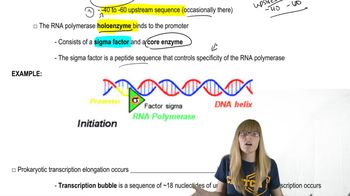
Intrinsic termination is a mechanism by which RNA polymerase stops transcription without the need for additional factors. It typically involves the formation of a stable hairpin structure in the RNA transcript, followed by a stretch of uracil residues. This hairpin structure disrupts the interaction between the RNA polymerase and the DNA template, leading to the release of the newly synthesized RNA.
Recommended video:
Guided course
10:14
Prokaryotic Transcription

Hairpin Structure Formation

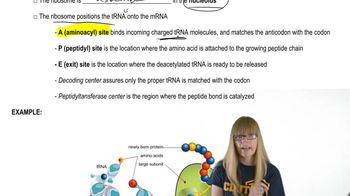
The hairpin structure is formed when complementary sequences within the RNA transcript base-pair with each other, creating a double-stranded region. This structure is crucial for intrinsic termination as it stabilizes the RNA molecule and causes RNA polymerase to pause. The presence of a GC-rich region followed by a series of uracils is often indicative of potential hairpin formation, which is essential for signaling the end of transcription.
Recommended video:
Guided course
03:49
Ribosome Structure

Role of Uracil in Termination

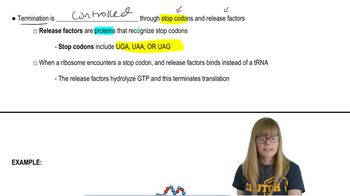
Uracil plays a significant role in the intrinsic termination process due to its weaker base-pairing with adenine compared to guanine-cytosine pairs. After the formation of the hairpin, the RNA polymerase encounters a stretch of uracils, which destabilizes the RNA-DNA hybrid. This instability leads to the dissociation of the RNA transcript from the DNA template, effectively terminating transcription.
Recommended video:
Guided course
01:55
Translation Termination
Related Practice
Textbook Question

The eukaryotic gene Gen-100 contains four introns labeled A to D. Imagine that Gen-100 has been isolated and its DNA has been denatured and mixed with polyadenylated mRNA from the gene.

Are intron regions single stranded or double stranded? Why?

659
views
Textbook Question

The segment of the bacterial TrpA gene involved in intrinsic termination of transcription is the following:

3'-TGGGTCGGGGCGGATTACTGCCCCGAAAAAAAACTTG-5'

5'-ACCCAGCCCCGCCTAATGACGGGGCTTTTTTTTGAAC-3' Draw the mRNA structure that forms during transcription of this segment of the TrpA gene.

546
views
Textbook Question

The segment of the bacterial TrpA gene involved in intrinsic termination of transcription is the following:

3'-TGGGTCGGGGCGGATTACTGCCCCGAAAAAAAACTTG-5'

5'-ACCCAGCCCCGCCTAATGACGGGGCTTTTTTTTGAAC-3'

Label the template and coding DNA strands.

483
views
Textbook Question

A 2-kb fragment of E. coli DNA contains the complete sequence of a gene for which transcription is terminated by the rho protein. The fragment contains the complete promoter sequence as well as the terminator region of the gene. The cloned fragment is examined by band shift assay. Each lane of a single electrophoresis gel contains the 2-kb cloned fragment under the following conditions:

Lane 1: 2-kb fragment alone

Lane 2: 2-kb fragment plus the core enzyme

Lane 3: 2-kb fragment plus the RNA polymerase holoenzyme

Lane 4: 2-kb fragment plus rho protein

Diagram the relative positions expected for the DNA fragments in this gel electrophoresis analysis.

588
views
Textbook Question

A 2-kb fragment of E. coli DNA contains the complete sequence of a gene for which transcription is terminated by the rho protein. The fragment contains the complete promoter sequence as well as the terminator region of the gene. The cloned fragment is examined by band shift assay. Each lane of a single electrophoresis gel contains the 2-kb cloned fragment under the following conditions:

Lane 1: 2-kb fragment alone

Lane 2: 2-kb fragment plus the core enzyme

Lane 3: 2-kb fragment plus the RNA polymerase holoenzyme

Lane 4: 2-kb fragment plus rho protein

Explain the relative positions of bands in lanes 1 and 3.

563
views
Textbook Question

A 2-kb fragment of E. coli DNA contains the complete sequence of a gene for which transcription is terminated by the rho protein. The fragment contains the complete promoter sequence as well as the terminator region of the gene. The cloned fragment is examined by band shift assay. Each lane of a single electrophoresis gel contains the 2-kb cloned fragment under the following conditions:

Lane 1: 2-kb fragment alone

Lane 2: 2-kb fragment plus the core enzyme

Lane 3: 2-kb fragment plus the RNA polymerase holoenzyme

Lane 4: 2-kb fragment plus rho protein

Explain the relative positions of bands in lanes 1 and 4.

504
views