Pearson+ LogoPearson+ Logo
Ch. 9 - The Molecular Biology of Translation
Sanders - Genetic Analysis: An Integrated Approach 3rd Edition
Sanders3rd EditionGenetic Analysis: An Integrated ApproachISBN: 9780135564172Not the one you use?Change textbook
Chapter 9, Problem 39k

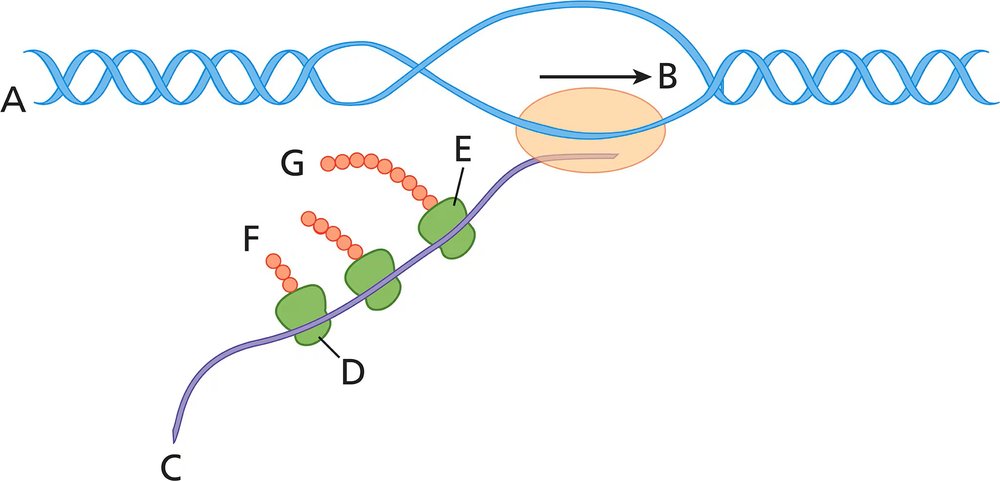
Answer the following questions about the accompanying diagram.
Diagram illustrating the process of translation, showing mRNA synthesis and protein assembly with labeled components.
What process(es) are illustrated in the diagram? 

Verified step by step guidance
1
Examine the diagram carefully. The image illustrates a process involving DNA (labeled A), mRNA (labeled C), ribosomes (labeled D), and polypeptide chains (labeled F and G). This suggests the diagram is depicting transcription and translation.
Identify the first part of the process. The DNA (A) is being transcribed into mRNA (C) by the enzyme RNA polymerase (labeled B). This is the transcription phase, where the genetic information in DNA is converted into a complementary RNA sequence.
Focus on the second part of the process. The mRNA (C) is interacting with ribosomes (D), which are facilitating the translation process. Translation is the synthesis of polypeptides (F and G) based on the sequence of codons in the mRNA.
Note the role of ribosomes (D). Ribosomes are responsible for reading the mRNA sequence and assembling amino acids into polypeptide chains (F and G) using tRNA molecules. This is a key step in protein synthesis.
Summarize the processes illustrated. The diagram shows two major processes in gene expression: transcription (DNA to mRNA) and translation (mRNA to polypeptide chains). These processes are essential for converting genetic information into functional proteins.

Verified video answer for a similar problem:

This video solution was recommended by our tutors as helpful for the problem above.
Video duration:
2m
Was this helpful?

Key Concepts

Here are the essential concepts you must grasp in order to answer the question correctly.

Translation

Translation is the process by which ribosomes synthesize proteins using messenger RNA (mRNA) as a template. During this process, the ribosome reads the sequence of codons in the mRNA, and transfer RNA (tRNA) molecules bring the corresponding amino acids to form a polypeptide chain. This is a crucial step in gene expression, converting genetic information into functional proteins.
Recommended video:
Guided course
07:58
Translation initiation

mRNA

Messenger RNA (mRNA) is a type of RNA that carries genetic information from DNA to the ribosome, where proteins are synthesized. It is transcribed from the DNA template during transcription and contains codons that specify the sequence of amino acids in a protein. The structure of mRNA is linear and single-stranded, allowing it to be translated into proteins.
Recommended video:
Guided course
08:39
mRNA Processing

Ribosome

Ribosomes are complex molecular machines found within all living cells that facilitate the translation of mRNA into proteins. They consist of ribosomal RNA (rRNA) and proteins, forming two subunits that come together during protein synthesis. Ribosomes read the mRNA sequence and coordinate the assembly of amino acids into polypeptides, making them essential for cellular function and growth.
Recommended video:
Guided course
03:49
Ribosome Structure