Pearson+ LogoPearson+ Logo
Ch. 9 - The Molecular Biology of Translation
Sanders - Genetic Analysis: An Integrated Approach 3rd Edition
Sanders3rd EditionGenetic Analysis: An Integrated ApproachISBN: 9780135564172Not the one you use?Change textbook
Chapter 9, Problem 22

Identify and describe the steps that lead to the secretion of proteins from eukaryotic cells.

Verified step by step guidance
1
span>Step 1: Protein Synthesis - Proteins are synthesized by ribosomes, which can be free in the cytoplasm or bound to the rough endoplasmic reticulum (ER). In the case of secretory proteins, ribosomes are typically bound to the rough ER.
span>Step 2: Entry into the ER - As the protein is synthesized, it enters the lumen of the rough ER, where it may undergo folding and post-translational modifications, such as glycosylation.
span>Step 3: Transport to the Golgi Apparatus - The protein is packaged into vesicles that bud off from the ER and are transported to the Golgi apparatus. This transport is mediated by coat protein complexes like COPII.
span>Step 4: Processing in the Golgi - Within the Golgi apparatus, the protein undergoes further modifications, such as additional glycosylation, and is sorted for transport to its final destination.
span>Step 5: Vesicle Transport and Secretion - The fully processed protein is packaged into secretory vesicles that bud off from the trans-Golgi network. These vesicles then move to the plasma membrane, where they fuse and release the protein outside the cell through exocytosis.

Verified video answer for a similar problem:

This video solution was recommended by our tutors as helpful for the problem above.
Video duration:
2m
Was this helpful?

Key Concepts

Here are the essential concepts you must grasp in order to answer the question correctly.

Transcription

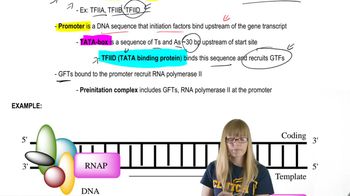
Transcription is the first step in the process of gene expression, where the DNA sequence of a gene is copied into messenger RNA (mRNA). This occurs in the nucleus of eukaryotic cells, facilitated by the enzyme RNA polymerase. The mRNA then undergoes processing, including splicing and the addition of a 5' cap and poly-A tail, before it is transported out of the nucleus into the cytoplasm.
Recommended video:
Guided course
09:16
Eukaryotic Transcription

Translation

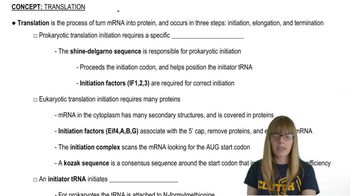
Translation is the process by which the mRNA is decoded to synthesize proteins. This occurs in the ribosomes, where transfer RNA (tRNA) molecules bring amino acids to the ribosome in the sequence specified by the mRNA. The ribosome facilitates the formation of peptide bonds between amino acids, resulting in a polypeptide chain that will fold into a functional protein.
Recommended video:
Guided course
07:58
Translation initiation

Post-Translational Modifications

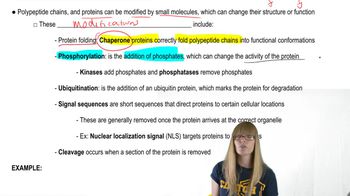
Post-translational modifications are chemical changes that occur to a protein after its synthesis, which are crucial for its functionality. These modifications can include phosphorylation, glycosylation, and ubiquitination, among others. They can affect the protein's activity, stability, localization, and interactions with other molecules, ultimately determining the protein's role within the cell.
Recommended video:
Guided course
04:30
Post Translational Modifications
Related Practice
Textbook Question

In an experiment to decipher the genetic code, a poly-AC mRNA (ACACACAC...) is synthesized. What pattern of amino acids would appear if this sequence were to be translated by a mechanism that reads the genetic code as

A triplet with overlaps?

776
views
Textbook Question

In an experiment to decipher the genetic code, a poly-AC mRNA (ACACACAC...) is synthesized. What pattern of amino acids would appear if this sequence were to be translated by a mechanism that reads the genetic code as

A quadruplet without overlaps?

547
views
Textbook Question

In an experiment to decipher the genetic code, a poly-AC mRNA (ACACACAC...) is synthesized. What pattern of amino acids would appear if this sequence were to be translated by a mechanism that reads the genetic code as

A quadruplet with overlaps?

581
views
Textbook Question

The amino acid sequence of a portion of a polypeptide is

N...Cys-Pro-Ala-Met-Gly-His-Lys...C

What is the mRNA sequence encoding this polypeptide fragment? Use N to represent any nucleotide, Pu to represent a purine, and Py to represent a pyrimidine. Label the 5′ and 3′ ends of the mRNA.

914
views
Textbook Question

The amino acid sequence of a portion of a polypeptide is

N...Cys-Pro-Ala-Met-Gly-His-Lys...C

Give the DNA template and coding strand sequences corresponding to the mRNA. Use the N, Pu, and Py symbols as placeholders.

712
views
Textbook Question

Har Gobind Khorana and his colleagues performed numerous experiments translating synthetic mRNAs. In one experiment, an mRNA molecule with a repeating UG dinucleotide sequence was assembled and translated.

Write the sequence of this mRNA and give its polarity.

640
views