Pearson+ LogoPearson+ Logo
Ch. 9 - The Molecular Biology of Translation
Sanders - Genetic Analysis: An Integrated Approach 3rd Edition
Sanders3rd EditionGenetic Analysis: An Integrated ApproachISBN: 9780135564172Not the one you use?Change textbook
Chapter 9, Problem 23a

The amino acid sequence of a portion of a polypeptide is
N...Cys-Pro-Ala-Met-Gly-His-Lys...C
What is the mRNA sequence encoding this polypeptide fragment? Use N to represent any nucleotide, Pu to represent a purine, and Py to represent a pyrimidine. Label the 5′ and 3′ ends of the mRNA.

Verified step by step guidance
1
Step 1: Understand the relationship between amino acids and codons. Each amino acid is encoded by a specific set of three nucleotides (codon) in the mRNA sequence. The genetic code table can be used to identify the codons corresponding to each amino acid.
Step 2: Identify the codons for each amino acid in the sequence. For example, Cysteine (Cys) is encoded by UGU or UGC, Proline (Pro) by CCU, CCC, CCA, or CCG, Alanine (Ala) by GCU, GCC, GCA, or GCG, Methionine (Met) by AUG, Glycine (Gly) by GGU, GGC, GGA, or GGG, Histidine (His) by CAU or CAC, and Lysine (Lys) by AAA or AAG.
Step 3: Construct the mRNA sequence by selecting one codon for each amino acid. Since the problem specifies using 'N' for any nucleotide, 'Pu' for purines (A or G), and 'Py' for pyrimidines (C or U), you can incorporate these placeholders where needed.
Step 4: Label the 5′ and 3′ ends of the mRNA sequence. The mRNA sequence is always written in the 5′ to 3′ direction, which corresponds to the direction of translation.
Step 5: Ensure the sequence matches the amino acid order provided (N...Cys-Pro-Ala-Met-Gly-His-Lys...C) and includes placeholders (N, Pu, Py) as specified in the problem.

Verified video answer for a similar problem:

This video solution was recommended by our tutors as helpful for the problem above.
Video duration:
2m
Was this helpful?

Key Concepts

Here are the essential concepts you must grasp in order to answer the question correctly.

Genetic Code

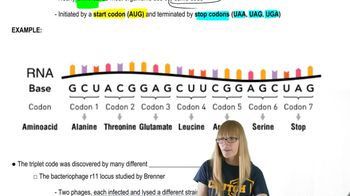
The genetic code is a set of rules that defines how the sequence of nucleotides in DNA and RNA is translated into the amino acid sequence of proteins. Each amino acid is encoded by a specific sequence of three nucleotides, known as a codon. Understanding the genetic code is essential for determining the mRNA sequence that corresponds to a given polypeptide.
Recommended video:
Guided course
11:43
The Genetic Code

Transcription

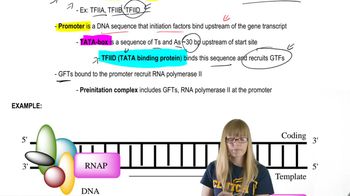
Transcription is the process by which the information in a gene's DNA sequence is copied into messenger RNA (mRNA). During transcription, RNA polymerase synthesizes mRNA by pairing complementary RNA nucleotides with the DNA template strand. This process is crucial for producing the mRNA that encodes the polypeptide fragment in the question.
Recommended video:
Guided course
09:16
Eukaryotic Transcription

Codon-Amino Acid Relationship

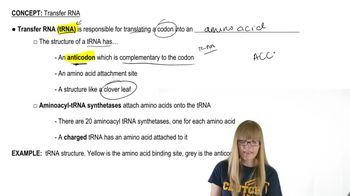
The relationship between codons and amino acids is fundamental in molecular biology. Each codon, a sequence of three nucleotides in mRNA, corresponds to a specific amino acid or a stop signal during protein synthesis. Knowing the amino acid sequence allows us to deduce the corresponding mRNA codons, which is necessary for answering the question about the mRNA sequence encoding the given polypeptide.
Recommended video: