Pearson+ LogoPearson+ Logo
Ch. 9 - The Molecular Biology of Translation
Sanders - Genetic Analysis: An Integrated Approach 3rd Edition
Sanders3rd EditionGenetic Analysis: An Integrated ApproachISBN: 9780135564172Not the one you use?Change textbook
Chapter 9, Problem 38a

Organisms of all three domains of life usually use the mRNA codon AUG as the start codon.
Do organisms of the three domains use the same amino acid as the initial amino acid in translation? Identify similarities and differences.

Verified step by step guidance
1
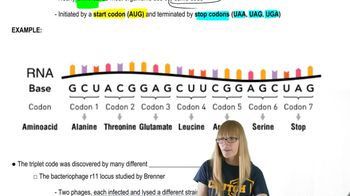
Understand that the start codon AUG is universally recognized in all three domains of life (Bacteria, Archaea, and Eukarya) as the signal to initiate translation.
Recall that the AUG codon codes for the amino acid methionine (Met) in most cases, but the form of methionine used as the initial amino acid can vary between domains.
In Bacteria, the initial methionine is a modified form called N-formylmethionine (fMet), which is specifically used for the initiation of protein synthesis.
In Archaea and Eukarya, the initial methionine is not formylated; instead, it is a regular methionine (Met) that is incorporated at the start of translation.
Summarize the similarity: all three domains use AUG as the start codon and methionine as the initial amino acid. Highlight the difference: Bacteria use N-formylmethionine (fMet), while Archaea and Eukarya use unmodified methionine (Met).

Verified video answer for a similar problem:

This video solution was recommended by our tutors as helpful for the problem above.
Video duration:
3m
Was this helpful?

Key Concepts

Here are the essential concepts you must grasp in order to answer the question correctly.

Start Codon

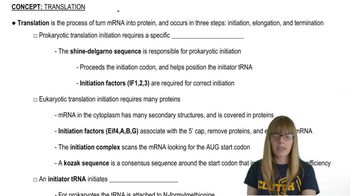
The start codon, AUG, is a specific sequence in mRNA that signals the beginning of translation. It codes for the amino acid methionine in eukaryotes and archaea, while in bacteria, it can also code for a modified form called N-formylmethionine. Understanding the role of the start codon is crucial for grasping how protein synthesis initiates across different organisms.
Recommended video:
Guided course
07:58
Translation initiation

Translation Initiation

Translation initiation is the first step in protein synthesis, where the ribosome assembles around the mRNA and the first tRNA molecule binds to the start codon. This process varies slightly among the three domains of life—bacteria, archaea, and eukaryotes—due to differences in ribosomal structure and initiation factors, which can affect the initial amino acid incorporated into the growing polypeptide chain.
Recommended video:
Guided course
07:58
Translation initiation

Amino Acids and Genetic Code

Amino acids are the building blocks of proteins, and the genetic code determines how sequences of nucleotides in mRNA are translated into amino acids. While AUG universally codes for methionine in eukaryotes and archaea, bacteria use it to code for N-formylmethionine, highlighting both similarities and differences in the translation process across the three domains of life.
Recommended video:
Guided course
11:43
The Genetic Code
Related Practice
Textbook Question

Table D lists α-globin and β-globin gene sequences for the 11 or 12 nucleotides preceding the start codon and the first nucleotide following the start codon (see Problem 34). The data are for 16 vertebrate globin genes reported by Kozak (1987). The sequences are written from -12 to +4 with the start codon sequence in capital letters. Use the data in this table to:

Compare the consensus sequence for these globin genes to the consensus sequence derived from the larger study of 699 vertebrate genes in Problem 34. 

551
views
Textbook Question

The six nucleotides preceding the start codon and the first nucleotide after the start codon in eukaryotes exhibit strong sequence conservation as determined by the percentages of nucleotides in the  to  positions and the  position (see Problem 34). Use the data given in the table for Problem 35 to determine the seven nucleotides that most commonly surround the start in vertebrates.

432
views
Textbook Question

In terms of the polycistronic composition of mRNAs and the presence or absence of Shine–Dalgarno sequences, compare and contrast bacterial, archaeal, and eukaryotic mRNAs.

600
views
Textbook Question

Organisms of all three domains of life usually use the mRNA codon AUG as the start codon.

Despite AUG being the most common start codon sequence, very few proteins have methionine as the first amino acid. Why is this the case?

390
views
Textbook Question

Answer the following questions about the accompanying diagram.

Is the DNA nearest A the template strand or the coding strand?

471
views
Textbook Question

Answer the following questions about the accompanying diagram.

Which end of the DNA is closest to A?

619
views