Pearson+ LogoPearson+ Logo
Ch. 9 - The Molecular Biology of Translation
Sanders - Genetic Analysis: An Integrated Approach 3rd Edition
Sanders3rd EditionGenetic Analysis: An Integrated ApproachISBN: 9780135564172Not the one you use?Change textbook
Chapter 9, Problem 38b

Organisms of all three domains of life usually use the mRNA codon AUG as the start codon.
Despite AUG being the most common start codon sequence, very few proteins have methionine as the first amino acid. Why is this the case?

Verified step by step guidance
1
Understand that AUG is the start codon in mRNA, and it codes for the amino acid methionine (Met) in eukaryotes and a modified form of methionine (formyl-methionine, fMet) in prokaryotes.
Recognize that during translation initiation, the ribosome identifies the AUG start codon and begins protein synthesis by incorporating methionine (or fMet) as the first amino acid in the polypeptide chain.
Note that after translation begins, post-translational modifications often occur. These modifications can include the removal of the initial methionine by specific enzymes, such as methionine aminopeptidases, which cleave the methionine from the N-terminus of the protein.
Understand that the removal of methionine is influenced by the identity of the second amino acid in the sequence and the structure of the protein, which determines whether the methionine is retained or removed.
Conclude that while AUG is the universal start codon and methionine is initially incorporated, post-translational modifications frequently result in proteins that do not retain methionine as the first amino acid.

Verified video answer for a similar problem:

This video solution was recommended by our tutors as helpful for the problem above.
Video duration:
3m
Was this helpful?

Key Concepts

Here are the essential concepts you must grasp in order to answer the question correctly.

Start Codon

The start codon is a specific sequence of nucleotides in mRNA that signals the beginning of protein synthesis. In most organisms, the codon AUG is recognized as the start codon, which codes for the amino acid methionine. This codon is crucial for initiating translation, as it sets the reading frame for the ribosome to assemble the corresponding amino acids into a polypeptide chain.
Recommended video:
Guided course
07:58
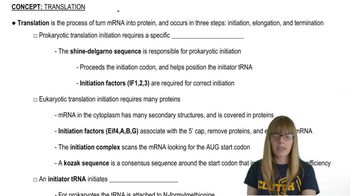
Translation initiation

Post-Translational Modifications

Post-translational modifications are chemical changes that occur to a protein after its synthesis. These modifications can include the removal of certain amino acids, such as methionine, or the addition of functional groups. Such alterations can significantly affect the protein's function, stability, and localization, explaining why many proteins do not retain methionine as their first amino acid despite it being coded by the start codon.
Recommended video:
Guided course
04:30
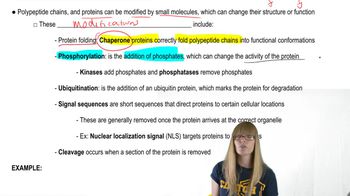
Post Translational Modifications

Alternative Start Codons

While AUG is the primary start codon, some organisms can utilize alternative start codons, such as GUG or UUG, under specific conditions. These alternative codons can lead to the incorporation of different amino acids at the beginning of the protein chain. This flexibility in translation initiation contributes to the diversity of protein structures and functions, further explaining the rarity of methionine as the first amino acid in many proteins.
Recommended video:
Guided course
01:57
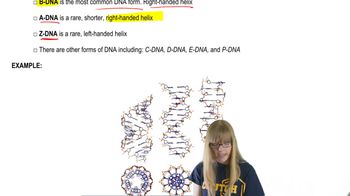
Alternative DNA Forms