Pearson+ LogoPearson+ Logo
Ch. 9 - The Molecular Biology of Translation
Sanders - Genetic Analysis: An Integrated Approach 3rd Edition
Sanders3rd EditionGenetic Analysis: An Integrated ApproachISBN: 9780135564172Not the one you use?Change textbook
Chapter 9, Problem 39b

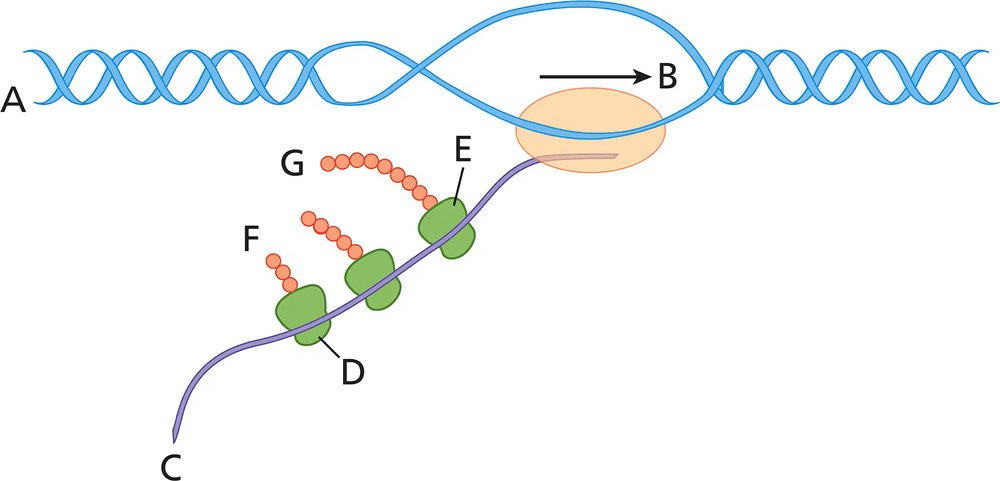
Answer the following questions about the accompanying diagram.
Diagram illustrating DNA transcription, showing DNA strands labeled A and B, and RNA synthesis with components C, D, E, F, and G.
Which end of the DNA is closest to A?

Verified step by step guidance
1
Examine the accompanying diagram carefully to identify the orientation of the DNA strand. DNA strands have a directionality, typically labeled as 5' (five-prime) and 3' (three-prime) ends.
Recall that the 5' end of a DNA strand has a phosphate group attached to the fifth carbon of the sugar, while the 3' end has a hydroxyl (-OH) group attached to the third carbon of the sugar.
Look for any visual cues in the diagram, such as the presence of a phosphate group or hydroxyl group, to determine the directionality of the DNA strand near point A.
If the diagram includes complementary base pairing, note that DNA strands run antiparallel to each other. This means that if one strand is oriented 5' to 3', the complementary strand will be oriented 3' to 5'. Use this information to infer the orientation of the strand near point A.
Based on the observed features in the diagram, determine whether the end of the DNA closest to point A is the 5' end or the 3' end.

Verified video answer for a similar problem:

This video solution was recommended by our tutors as helpful for the problem above.
Video duration:
2m
Was this helpful?

Key Concepts

Here are the essential concepts you must grasp in order to answer the question correctly.

DNA Structure

DNA is a double helix composed of two strands running in opposite directions, known as antiparallel strands. Each strand has a 5' (five-prime) end and a 3' (three-prime) end, which are crucial for understanding the directionality of DNA. The 5' end has a phosphate group, while the 3' end has a hydroxyl group, influencing how DNA is replicated and transcribed.
Recommended video:
Guided course
06:25
DNA Structure

Nucleotide Orientation

Nucleotides, the building blocks of DNA, are linked together by phosphodiester bonds between the 5' phosphate group of one nucleotide and the 3' hydroxyl group of another. This orientation is essential for understanding how DNA strands are synthesized and how they interact with enzymes during processes like replication and transcription.
Recommended video:
Guided course
05:02
Directionality

DNA Terminology

In molecular biology, the terms '5' end' and '3' end' are used to describe the orientation of the DNA strands. When analyzing a diagram, identifying which end is labeled as 5' or 3' helps determine the direction of the DNA strand and its relationship to other components, such as genes or regulatory elements, which may be crucial for answering questions about the diagram.
Recommended video:
Guided course
01:45
DNA Proofreading