
Textbook Question
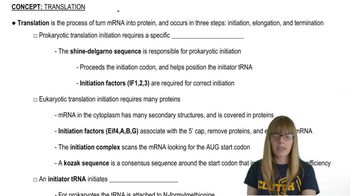
In terms of the polycistronic composition of mRNAs and the presence or absence of Shine–Dalgarno sequences, compare and contrast bacterial, archaeal, and eukaryotic mRNAs.
602
views

 Verified step by step guidance
 07:58
07:58
 08:55
08:55 02:48
02:48In terms of the polycistronic composition of mRNAs and the presence or absence of Shine–Dalgarno sequences, compare and contrast bacterial, archaeal, and eukaryotic mRNAs.
Organisms of all three domains of life usually use the mRNA codon AUG as the start codon.
Despite AUG being the most common start codon sequence, very few proteins have methionine as the first amino acid. Why is this the case?
Organisms of all three domains of life usually use the mRNA codon AUG as the start codon.
Do organisms of the three domains use the same amino acid as the initial amino acid in translation? Identify similarities and differences.
Table D lists α-globin and β-globin gene sequences for the 11 or 12 nucleotides preceding the start codon and the first nucleotide following the start codon (see Problem 34). The data are for 16 vertebrate globin genes reported by Kozak (1987). The sequences are written from -12 to +4 with the start codon sequence in capital letters. Use the data in this table to:
Compare the consensus sequence for these globin genes to the consensus sequence derived from the larger study of 699 vertebrate genes in Problem 34.
Table C contains DNA-sequence information compiled by Marilyn Kozak (1987). The data consist of the percentage of A, C, G, and T at each position among the 12 nucleotides preceding the start codon in 699 genes from various vertebrate species and at the first nucleotide after the start codon. (The start codon occupies positions +1 to +3 and the first nucleotide immediately after the start codon occupies position +4) Use the data to determine the consensus sequence for the 13 nucleotides ( -12 to -1 and +4) surrounding the start codon in vertebrate genes.
Table D lists α-globin and β-globin gene sequences for the 11 or 12 nucleotides preceding the start codon and the first nucleotide following the start codon (see Problem 34). The data are for 16 vertebrate globin genes reported by Kozak (1987). The sequences are written from -12 to +4 with the start codon sequence in capital letters. Use the data in this table to:
Determine the consensus sequence for the 16 selected α-globin and β-globin genes.