Pearson+ LogoPearson+ Logo
Ch.19 Enzymes and Vitamins
McMurry - Fundamentals of GOB 8th Edition
McMurry8th EditionFundamentals of GOBISBN: 9780134015187Not the one you use?Change textbook
Chapter 19, Problem 17c

Does the enzyme described in each of the following statements require a cofactor to be active?
c. The presence of K+ does not affect the reaction.

Verified step by step guidance
1
Understand the concept of cofactors: Cofactors are non-protein chemical compounds or metallic ions that are required for an enzyme's biological activity. They can be either organic molecules (coenzymes) or inorganic ions (e.g., metal ions like K⁺, Mg²⁺, or Zn²⁺).
Analyze the statement: The problem states that the presence of K⁺ does not affect the reaction. This implies that the enzyme's activity is independent of K⁺.
Determine the role of K⁺: Since K⁺ does not influence the reaction, it is not acting as a cofactor for this enzyme. A cofactor is essential for the enzyme's activity, and its absence or presence would typically affect the reaction.
Conclude whether a cofactor is required: Based on the information provided, the enzyme described in this statement does not require K⁺ as a cofactor to be active.
Generalize the reasoning: If no other cofactors are mentioned in the problem, it is reasonable to conclude that this enzyme does not require a cofactor for its activity.

Verified video answer for a similar problem:

This video solution was recommended by our tutors as helpful for the problem above.
Video duration:
1m
Was this helpful?

Key Concepts

Here are the essential concepts you must grasp in order to answer the question correctly.

Enzymes and Cofactors

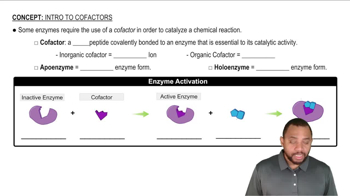
Enzymes are biological catalysts that speed up chemical reactions in the body. Many enzymes require cofactors, which are non-protein molecules that assist in enzyme activity. Cofactors can be metal ions, like K⁺, or organic molecules known as coenzymes. Understanding whether an enzyme needs a cofactor is crucial for determining its functionality and the conditions under which it operates.
Recommended video:
Guided course
2:39
Intro to Cofactors Concept 1

Role of Potassium Ions (K⁺)

Potassium ions (K⁺) are essential for various physiological processes, including nerve transmission and muscle contraction. In enzymatic reactions, K⁺ can act as a cofactor for some enzymes, influencing their activity. However, if the presence of K⁺ does not affect the reaction, it suggests that the enzyme in question does not require this ion for its catalytic function, indicating a different mechanism of action.
Recommended video:
Guided course
03:23
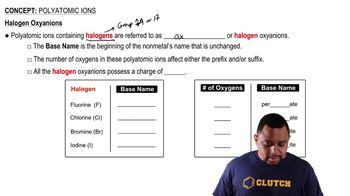
Polyatomic Ions

Enzyme Activity and Regulation

Enzyme activity can be influenced by various factors, including the presence of cofactors, temperature, pH, and substrate concentration. Regulation of enzyme activity is vital for maintaining homeostasis in biological systems. Understanding how these factors interact helps in determining whether an enzyme is active under specific conditions and whether it requires additional molecules, like cofactors, to function effectively.
Recommended video:
Guided course
1:06
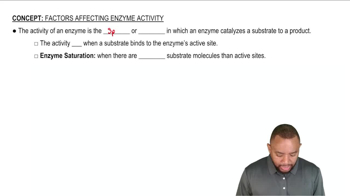
Factors Affecting Enzyme Activity Concept 1