
Pearson+ LogoPearson+ Logo
Ch.17 Carboxylic Acids and Their Derivatives
McMurry - Fundamentals of GOB 8th Edition
McMurry8th EditionFundamentals of GOBISBN: 9780134015187Not the one you use?Change textbook
Chapter 17, Problem 20a

Draw structures of the amides that can be made from the following reactants:
a. CH3NH2 + (CH3)2CHCOOH →?

Verified step by step guidance
1
Identify the functional groups in the reactants: CH₃NH₂ is a primary amine, and (CH₃)₂CHCOOH is a carboxylic acid. Amides are formed when an amine reacts with a carboxylic acid, typically through a condensation reaction where water (H₂O) is eliminated.
Determine the mechanism of the reaction: The amine (CH₃NH₂) will act as a nucleophile, attacking the carbonyl carbon of the carboxylic acid ((CH₃)₂CHCOOH). This forms a tetrahedral intermediate.
Recognize the elimination step: The tetrahedral intermediate will lose a molecule of water (H₂O), resulting in the formation of the amide bond (C=O-NH).
Draw the structure of the resulting amide: The amide will have the structure (CH₃)₂CH-C(=O)-NH-CH₃. The isopropyl group ((CH₃)₂CH-) comes from the carboxylic acid, and the methyl group (CH₃-) attached to the nitrogen comes from the amine.
Verify the product: Ensure that the product contains the amide functional group (-C(=O)-NH-) and that all atoms are accounted for from the reactants, with water (H₂O) as the byproduct.

Verified video answer for a similar problem:

This video solution was recommended by our tutors as helpful for the problem above.
Video duration:
2m
Was this helpful?

Key Concepts

Here are the essential concepts you must grasp in order to answer the question correctly.

Amides

Amides are organic compounds derived from carboxylic acids where the hydroxyl group (-OH) is replaced by an amine group (-NH₂, -NHR, or -NR₂). They are characterized by the functional group -C(=O)N-, and are important in various biological processes, including protein synthesis. Understanding the structure of amides is crucial for predicting their reactivity and properties.
Recommended video:
Guided course
1:03
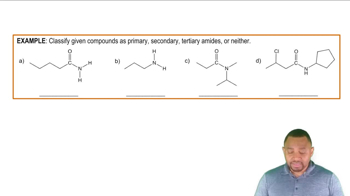
Intro to Amides Example 1

Carboxylic Acids

Carboxylic acids are organic compounds containing a carboxyl group (-COOH), which is responsible for their acidic properties. They can react with amines to form amides through a condensation reaction, where water is eliminated. Recognizing the structure and reactivity of carboxylic acids is essential for understanding how amides are synthesized.
Recommended video:
Guided course
1:09
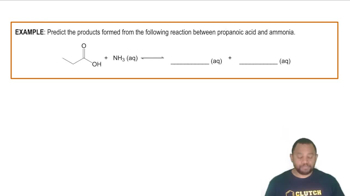
Carboxylic Acid Reactions Example 1

Condensation Reaction

A condensation reaction is a chemical process where two molecules combine to form a larger molecule, accompanied by the loss of a small molecule, often water. In the context of amide formation, the reaction between an amine and a carboxylic acid exemplifies this process. Grasping the concept of condensation reactions is vital for predicting the products formed in organic synthesis.
Recommended video:
Guided course
1:53
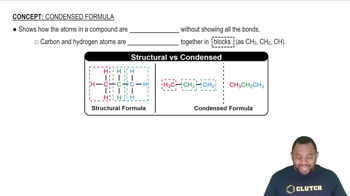
Condensed Formula Concept 1