Pearson+ LogoPearson+ Logo
Ch.16 Amines
McMurry - Fundamentals of GOB 8th Edition
McMurry8th EditionFundamentals of GOBISBN: 9780134015187Not the one you use?Change textbook
Chapter 16, Problem 13c

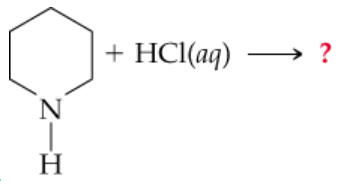
Complete the following equations:
c. Chemical equation showing a cyclic amine reacting with hydrochloric acid, with a question mark indicating an incomplete reaction.

Verified step by step guidance
1
Step 1: Analyze the given chemical equation in the image. Identify the reactants and products, and determine if the equation is balanced or incomplete.
Step 2: Write out the chemical formulas for all reactants and products. Ensure that the correct chemical symbols and subscripts are used for each compound.
Step 3: Apply the law of conservation of mass, which states that the number of atoms of each element must be the same on both sides of the equation. Count the atoms of each element on the reactant and product sides.
Step 4: Adjust the coefficients (the numbers in front of the chemical formulas) to balance the equation. Start with the most complex molecule and balance one element at a time, ensuring that the coefficients are in the simplest whole-number ratio.
Step 5: Double-check your work by recounting the atoms of each element on both sides of the equation to confirm that the equation is balanced. If necessary, make further adjustments to the coefficients.

Verified video answer for a similar problem:

This video solution was recommended by our tutors as helpful for the problem above.
Was this helpful?

Key Concepts

Here are the essential concepts you must grasp in order to answer the question correctly.

Equations

Equations are mathematical statements that assert the equality of two expressions. They often involve variables and constants, and solving an equation means finding the values of the variables that make the equation true. Understanding how to manipulate and solve equations is fundamental in various fields, including physics, engineering, and economics.
Recommended video:
Guided course
01:13
Thermochemical Equations

Variables

Variables are symbols used to represent unknown values in mathematical expressions and equations. They can take on different values and are essential for formulating equations that describe relationships between quantities. Recognizing how to identify and work with variables is crucial for solving equations and understanding their implications.
Recommended video:
Guided course
01:06
Electronic Structure: Subshells Concept 1

Mathematical Operations

Mathematical operations include addition, subtraction, multiplication, and division, which are the basic processes used to manipulate numbers and variables in equations. Mastery of these operations is necessary for simplifying expressions, solving equations, and performing calculations accurately. Each operation has specific rules that govern how they interact with different types of numbers.
Recommended video:
Guided course
01:55
Addition and Subtraction Operations