Pearson+ LogoPearson+ Logo
Ch.24 Lipid Metabolism
McMurry - Fundamentals of GOB 8th Edition
McMurry8th EditionFundamentals of GOBISBN: 9780134015187Not the one you use?Change textbook
Chapter 24, Problem 11

Oxygen is not a reactant in the β oxidation of fatty acids. Can β oxidation occur under anaerobic conditions? Explain.

Verified step by step guidance
1
Understand the process of ß oxidation: ß oxidation is the metabolic pathway where fatty acids are broken down in the mitochondria to generate acetyl-CoA, NADH, and FADH₂. These products are then used in other metabolic pathways like the citric acid cycle and oxidative phosphorylation.
Recognize the role of oxygen in cellular metabolism: While oxygen is not directly involved in the chemical reactions of ß oxidation, it is essential for the electron transport chain (ETC), where NADH and FADH₂ are oxidized to regenerate NAD⁺ and FAD. These cofactors are required for ß oxidation to continue.
Analyze the conditions for anaerobic metabolism: Under anaerobic conditions (absence of oxygen), the ETC cannot function, leading to a lack of regeneration of NAD⁺ and FAD. Without these cofactors, ß oxidation cannot proceed efficiently.
Conclude the dependency of ß oxidation on oxygen indirectly: Although oxygen is not a reactant in ß oxidation, the process relies on oxygen-dependent pathways (like the ETC) to sustain the supply of necessary cofactors.
Summarize the explanation: ß oxidation cannot occur under anaerobic conditions because the absence of oxygen halts the ETC, preventing the regeneration of NAD⁺ and FAD, which are essential for the continuation of ß oxidation.

Verified video answer for a similar problem:

This video solution was recommended by our tutors as helpful for the problem above.
Video duration:
1m
Was this helpful?

Key Concepts

Here are the essential concepts you must grasp in order to answer the question correctly.

Beta Oxidation

Beta oxidation is a metabolic process that breaks down fatty acids into acetyl-CoA units, which can then enter the citric acid cycle for energy production. This process occurs in the mitochondria and involves a series of enzymatic reactions that sequentially remove two-carbon units from the fatty acid chain.
Recommended video:
Guided course
01:26
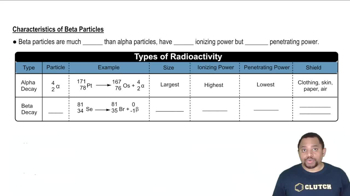
Beta Decay Example 1

Anaerobic Conditions

Anaerobic conditions refer to environments lacking oxygen, where certain metabolic processes can occur without it. In such conditions, organisms may rely on alternative pathways for energy production, such as fermentation, which do not require oxygen but are less efficient than aerobic respiration.
Recommended video:
Guided course
1:47
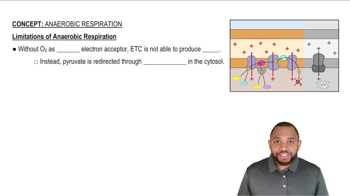
Anaerobic Respiration Concept 1

Energy Yield from Fatty Acids

The energy yield from fatty acids during beta oxidation is significant, as each cycle produces acetyl-CoA, NADH, and FADH2, which are crucial for ATP generation. However, under anaerobic conditions, the complete oxidation of fatty acids is hindered, limiting the overall energy production compared to aerobic conditions.
Recommended video:
Guided course
4:19
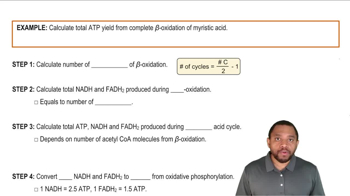
Total Energy from Fatty Acids Example 1