Pearson+ LogoPearson+ Logo
Ch.12 Food as Fuel An Overview of Metabolism
Frost - General, Organic and Biological Chemistry 4th Edition
Frost4th EditionGeneral, Organic and Biological ChemistryISBN: 9780134988696Not the one you use?Change textbook
Chapter 8, Problem 47

According to the chemiosmotic theory, how does the proton gradient provide energy to synthesize ATP?

Verified step by step guidance
1
Understand the chemiosmotic theory: This theory, proposed by Peter Mitchell, explains how ATP is synthesized in mitochondria and chloroplasts. It involves the movement of protons (H⁺ ions) across a membrane to create a gradient, which stores potential energy.
Recognize the role of the proton gradient: The proton gradient is established by the electron transport chain (ETC) in the inner mitochondrial membrane. As electrons are passed along the ETC, protons are pumped from the mitochondrial matrix into the intermembrane space, creating a high concentration of protons outside the matrix.
Identify the energy source: The energy stored in the proton gradient is a form of potential energy, often referred to as the proton-motive force. This force is due to both the concentration gradient (difference in proton concentration) and the electrical gradient (difference in charge across the membrane).
Understand ATP synthase function: ATP synthase is an enzyme embedded in the inner mitochondrial membrane. Protons flow back into the mitochondrial matrix through ATP synthase, driven by the proton-motive force. This flow of protons provides the energy needed for ATP synthase to catalyze the conversion of ADP (adenosine diphosphate) and inorganic phosphate (Pi) into ATP (adenosine triphosphate).
Summarize the process: The proton gradient provides energy for ATP synthesis by coupling the movement of protons down their gradient (from high to low concentration) with the mechanical rotation of ATP synthase, which facilitates the phosphorylation of ADP to form ATP.

Verified video answer for a similar problem:

This video solution was recommended by our tutors as helpful for the problem above.
Video duration:
3m
Was this helpful?

Key Concepts

Here are the essential concepts you must grasp in order to answer the question correctly.

Chemiosmotic Theory

The chemiosmotic theory, proposed by Peter Mitchell, explains how ATP is generated in mitochondria and chloroplasts. It posits that energy from electron transport chains is used to pump protons (H+) across a membrane, creating a proton gradient. This gradient represents potential energy, which is harnessed to synthesize ATP as protons flow back across the membrane through ATP synthase.
Recommended video:
Guided course
05:22
Atomic Theory

Proton Gradient

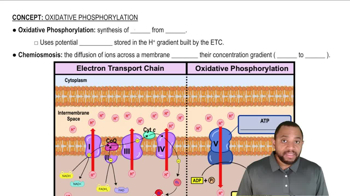
A proton gradient is a difference in proton concentration across a membrane, resulting in a higher concentration of protons on one side. This gradient creates an electrochemical potential, which is a form of stored energy. In cellular respiration and photosynthesis, the proton gradient is crucial for driving the synthesis of ATP, as protons move down their concentration gradient through ATP synthase.
Recommended video:
Guided course
2:37
Oxidative Phosphorylation Concept 1

ATP Synthase

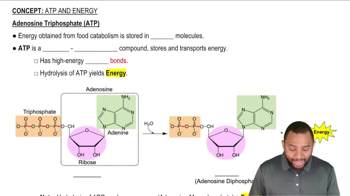
ATP synthase is an enzyme complex located in the inner mitochondrial membrane and thylakoid membranes of chloroplasts. It utilizes the energy from the flow of protons down their gradient to catalyze the conversion of ADP and inorganic phosphate into ATP. This process, known as oxidative phosphorylation in respiration and photophosphorylation in photosynthesis, is essential for energy production in cells.
Recommended video:
Guided course
2:20
Adenosine Triphosphate (ATP) Concept 2