Pearson+ LogoPearson+ Logo
Ch.12 Food as Fuel An Overview of Metabolism
Frost - General, Organic and Biological Chemistry 4th Edition
Frost4th EditionGeneral, Organic and Biological ChemistryISBN: 9780134988696Not the one you use?Change textbook
Chapter 8, Problem 51a

List the energy yield in ATP molecules for each of the following:
a. NADH → NAD+

Verified step by step guidance
1
Understand the context: NADH is a molecule involved in cellular respiration, specifically in the electron transport chain. It donates electrons to the chain, which ultimately leads to the production of ATP.
Recall the energy yield: Each NADH molecule contributes to the generation of ATP during oxidative phosphorylation. The typical yield is approximately 2.5 ATP molecules per NADH under ideal conditions.
Identify the process: NADH is oxidized to NAD⁺ in the electron transport chain, releasing energy that drives the synthesis of ATP from ADP and inorganic phosphate.
Relate the reaction to ATP production: The electrons from NADH are transferred through a series of protein complexes in the mitochondrial membrane, creating a proton gradient that powers ATP synthase to produce ATP.
Summarize the energy yield: For every NADH molecule oxidized to NAD⁺, approximately 2.5 ATP molecules are generated in eukaryotic cells under optimal conditions.

Verified video answer for a similar problem:

This video solution was recommended by our tutors as helpful for the problem above.
Video duration:
2m
Was this helpful?

Key Concepts

Here are the essential concepts you must grasp in order to answer the question correctly.

NADH and NAD⁺

NADH (Nicotinamide adenine dinucleotide) is a reduced form of NAD⁺, a coenzyme involved in redox reactions. During cellular respiration, NADH carries electrons to the electron transport chain, where it is oxidized back to NAD⁺. This process is crucial for energy production in cells, as it facilitates the transfer of electrons and protons, ultimately leading to ATP synthesis.
Recommended video:
Guided course
1:43
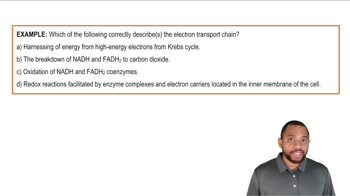
Intro to Electron Transport Chain Example 1

Electron Transport Chain (ETC)

The electron transport chain is a series of protein complexes located in the inner mitochondrial membrane that transfer electrons from NADH and FADH₂ to oxygen. As electrons move through the chain, energy is released and used to pump protons across the membrane, creating a proton gradient. This gradient drives ATP synthesis through ATP synthase, making the ETC a vital component of aerobic respiration.
Recommended video:
Guided course
3:10
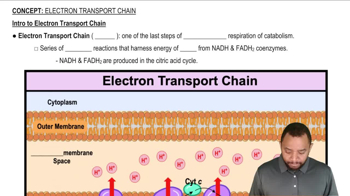
Intro to Electron Transport Chain Concept 1

ATP Yield from NADH

The oxidation of one molecule of NADH in the electron transport chain typically results in the production of approximately 2.5 to 3 ATP molecules, depending on the efficiency of the system and the organism. This yield is a key aspect of cellular respiration, as it quantifies the energy extracted from nutrients and highlights the importance of NADH in energy metabolism.
Recommended video:
Guided course
03:09
Percent Yield