Pearson+ LogoPearson+ Logo
Ch.6 Carbohydrates Life's Sweet Molecules
Frost - General, Organic and Biological Chemistry 4th Edition
Frost4th EditionGeneral, Organic and Biological ChemistryISBN: 9780134988696Not the one you use?Change textbook
Chapter 3, Problem 73

Draw the Fischer projection of the product of reduction reaction of D-galactose at C1.

Verified step by step guidance
1
Understand the problem: The reduction of D-galactose at C1 involves converting the aldehyde group (-CHO) at carbon 1 into a primary alcohol (-CH2OH). This is a common reaction in carbohydrate chemistry.
Recall the structure of D-galactose: D-galactose is an aldohexose, meaning it has six carbons with an aldehyde group at C1 and hydroxyl groups (-OH) attached to the other carbons in a specific stereochemical arrangement.
Visualize the reduction reaction: During the reduction, the aldehyde group at C1 is reduced to a primary alcohol. This means the -CHO group becomes -CH2OH. The stereochemistry of the other carbons (C2 to C6) remains unchanged.
Draw the Fischer projection: In the Fischer projection, the carbon chain is drawn vertically with the most oxidized carbon (C1) at the top. After reduction, C1 will now have a -CH2OH group. The hydroxyl groups on C2, C3, C4, and C5 should be placed on the left or right based on the stereochemistry of D-galactose.
Double-check the stereochemistry: Ensure that the hydroxyl groups on C2 (right), C3 (left), C4 (left), and C5 (right) are correctly positioned in the Fischer projection. The new -CH2OH group at C1 should be at the top, and the -CH2OH group at C6 should remain at the bottom.

Verified video answer for a similar problem:

This video solution was recommended by our tutors as helpful for the problem above.
Video duration:
2m
Was this helpful?

Key Concepts

Here are the essential concepts you must grasp in order to answer the question correctly.

Fischer Projection

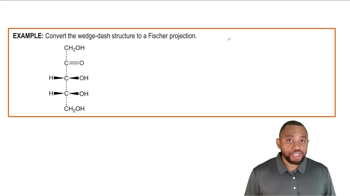
The Fischer projection is a two-dimensional representation of a three-dimensional organic molecule, particularly useful for depicting carbohydrates. In this format, the carbon skeleton is arranged vertically, with the most oxidized carbon at the top. Horizontal lines represent bonds that project out of the plane towards the viewer, while vertical lines indicate bonds that extend behind the plane.
Recommended video:
Guided course
0:48
Fischer Projections Example 1

Reduction Reaction

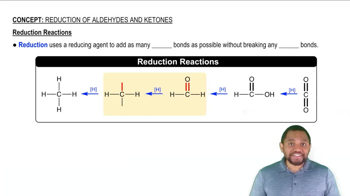
A reduction reaction involves the gain of electrons or hydrogen atoms by a molecule, often resulting in a decrease in oxidation state. In the context of carbohydrates, reduction typically refers to the conversion of an aldehyde or ketone group into an alcohol. For d-galactose, the reduction at C1 transforms the aldehyde group into a primary alcohol, altering its chemical properties and reactivity.
Recommended video:
Guided course
2:38
Reduction Reactions Concept 1

D-Galactose

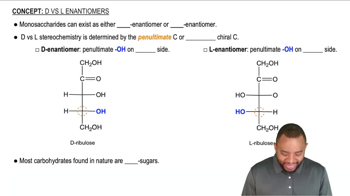
D-galactose is a monosaccharide and an epimer of glucose, differing at the C4 position. It is an important sugar in biological systems, often found in lactose and various polysaccharides. Understanding its structure and functional groups is crucial for predicting the outcomes of chemical reactions, such as reduction, which modifies its stereochemistry and functional properties.
Recommended video:
Guided course
1:30
D vs L Enantiomers Concept 1