Pearson+ LogoPearson+ Logo
Ch.8 Gases
Timberlake - Chemistry: An Introduction to General, Organic, and Biological Chemistry 13th Edition
Timberlake13th EditionChemistry: An Introduction to General, Organic, and Biological ChemistryISBN: 9780134421353Not the one you use?Change textbook
Chapter 8, Problem 2b

Use the kinetic molecular theory of gases to explain each of the following:
b. The air in a hot-air balloon is heated to make the balloon rise.

Verified step by step guidance
1
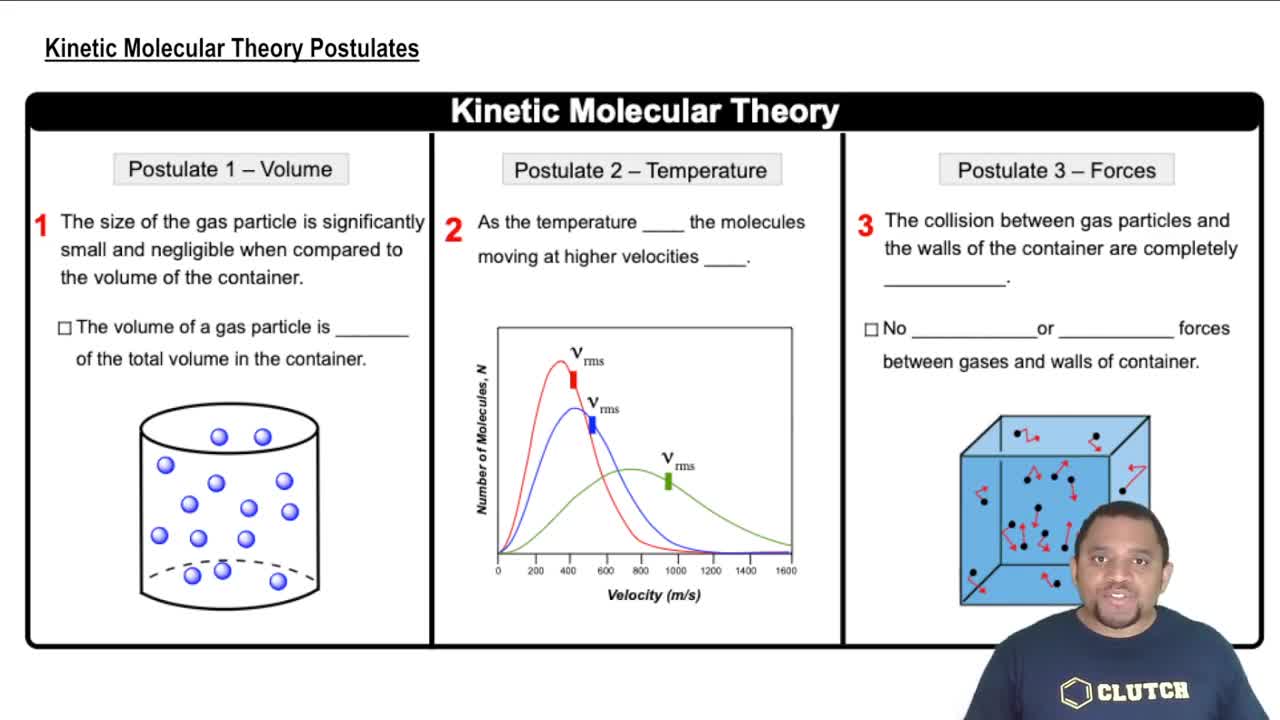
The kinetic molecular theory of gases states that gas particles are in constant, random motion and that their kinetic energy is directly proportional to the temperature of the gas. This means that as the temperature of a gas increases, the average kinetic energy of its particles also increases.
When the air inside the hot-air balloon is heated, the temperature of the gas increases. According to the kinetic molecular theory, this causes the gas particles to move faster and spread out, increasing the volume of the gas if the pressure remains constant.
As the volume of the heated air increases, the density of the air inside the balloon decreases because density is defined as mass per unit volume (\( \text{Density} = \frac{\text{Mass}}{\text{Volume}} \)).
The lower density of the heated air inside the balloon compared to the cooler, denser air outside creates a buoyant force. This buoyant force is what causes the hot-air balloon to rise.
In summary, the heating of the air inside the balloon reduces its density, and the difference in density between the inside and outside air allows the balloon to rise due to the buoyant force acting on it.

Verified video answer for a similar problem:

This video solution was recommended by our tutors as helpful for the problem above.
Video duration:
1m
Was this helpful?

Key Concepts

Here are the essential concepts you must grasp in order to answer the question correctly.

Kinetic Molecular Theory

The kinetic molecular theory explains the behavior of gases in terms of particles in constant motion. It posits that gas particles are small, widely spaced, and move randomly at high speeds. This theory helps to understand how temperature affects the energy and movement of gas particles, which is crucial for explaining phenomena like the behavior of air in a hot-air balloon.
Recommended video:
Guided course
01:19
Kinetic Molecular Theory Concept 1

Temperature and Kinetic Energy

Temperature is a measure of the average kinetic energy of the particles in a substance. In the context of a hot-air balloon, heating the air increases the kinetic energy of the air molecules, causing them to move faster and collide more forcefully with each other. This increase in kinetic energy results in a decrease in air density, allowing the balloon to rise as the warmer, lighter air becomes buoyant compared to the cooler, denser air outside.
Recommended video:
Guided course
03:23
Kinetic Molecular Theory Concept 2

Buoyancy

Buoyancy is the upward force exerted by a fluid that opposes the weight of an object immersed in it. In the case of a hot-air balloon, the heated air inside the balloon is less dense than the cooler air outside, creating a buoyant force. This difference in density allows the balloon to rise, as the buoyant force acting on it exceeds the gravitational force pulling it down.