Indietro
 Mullins 1st EditionCh. 17 - Carbonyl Addition Reactions: Aldehydes and Ketones
Problema 1b
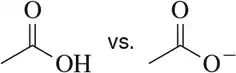
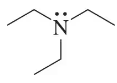
In each case, circle the stronger nucleophile.
(b)
Problema 1c
In each case, circle the stronger nucleophile.
(c)
Problema 1d
In each case, circle the stronger nucleophile.
(d)
Problema 2a
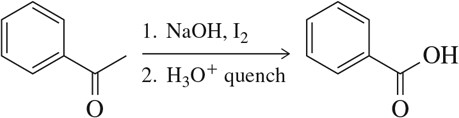
Identify the following reactions as oxidation or reduction (based on what happens to the organic molecule).
(a)
Problema 2b
Identify the following reactions as oxidation or reduction (based on what happens to the organic molecule).
(b)
Problema 2c
Identify the following reactions as oxidation or reduction (based on what happens to the organic molecule).
(c)
Problema 4a
Based on the analysis you used in Assessment 17.3, which carbonyl would you expect to react most quickly with a nucleophile?
(a)
Problema 4c
Based on the analysis you used in Assessment 17.3, which carbonyl would you expect to react most quickly with a nucleophile?
(c)
Problema 7d
Give a structure that corresponds to the name provided.
d. E-4-oxopent-2-enal
Problema 8a
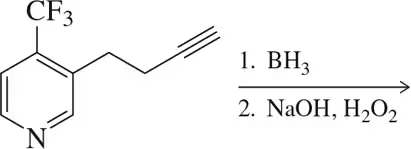
Predict the product of the following aldehyde/ketone syntheses.
(a)
Problema 8c
Predict the product of the following aldehyde/ketone syntheses.
(c)
Problema 8d
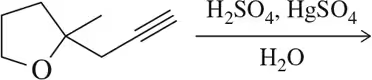
Predict the product of the following aldehyde/ketone syntheses.
(d)
Problema 9a
Predict the reagents or reactant(s) necessary to complete the following syntheses.
(a)
Problema 9b
Predict the reagents or reactant(s) necessary to complete the following syntheses.
(b)
Problema 9c
Predict the reagents or reactant(s) necessary to complete the following syntheses.
(c)
Problema 10
Another way the preceding might be presented is to say that the minor resonance structure(s) reveal the reactivity of a molecule. Show how the minor resonance structure(s) can help us understand that the following reactions occur with the regioselectivity shown.
(a)
(b)
(c)
Problema 11
Identify the bonds broken and formed in the following addition reaction.
(a) Would you expect this reaction to be favored based on entropy?
(b) Based on enthalpy [qualitatively]?
(c) Overall?
Problema 12a
Classify the following nucleophiles as strong, weak, or intermediate. Would you expect each to add to a carbonyl directly or wait for a carbocation to form?
(a)
Problema 12b
Classify the following nucleophiles as strong, weak, or intermediate. Would you expect each to add to a carbonyl directly or wait for a carbocation to form?
b)
Problema 12d
Classify the following nucleophiles as strong, weak, or intermediate. Would you expect each to add to a carbonyl directly or wait for a carbocation to form?
(d)
Problema 17a
A student, when solving the following 'predict-the-product' question, made a common mistake by writing the answer shown here. Explain why this reaction would not work as written.
Problema 20a
Suggest an acetylide ion and a carbonyl that might be used to make the following products.
(a) oct-4-yn-3-ol
Problema 20b
Suggest an acetylide ion and a carbonyl that might be used to make the following products.
(b) 2,6-dimethylhept-3-yn-2-ol
Problema 20c
Suggest an acetylide ion and a carbonyl that might be used to make the following products.
(c) 5-phenylhex-2-yn-1-ol
Problema 22a
Suggest a carbonyl to react with NaCN/HCN to produce the following cyanohydrins.
(a)
Problema 23a
For each of the following carbonyl addition reactions, would you expect a racemic mixture or a mixture enriched in one stereoisomer? In each case, draw both possible stereoisomeric products.
(a)
Problema 26a
Suggest the appropriate carbonyl and Wittig reagent to make the following alkenes.
a. (E)-7-methylnon-4-en-3-one
Problema 31c
Identify the hemiacetal functional group in each of the following molecules. These molecules may not be stable enough to be the favorable product in an equilibrium reaction.
(c)
Problema 32a
Provide a mechanism for the formation of the hemiacetals shown. [Only (c) is favored as written.]
(a)
Problema 33a
Which of the following cyclic hemiacetals would you expect to have the highest Keq for their formation? Explain your answer.
(a)