Indietro
Problema 15b
Show how you would accomplish the following transformations.
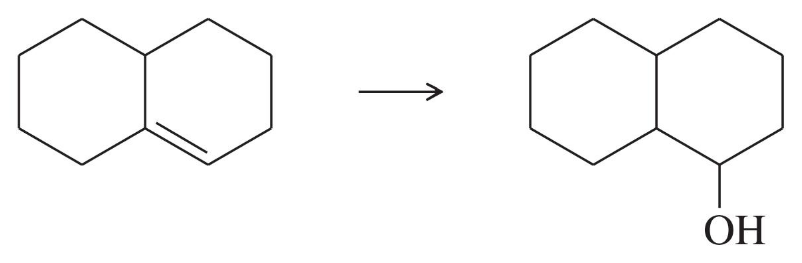
(b)
Problema 15c
Show how you would accomplish the following transformations.
(c) 1-methylcycloheptanol → 2-methylcycloheptanol
Problema 16a
When HBr adds across the double bond of 1,2-dimethylcyclopentene, the product is a mixture of the cis and trans isomers. Show why this addition is not stereospecific.
Problema 16b
When 1,2-dimethylcyclopentene undergoes hydroboration–oxidation, one diastereomer of the product predominates. Show why this addition is stereospecific, and predict the stereochemistry of the major product.
Problema 17
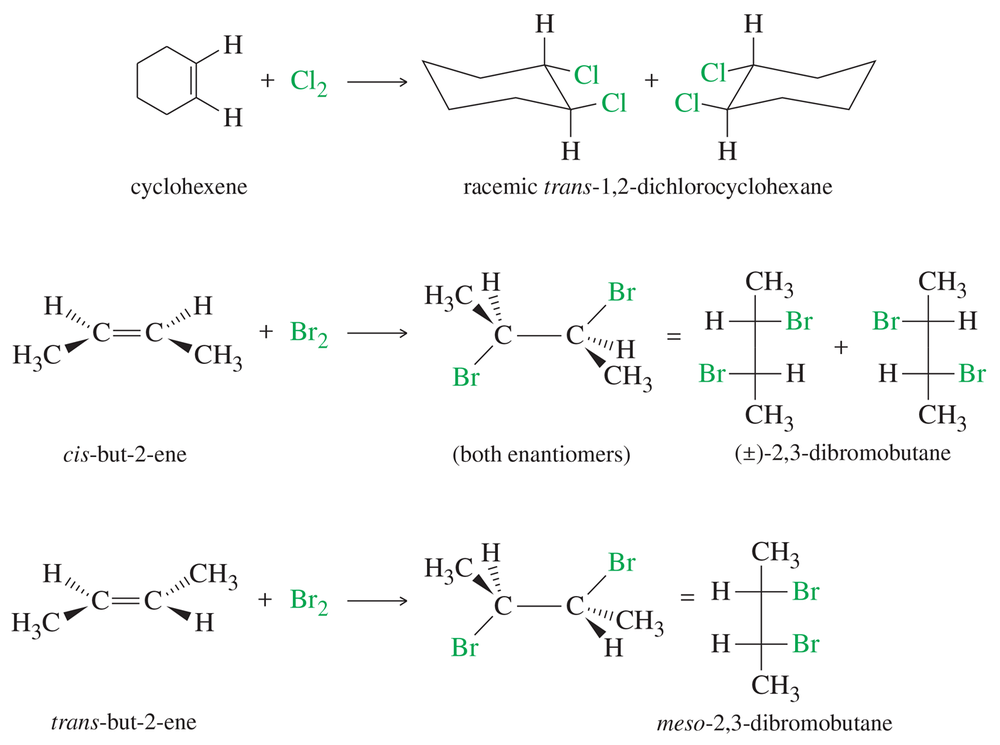
Give mechanisms to account for the stereochemistry of the products observed from the addition of bromine to cis- and trans-but-2-ene (Figure 8-5). Why are two products formed from the cis isomer but only one from the trans? (Making models will be helpful.)
Problema 18c,d
Propose mechanisms and predict the major products of the following reactions. Include stereochemistry where appropriate.
(c) (E)-dec-3-ene + Br2 in CCl4
(d) (Z)-dec-3-ene + Br2 in CCl4
Problem-Solving Hint: Models may be helpful whenever stereochemistry is involved. Write complete structures, including all bonds and charges, when writing mechanisms.
Problema 19
Propose a mechanism for the addition of bromine water to cyclopentene, being careful to show why the trans product results and how both enantiomers are formed.
Problema 20a
The solutions to Solved Problem 8-5 showed only how one enantiomer of the product is formed. For each product, show how an equally probable reaction forms the other enantiomer.
Problema 20b
The solutions to Solved Problem 8-6 showed only how one enantiomer of the product is formed. For each product, show how an equally probable reaction forms the other enantiomer.
Problema 21a,b
Predict the major product(s) for each reaction. Include stereochemistry where appropriate.
a. 1-methylcyclohexene + Cl2/H2O
b. 2-methylbut-2-ene + Br2/H2O
Problema 21c,d
Predict the major product(s) for each reaction. Include stereochemistry where appropriate.
c. cis-but-2-ene + Cl2/H2O
d. trans-but-2-ene + Cl2/H2O
Problema 21e
Predict the major product(s) for each reaction. Include stereochemistry where appropriate.
e. 1-methylcyclopentene + Br2 in saturated aqueous NaCl
Problema 22a
Show how you would accomplish the following synthetic conversions.
a. 3-methylpent-2-ene → 2-chloro-3-methylpentan-3-ol
Problem-Solving Hint: The opening of a halonium ion is driven by its electrophilic nature. The weak nucleophile attacks the carbon bearing more positive charge.
Problema 22b
Show how you would accomplish the following synthetic conversions.
b. chlorocyclohexane → trans-2-chlorocyclohexanol
Problem-Solving Hint: The opening of a halonium ion is driven by its electrophilic nature. The weak nucleophile attacks the carbon bearing more positive charge.
Problema 22c
Show how you would accomplish the following synthetic conversions.
c. 1-methylcyclopentanol → 2-chloro-1-methylcyclopentanol
Problem-Solving Hint: The opening of a halonium ion is driven by its electrophilic nature. The weak nucleophile attacks the carbon bearing more positive charge.
Problema 23a,b
Give the expected major product for each reaction, including stereochemistry where applicable.
(a) but-1-ene + H2/Pt
(b) cis-but-2-ene + H2/Ni
Problema 23c,d
Give the expected major product for each reaction, including stereochemistry where applicable.
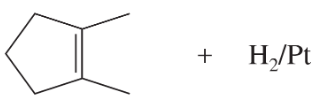
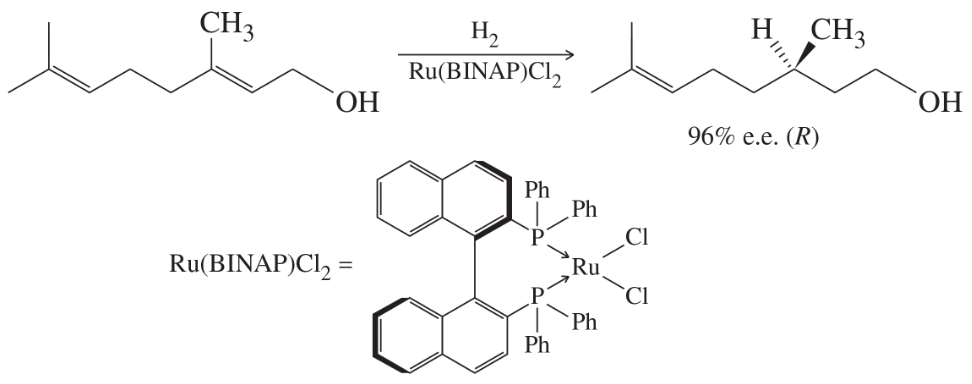
(c)
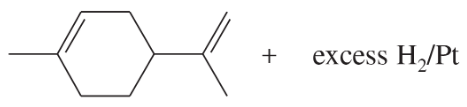
(d)
Problema 24a
One of the principal components of lemongrass oil is limonene, C10H16. When limonene is treated with excess hydrogen and a platinum catalyst, the product is an alkane of formula C10H20. What can you conclude about the structure of limonene?
Problema 25
The chiral BINAP ligand shown in Figure 8-8 contains no asymmetric carbon atoms. Explain how this ligand is chiral.
Problema 26
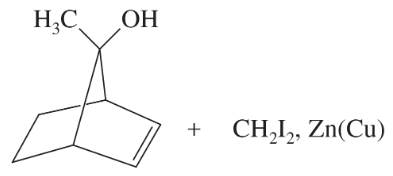
Predict the carbenoid addition products of the following reactions.
a. trans-hex-3-ene + CH2I2, Zn(Cu)
b. cis-hex-3-ene + CH2I2, Zn(Cu)
Problema 27a
Predict the carbenoid addition products of the following reactions.
(a) cyclohexene + CHCl3, 50% NaOH/H2O
Problema 27b
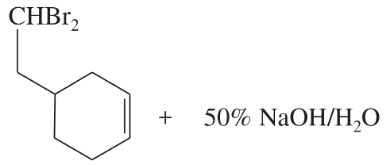
Predict the carbenoid addition products of the following reactions.
(b)
Problema 27c
Predict the carbenoid addition products of the following reactions.
(c)
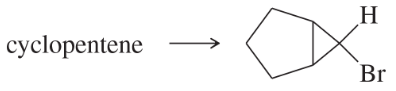
Problema 28a
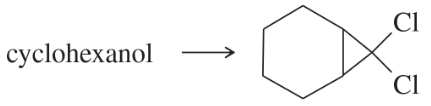
Show how you would accomplish each of the following synthetic conversions.
a. trans-but-2-ene → trans-1,2-dimethylcyclopropane
Problema 28(a)
What are the products of the following reactions, assuming that one equivalent of each reagent is used in each reaction?
a.
Problema 28b
Show how you would accomplish each of the following synthetic conversions.
(b)
Problema 28c
Show how you would accomplish each of the following synthetic conversions.
(c)
Problema 29a,b
Predict the products, including stereochemistry where appropriate, for the m-chloroperoxybenzoic acid epoxidations of the following alkenes.
a. cis-hex-2-ene
b. trans-hex-2-ene
Problema 29c,d
Predict the products, including stereochemistry where appropriate, for the m-chloroperoxybenzoic acid epoxidations of the following alkenes.
c. cis-cyclodecene
d. trans-cyclodecene
Problema 30
a. Propose a mechanism for the conversion of cis-hex-3-ene to the epoxide (3,4-epoxyhexane) and the ring-opening reaction to give the glycol, hexane-3,4-diol. In your mechanism, pay particular attention to the stereochemistry of the intermediates and products.
b. Repeat part (a) for trans-hex-3-ene. Compare the products obtained from cis- and trans-hex-3-ene. Is this reaction sequence stereospecific?