Back
Back
Problem 1
Indicate which form of electron microscopy is being described: SEM, TEM, or both.
a. Images the external surface of a specimen
b. Sample must be thinly sliced prior to viewing
c. Provides details about internal structures of the sample
d. Can be used to image viruses
e. Provides black-and-white images
f. Specimen is dead
Problem 2
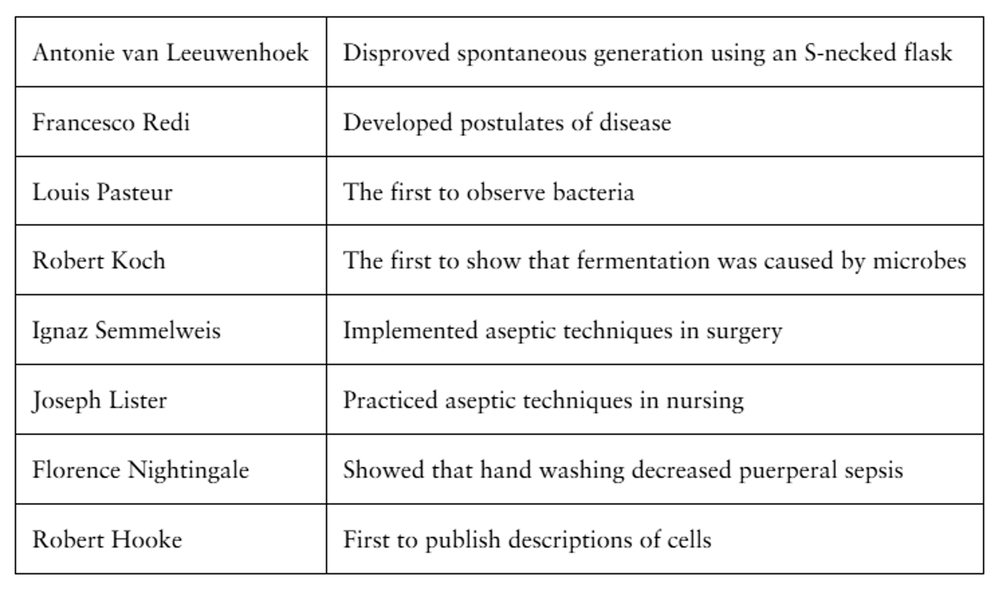
Match the following people to their scientific/medical contribution:
Note: Choices may be used more than once or not at all.
Problem 3
Indicate the true statements and then correct the false statements so that they are true.
a. The Gram stain is a simple stain.
b. Simple stains reveal information about size, shape, and arrangement.
c. Bright field microscopy requires a stained sample.
d. Dark field microscopy requires a stained sample.
e. The acid-fast stain detects peptidoglycan in the cell walls of certain bacteria.
f. Gram-positive bacteria have a thin peptidoglycan layer in the cell wall.
Problem 4
Select the most accurate statement.
a. The Gram stain is a simple stain.
b. Bacterial endospores appear green from the acid-fast stain.
c. The acid-fast stain is used to detect bacteria that have a capsule.
d. Bacterial flagella can only be seen with electron microscopes.
e. The mordant in the Gram stain is iodine.
Problem 5
Assume you are asked to view and draw all samples at a final magnification of 1000x. If the ocular lens is 10x, what objective lens should be in place as you draft your drawings?
Problem 6
Identify the following statements as observations or conclusions.
a. The solution turned red.
b. The bacterium is a rod shape.
c. The cell died due to lack of nutrients.
d. The bacterium is E. coli.
e. The cell is Gram-positive.
f. The bacterium is a pathogen.
g. There are small green structures present upon performing the endospore stain.
h. The solution remained clear after 10 hours of incubation.
i. Fermentation occurred.
j. Life comes from life.
Problem 7
Fill in the blanks: Bacteria are ___________________ cells in the domain ___________________. In contrast, the domain ___________________ includes unicellular and multicellular organisms that are made of ___________________ cells, or cells that have a nucleus and membrane-bound organelles.
Problem 8
Assume that you isolated a unicellular, non-nucleated cell from a deep-sea vent. Select the statement that is least likely regarding the cell you found.
a. The cell is a prokaryote.
b. The cell is a fungus or yeast.
c. The cell is an archaea.
d. The cell is not a pathogen.
e. The cell is in Domain Archaea.
Problem 9
Fill in the blanks: In taxonomy, the broadest groupings are called ___________________, which are further subdivided into six different ___________________. The most specific or narrowest grouping is ___________________, which is the ___________________ name in the binomial nomenclature system.
Problem 10
How is an opportunistic pathogen different from a pathogen?
Problem 11
A(n) ___________________ is a genetic variant of the same species.
Problem 12
Label and describe the function of each indicated part of the compound light microscope.
<IMAGE>
Problem 13
___________________ are dormant structures that certain bacteria can make. These structures can be seen using the structural stain called the ___________________.
Problem 14
Classify the following as bright field, dark field, phase contrast, or differential interference contrast (DIC).
a. Sample must be stained or have its own coloration to be seen:
b. Specimen is illuminated with polarized light:
c. Generates a falsely three-dimensional image:
d. The simplest and most common form of light microscopy:
e. Generates a negative image using a hollow cone of light:
f. Generates a negative image in which light shifts are converted into visible changes in brightness and contrast:
Problem 15
Which of the following is/are true regarding our normal microbiota? Select all that apply.
a. Our normal microbiota is easily disrupted by hygiene practices like hand washing.
b. Our normal microbiota can include pathogens.
c. Normal microbiota compete with pathogens.
d. Normal microbiota may colonize us before we are even born.
e. Normal microbiota changes over time.
f. The normal microbiota that we have as adults is the same as we had as children.
g. The normal microbiota of the gut is similar to that of the skin.
Problem 16
Immersion oil improves resolution by:
a. Limiting light refraction.
b. Magnifying the specimen.
c. Improving specimen contrast.
d. Making light waves shorter.
e. Making light waves faster.
Problem 17
List the following taxonomic groupings in order from general to specific.
Phylum, Kingdom, Genus, Family, Class, Domain, Species, Order
Problem 18
Why is it clinically helpful to know the Gram property of an organism?
Problem 19
Over time, Koch’s disease postulates have been rephrased in a variety of ways, but they still reflect the same process outlined by Robert Koch. The following are reworded versions of Koch’s postulates. Based on the original postulates, put the following items in the correct order.
a. Use the purified agent to cause infection in a test animal.
b. Isolate an infectious agent from a diseased animal.
c. Grow the infectious agent as a pure culture in the lab.
d. From the test animal, re-isolate the infectious agent that was originally grown in pure culture.
Problem 20
Acid-fast bacteria contain ___________________ in their cell wall.
Problem 21
Which of the following is true?
a. SEM is higher resolution than TEM.
b. Most viruses can be seen using a light microscope.
c. Simple staining involves an acidic and a basic dye in combination.
d. Samples can be stained or unstained for light microscopy.
e. These are all false statements.
Problem 22
What best describes the relationship between host and pathogen?
a. Mutualism
b. Parasitism
c. Commensalism
d. Endosymbiosis