Ch.1 - Structure and Bonding
Wade - Organic Chemistry 9th Edition
Wade9th EditionOrganic ChemistryISBN: 9780135213728Not the one you use?Change textbook
Chapter 1, Problem 12a,b

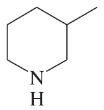
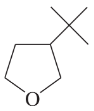
Give Lewis structures corresponding to the following line–angle structures. Give the molecular formula for each structure.
(a)
(b)

Verified step by step guidance
1
Identify the line-angle structure: The first image shows a six-membered ring with a nitrogen atom and a methyl group attached. The second image shows a five-membered ring with an oxygen atom and a tert-butyl group attached.
Convert the line-angle structure to a Lewis structure: For the first image, draw a six-membered ring with alternating single bonds. Place a nitrogen atom in one of the positions and add a hydrogen atom to it. Attach a methyl group (CH₃) to the carbon adjacent to the nitrogen. For the second image, draw a five-membered ring with an oxygen atom in one of the positions. Attach a tert-butyl group (C(CH₃)₃) to the carbon adjacent to the oxygen.
Add hydrogen atoms: For each carbon atom in the ring, add enough hydrogen atoms to satisfy the tetravalency of carbon. Remember that each line in the line-angle structure represents a bond, and each carbon should have four bonds in total.
Determine the molecular formula: Count the number of each type of atom in the Lewis structure. For the first structure, count the carbon, hydrogen, and nitrogen atoms. For the second structure, count the carbon, hydrogen, and oxygen atoms.
Write the molecular formula: For the first structure, write the molecular formula in the form CₓHᵧNₓ. For the second structure, write the molecular formula in the form CₓHᵧOₓ, where x, y, and z are the number of each type of atom.

Verified video answer for a similar problem:

This video solution was recommended by our tutors as helpful for the problem above.
Video duration:
4m
Was this helpful?

Key Concepts

Here are the essential concepts you must grasp in order to answer the question correctly.

Lewis Structures

Lewis structures are diagrams that represent the bonding between atoms in a molecule and the lone pairs of electrons that may exist. They use dots to represent electrons and lines to represent bonds between atoms. Understanding how to draw Lewis structures is essential for visualizing molecular geometry and predicting reactivity.
Recommended video:
Guided course
04:12
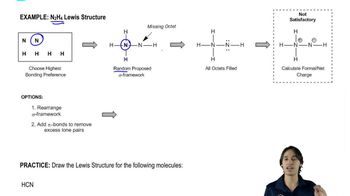
Drawing the Lewis Structure for N2H4.

Line-Angle Structures

Line-angle structures, also known as skeletal structures, are a shorthand way of drawing organic molecules. In these diagrams, vertices represent carbon atoms, and lines represent bonds. Hydrogen atoms attached to carbons are usually omitted for simplicity, making it easier to visualize complex organic compounds quickly.
Recommended video:
Guided course
02:46
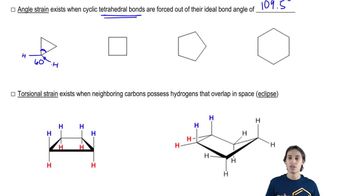
What is angle strain?

Molecular Formula

A molecular formula indicates the number and type of atoms in a molecule, providing a concise representation of its composition. It is essential for understanding the molecular structure and stoichiometry of a compound. For example, the molecular formula C6H11N corresponds to a compound with six carbon atoms, eleven hydrogen atoms, and one nitrogen atom.
Recommended video:
Guided course
02:17
How to use IHD with molecular formula.