Ch.10 - Structure and Synthesis of Alcohols
Wade - Organic Chemistry 9th Edition
Wade9th EditionOrganic ChemistryISBN: 9780135213728Not the one you use?Change textbook
Chapter 10, Problem 42g

Complete the following acid–base reactions. In each case, indicate whether the equilibrium favors the reactants or the products, and explain your reasoning.
(g) KOH + CH3CH2OH ⇌

Verified step by step guidance
1
Step 1: Identify the acid and base in the reaction. Potassium hydroxide (KOH) is a strong base, and ethanol (CH3CH2OH) can act as a weak acid due to the presence of the hydroxyl (-OH) group.
Step 2: Write the reaction mechanism. KOH will deprotonate ethanol, resulting in the formation of CH3CH2O⁻ (ethoxide ion) and H2O (water). The reaction can be represented as: KOH + CH3CH2OH ⇌ K⁺ + CH3CH2O⁻ + H2O.
Step 3: Analyze the strength of the conjugate acid and base. Ethoxide ion (CH3CH2O⁻) is a strong conjugate base, and water (H2O) is a weak conjugate acid. This suggests that the equilibrium may favor the reactants.
Step 4: Consider the relative acidity of ethanol and water. Ethanol is a weaker acid compared to water, meaning the equilibrium will favor the side with the weaker acid, which is ethanol.
Step 5: Conclude the equilibrium direction. Based on the analysis, the equilibrium favors the reactants (KOH and CH3CH2OH) because the products include a strong base (CH3CH2O⁻) and a weak acid (H2O), which are less stable compared to the reactants.

Verified video answer for a similar problem:

This video solution was recommended by our tutors as helpful for the problem above.
Video duration:
5m
Was this helpful?

Key Concepts

Here are the essential concepts you must grasp in order to answer the question correctly.

Acid-Base Theory

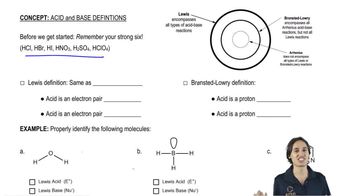
Acid-base theory explains the behavior of acids and bases in chemical reactions. According to the Brønsted-Lowry theory, acids are proton donors and bases are proton acceptors. In the reaction between KOH and CH3CH2OH, KOH acts as a strong base, while CH3CH2OH (ethanol) can act as a weak acid, donating a proton.
Recommended video:
Guided course
02:49
The Lewis definition of acids and bases.

Equilibrium in Chemical Reactions

Chemical equilibrium occurs when the rates of the forward and reverse reactions are equal, resulting in constant concentrations of reactants and products. The position of equilibrium can be influenced by factors such as concentration, temperature, and the strength of acids and bases involved. Understanding this concept is crucial for predicting whether the equilibrium favors reactants or products.
Recommended video:
3:11
Chemical Reactions of Phosphate Anhydrides Concept 1

Strength of Acids and Bases

The strength of an acid or base is determined by its ability to donate or accept protons. Strong acids and bases dissociate completely in solution, while weak acids and bases do not. In the given reaction, KOH is a strong base, which will favor the formation of products, while ethanol is a weak acid, influencing the equilibrium position towards the products.
Recommended video:
2:50
Acid-Base Catalysis Concept 3